KEPLER-186 SYSTEM / PLANETARY DOSSIER

Kepler-186 f

A habitable-zone milestone from Kepler, with unknown mass and a published validation caveat.

Artist’s impression of Kepler-186 f; appearance is hypothetical; diameter is inferred from transits
Earth-sized exoplanet · reliability debated

Earth-sized, with a climate still unknown.

Environment ↗

02
ATMOSPHERE

Not measured

DIAMETER
1.110 × Earth
POSSIBILITY FOR LIFE
Unknown · habitable-zone orbit
WITHOUT PROTECTION
Not established as survivable

Mass comparison ↗

04
MASS

Not measured

No measured mass is adopted. A mass predicted from radius and an assumed composition would not be a dynamical measurement.

Density and surface gravity remain unknown.
KEPLER-186 F

Instrument detail

Artist’s impression of Kepler-186 f

Artist’s impression · appearance is hypothetical; diameter is inferred from transits.

A milestone in the search for smaller worlds.

Announced in 2014 as the first Earth-sized planet in another star’s habitable zone, Kepler-186 f showed why size and stellar heating must be studied together. Neither property establishes Earth-like surface conditions.

A longer year around a smaller sun.

The discovery fit gives an orbit of about 130 days and 0.356 AU. Its estimated incoming starlight is roughly one third of Earth’s; atmospheric warming and reflectivity would determine the actual climate.

Confirmed in the archive, with a published caveat.

The NASA archive retains a confirmed-planet classification and a controversial flag. Burke et al. (2019) found that f fell below 99% confidence when instrumental false alarms were included. This concern does not prove the signal is false, but warrants an explicit qualification.

Size leaves essential questions open.

The transit yields a radius estimate. Without a measured mass or atmospheric characterization, bulk density, gravity and surface conditions remain uncertain. The illustrations explore a rocky possibility rather than a detected second Earth.

Size, mass and atmosphere

DIAMETER / EARTH1.110 ×

+0.140 / −0.130 · Earth-relative ratio

Adopted discovery radius: 1.11 (+0.14 / −0.13) Earth radii, Quintana et al. (2014), Table S2. Later stellar-radius solutions shift this estimate.

MASS

Not measured

No measured mass is adopted. A mass predicted from radius and an assumed composition would not be a dynamical measurement.

ATMOSPHERE / COMPOSITION

Not measured

An atmosphere, its composition and surface pressure have not been established. The dry airless landscapes shown here are only one hypothetical scenario.

Habitability

NATURAL CONDITIONSUnknown · habitable-zone orbit

Stellar heating could permit liquid water under suitable atmospheric conditions. Neither water, a habitable climate nor life has been detected.

HUMANS / WITHOUT PROTECTIONNot established as survivable

Breathable air, safe pressure and tolerable temperatures are not known. A survival time would be speculation.

SURFACE TEMPERATURE
Unknown
SURFACE PRESSURE
Unknown
LIQUID WATER
Not established
SURFACE GRAVITY
Unknown · mass required

A year around Kepler-186

129.9459 Earth days

Semimajor axis: 0.356 AU. One astronomical unit is approximately the mean Earth–Sun distance.

The overview is a schematic: sizes, orbital shape and the planet’s position are illustrative. It does not show a measured eccentricity, the orbit’s orientation or a live position.

The discovery fit gives an orbit of about 130 days and 0.356 AU. Its estimated incoming starlight is roughly one third of Earth’s; atmospheric warming and reflectivity would determine the actual climate.

Quintana et al. (2014) · orbital measurements ↗
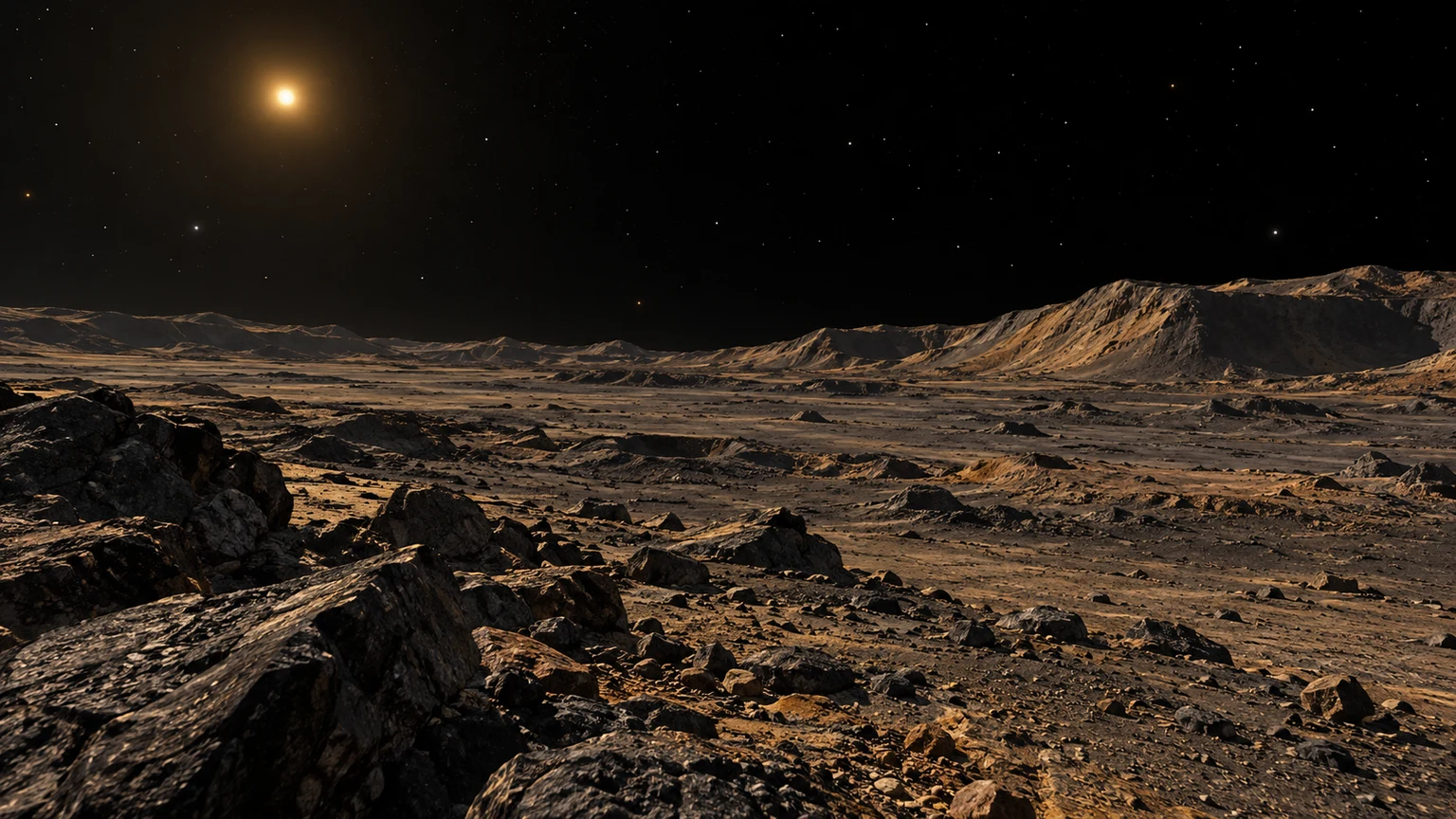
An invented dry, airless landscape under subdued warm light. Rocks, colors and the absence of atmosphere are assumptions, not observations.

Across a possible rocky plain

An invented dry, airless landscape under subdued warm light. Rocks, colors and the absence of atmosphere are assumptions, not observations.

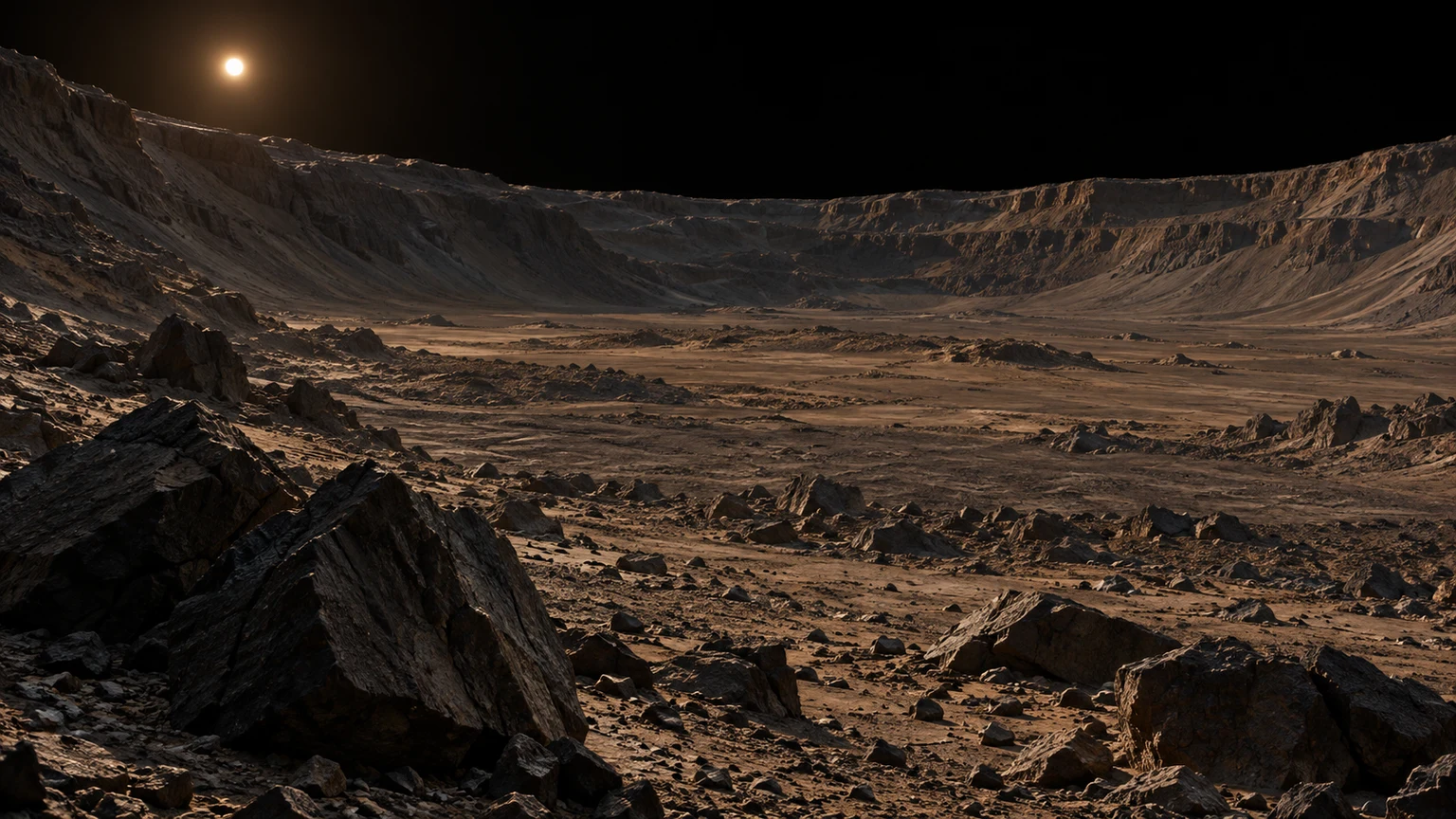
A hypothetical impact basin with angular foreground rocks. No crater or landing site has been mapped on Kepler-186 f.

Inside an imagined basin

A hypothetical impact basin with angular foreground rocks. No crater or landing site has been mapped on Kepler-186 f.

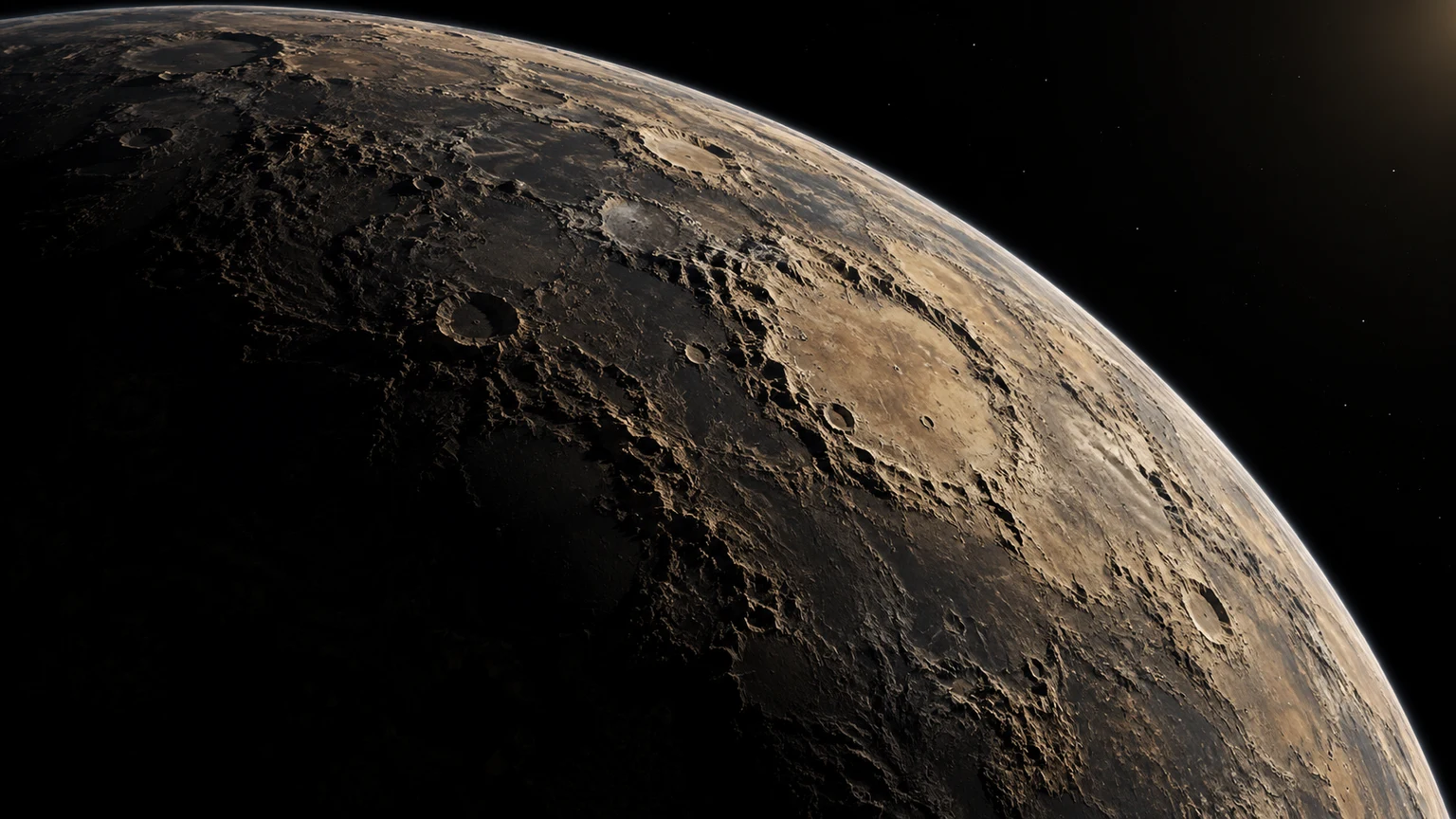
A speculative orbital view of dry rocky terrain. The terminator and surface features are invented; this does not rule out a different climate or composition.

At the day–night boundary

A speculative orbital view of dry rocky terrain. The terminator and surface features are invented; this does not rule out a different climate or composition.

Planet and landscape images are hypothetical artistic interpretations.