ORION / STELLAR DOSSIER

Rigel

862.85 light-years from Sol

An enormous hot star whose subtle pulsations reveal a changing interior.

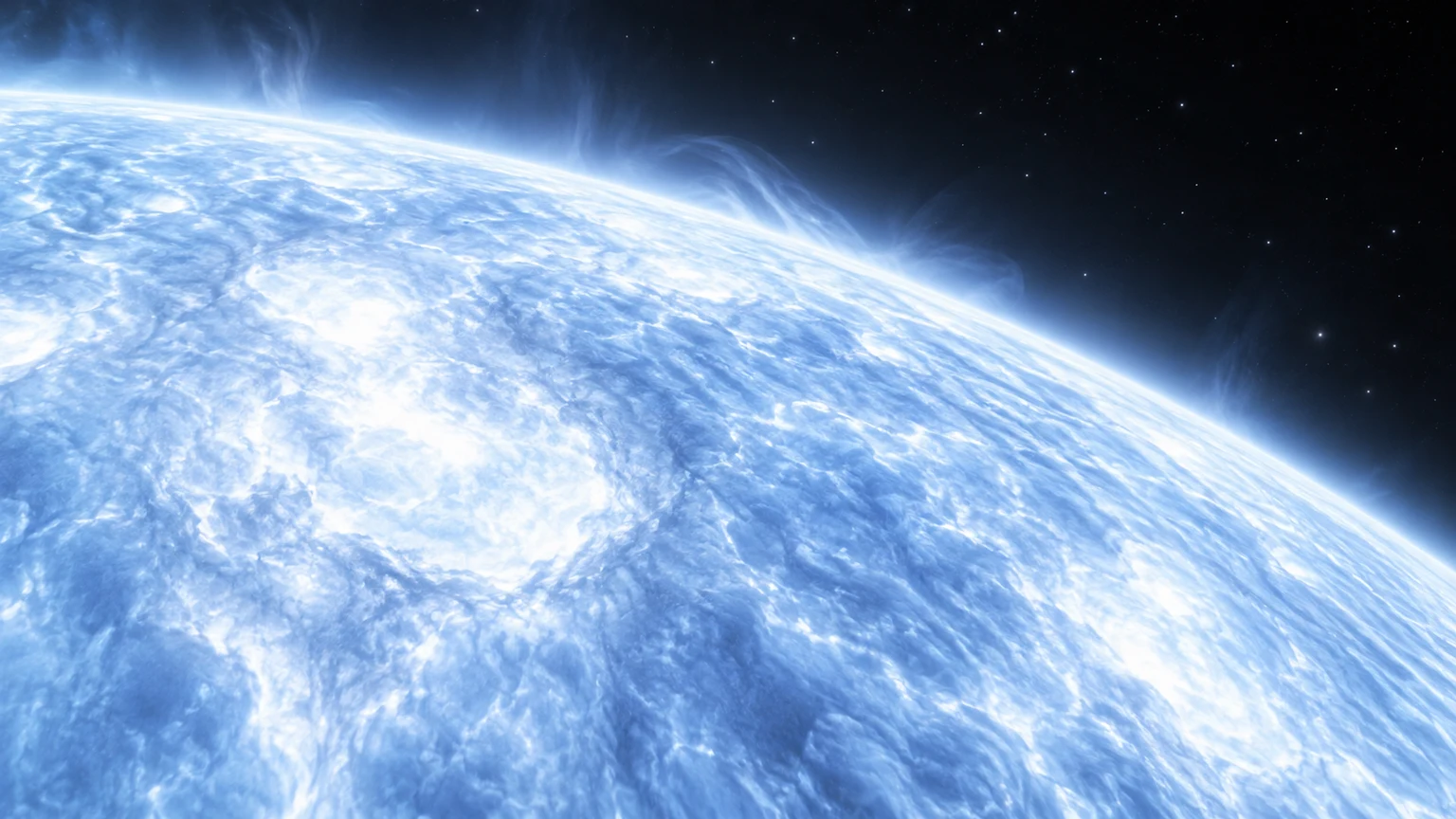
Artist’s impression of Rigel
B8 Ia · blue supergiant

A blue-white giant at Orion’s foot.

Stellar conditions ↗

02
EFFECTIVE TEMPERATURE12,100 K

A blue-white photosphere, hotter than Sol.

Rigel12,100 K
Sol5,770 K
Shared scale 0–20,000 K · effective, not core temperature

Evolution ↗

03
CURRENT PHASE

Blue supergiant.

  1. NOWEvolved massive star
  2. LATERAdvanced nuclear burning
  3. OUTLOOKCore collapse
A broad massive-star pathway. The exact evolutionary history, timing and final remnant remain model-dependent.
An imagined approach to Rigel’s blue-white gaseous photosphere. Fine structure and exposure are illustrative, not resolved observations.Over a brilliant limb ↗ ARTIST’S IMPRESSION · 3 VIEWS

Diameter comparison ↗

06
78.9 × Sol
RIGEL

Instrument detail

Artist’s impression of Rigel

Artist’s impression · structure and color are illustrative.

An immense source of light.

Rigel combines a radius about 79 times Sol’s with a photosphere near 12,100 K. Its size and temperature imply roughly 120,000 times the Sun’s total radiant power. The adopted radius depends on the Hipparcos distance and an interferometric angular diameter.

A star with many rhythms.

Six years of radial-velocity monitoring revealed nineteen significant pulsation modes. These small changes help probe the interior; the moving textures in our illustrations are not images of those modes.

Beyond the main sequence.

Rigel is already an evolved massive star. Such stars eventually exhaust the fuels that support their interiors and undergo core collapse. This is an evolutionary expectation, not a prediction of an imminent explosion.

The hidden layers are reconstructed.

A seismic model explored helium burning in the core and hydrogen burning in a surrounding shell. Matching the longer observed periods helps test this interpretation, while shorter periods were not explained by that mechanism.

A star in perspective.

DIAMETER / SOL78.90 ×

About 7790% wider than our Sun.

Circles compare diameter, not mass or luminosity. Adopted radius 78.9 ± 7.4 solar radii, Moravveji et al. (2012), Table 1. Diameter has the same solar ratio.

EFFECTIVE TEMPERATURE

A blue-white photosphere, hotter than Sol.

  • Rigel≈ 12,100 K
  • Sol≈ 5,770 K

Shared scale: 0–20,000 K. Effective temperature describes total emitted energy per unit surface area; it is not the core temperature. Effective temperature 12,100 ± 150 K, Przybilla et al. (2010), compiled in the same table.

LIFE PHASE

Blue supergiant.

  1. NOWEvolved massive star
  2. LATERAdvanced nuclear burning
  3. OUTLOOKCore collapse

A broad massive-star pathway. The exact evolutionary history, timing and final remnant remain model-dependent.

Research · size and temperature ↗
LIFE & HUMAN SURVIVAL / THE STAR ITSELF
POSSIBILITY FOR LIFEIncompatible with known life

The star’s hot gaseous layers cannot provide the cool, stable environment required by life as we know it. Conditions on any orbiting worlds are a separate question.

WITHOUT PROTECTIONNot survivable

No breathable air or solid ground. Extreme heat and radiation make a close encounter lethal; a meaningful survival timer depends on where you are.

NASA · stellar structure and evolution ↗

Blue supergiant.

  1. NOWEvolved massive star
  2. LATERAdvanced nuclear burning
  3. OUTLOOKCore collapse

A broad massive-star pathway. The exact evolutionary history, timing and final remnant remain model-dependent.

Research ↗

Rigel is already an evolved massive star. Such stars eventually exhaust the fuels that support their interiors and undergo core collapse. This is an evolutionary expectation, not a prediction of an imminent explosion.

How much energy leaves the star?

≈ 120,000 × Sol

This compares total radiant power across all wavelengths, not just visible light or apparent brightness in our sky. The beams on the dashboard share a linear length scale.

The estimate combines this log’s diameter ratio (78.9 × Sol) and effective temperature (12,100 K): luminosity scales with radius squared and temperature to the fourth power. It is derived from rounded values, not an independent luminosity measurement.

Adopted radius 78.9 ± 7.4 solar radii, Moravveji et al. (2012), Table 1. Diameter has the same solar ratio.

Effective temperature 12,100 ± 150 K, Przybilla et al. (2010), compiled in the same table.

Swinburne University · Stefan–Boltzmann law ↗

An immense source of light.

Rigel combines a radius about 79 times Sol’s with a photosphere near 12,100 K. Its size and temperature imply roughly 120,000 times the Sun’s total radiant power. The adopted radius depends on the Hipparcos distance and an interferometric angular diameter.

A star with many rhythms.

Six years of radial-velocity monitoring revealed nineteen significant pulsation modes. These small changes help probe the interior; the moving textures in our illustrations are not images of those modes.

Beyond the main sequence.

Rigel is already an evolved massive star. Such stars eventually exhaust the fuels that support their interiors and undergo core collapse. This is an evolutionary expectation, not a prediction of an imminent explosion.

The hidden layers are reconstructed.

A seismic model explored helium burning in the core and hydrogen burning in a surrounding shell. Matching the longer observed periods helps test this interpretation, while shorter periods were not explained by that mechanism.

An imagined approach to Rigel’s blue-white gaseous photosphere. Fine structure and exposure are illustrative, not resolved observations.

Over a brilliant limb

An imagined approach to Rigel’s blue-white gaseous photosphere. Fine structure and exposure are illustrative, not resolved observations.

An invented close study of flowing luminous gas. The emphasized ripples evoke variability without mapping measured pulsation modes.

Ripples in the light

An invented close study of flowing luminous gas. The emphasized ripples evoke variability without mapping measured pulsation modes.

A conceptual view of a faint outflow around the star. Gas brightness and extent are enhanced for visibility; this is not an explosion or a photograph.

A diffuse stellar wind

A conceptual view of a faint outflow around the star. Gas brightness and extent are enhanced for visibility; this is not an explosion or a photograph.

Stellar images are artistic interpretations, not resolved photographs of this star.