TRAPPIST-1 SYSTEM / PLANETARY DOSSIER

TRAPPIST-1 e

An Earth-sized world in the system’s temperate orbital region, with no confirmed surface habitat.
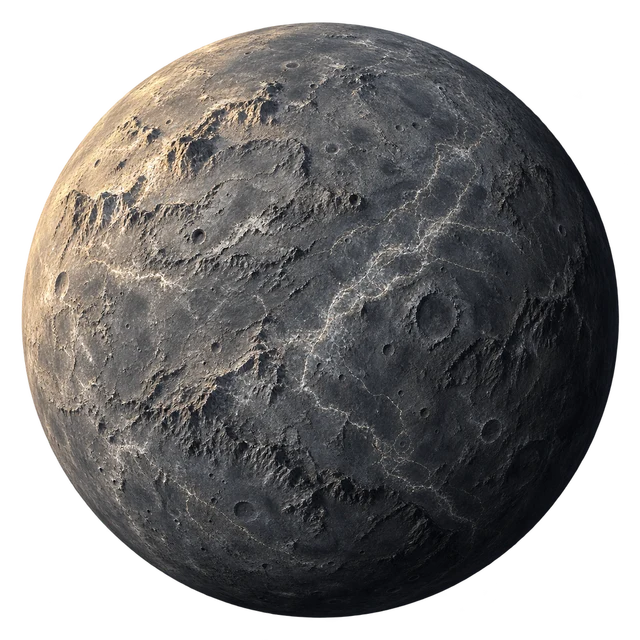
Artist’s impression of TRAPPIST-1 e; appearance is hypothetical; diameter is inferred from transits
Earth-sized rocky exoplanet

A promising orbit, an unanswered sky.

Environment ↗

02
ATMOSPHERE

Presence still unresolved

DIAMETER
0.920 × Earth
POSSIBILITY FOR LIFE
Unknown · temperate orbital region
WITHOUT PROTECTION
Not established as survivable

Mass comparison ↗

04
DYNAMICAL MASS0.692 × Earth

± 0.022 Earth masses

Mutual gravitational perturbations shift transit times, constraining planetary masses.
TRAPPIST-1 E

Instrument detail

Artist’s impression of TRAPPIST-1 e

Artist’s impression · appearance is hypothetical; diameter is inferred from transits.

A year in the seven-world chain.

Planet e occupies the middle of the seven-world sequence. Its roughly six-day circuit places it in a region often investigated for possible temperate climates. The phrase habitable zone describes a range of incoming energy under suitable atmospheric assumptions; it does not certify this particular world as habitable.

A silhouette we can measure.

The measured radius is slightly smaller than Earth’s, and the adopted mass is lower too. Together these observations constrain its bulk structure more effectively than mass alone. They still permit multiple interior compositions, and they say nothing directly about the silvery veins painted into the imagined terrain.

What the light can tell us.

Webb observations constrain some thick atmospheric models, while thinner atmospheres remain difficult to distinguish from no atmosphere. Stellar contamination complicates the interpretation; no atmosphere or biosignature is confirmed here. The linked result describes observational limits, while the three scenes illustrate one possible setting.

An imagined place beyond the measurements.

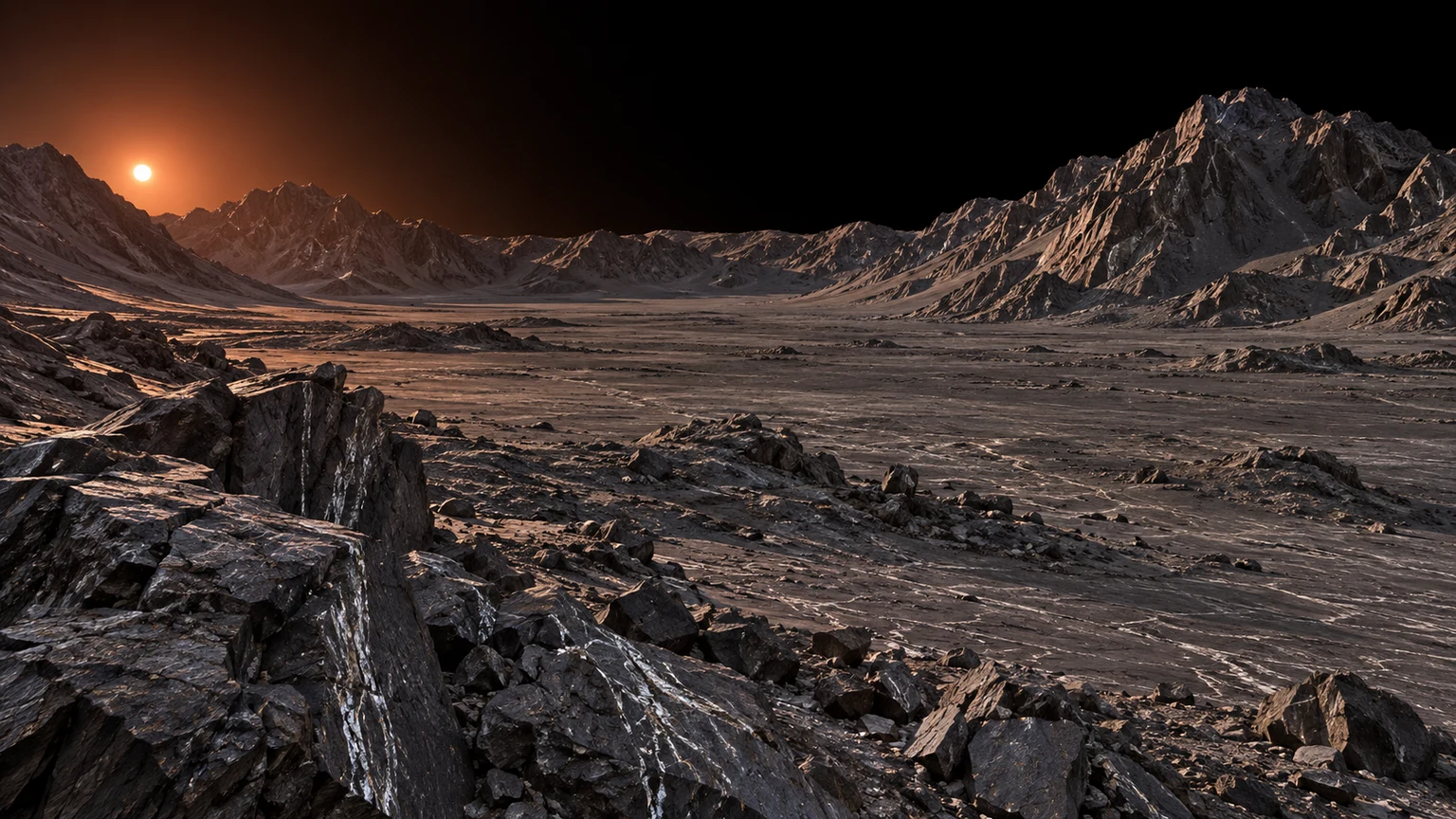
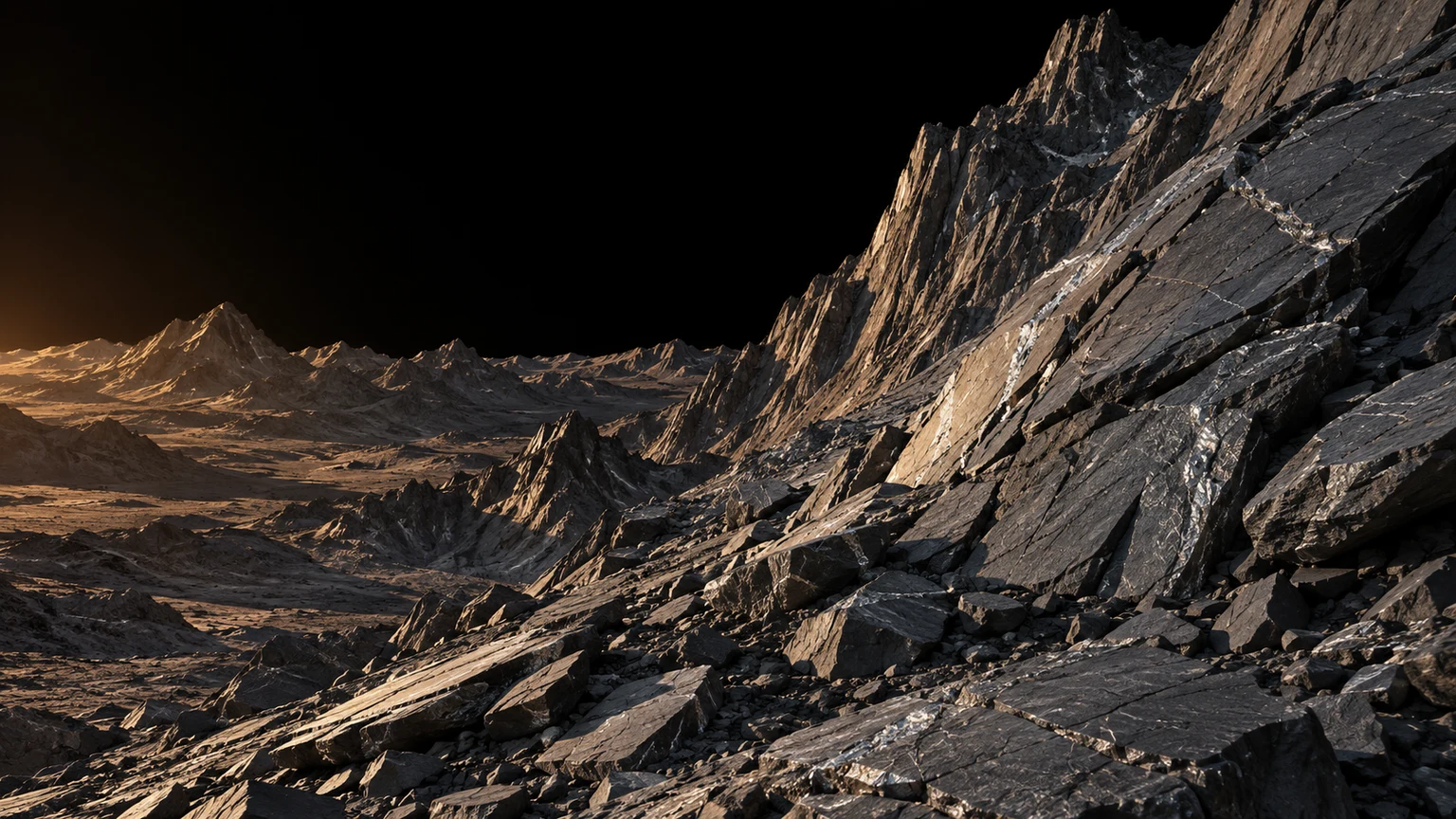
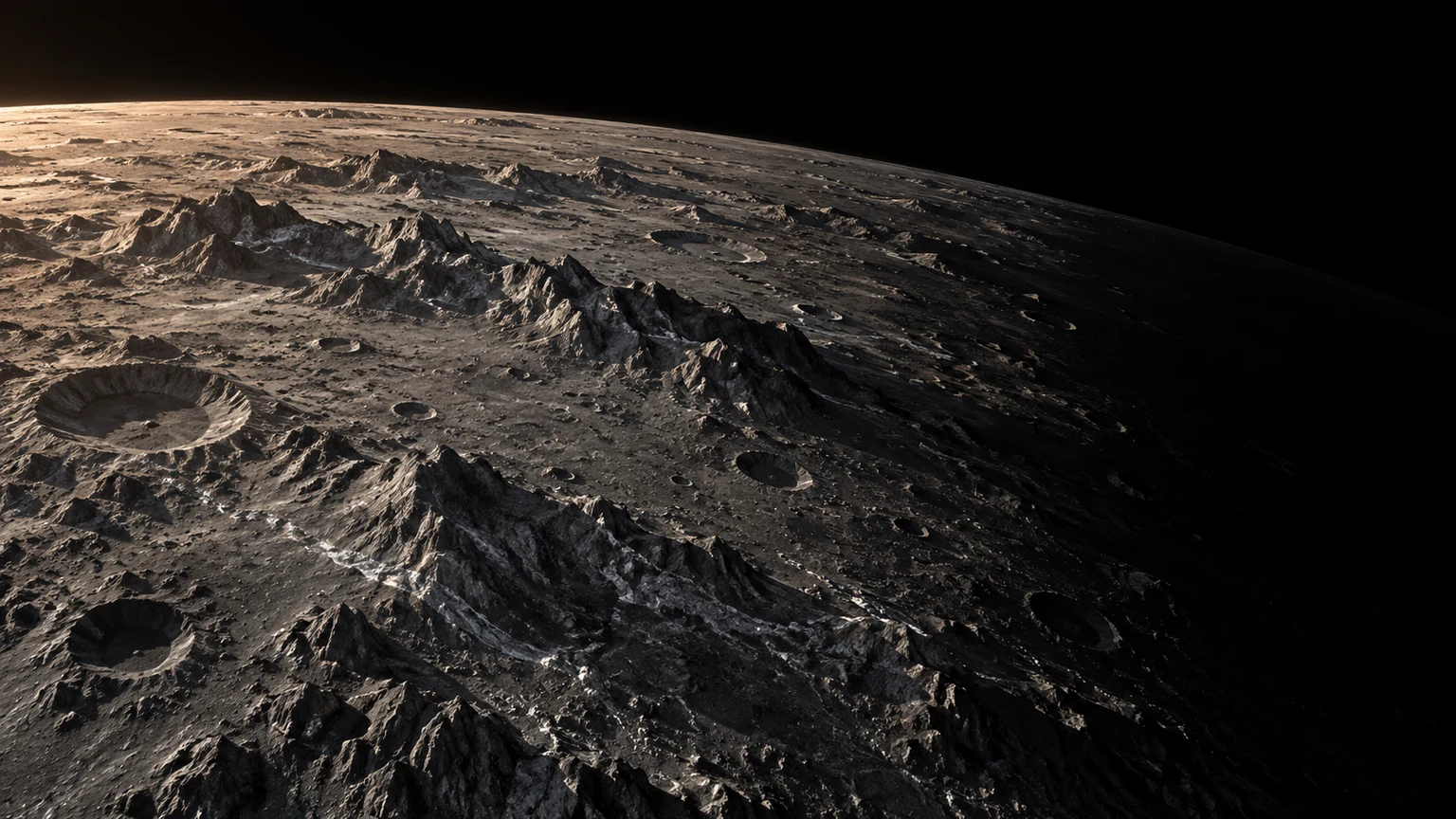
Basins, cliffs and ridges provide three distinct viewpoints on a possible rocky world. No particular crater or mineral has been resolved. The illustrations deliberately leave out buildings and biological features. A compelling view is useful for exploration, but it does not fill the gaps in atmospheric or habitability evidence.

Size, mass and atmosphere

DIAMETER / EARTH0.920 ×

+0.013 / −0.012 · Earth-relative ratio

Agol et al. (2021), Table 6. Radius inferred from transit depth and stellar size. Radius and diameter have the same Earth-relative ratio; this does not resolve terrain.

DYNAMICAL MASS / EARTH
  • TRAPPIST-1 e0.692 ± 0.022 M⊕
  • Earth · reference mass1.00 M⊕

Shared scale: 0–1.5 Earth masses. Mutual gravitational perturbations shift transit times, constraining planetary masses. Agol et al. (2021), Table 6. Dynamical mass from transit-timing variations with an adopted stellar mass; not a radial-velocity minimum.

ATMOSPHERE / COMPOSITION

Presence still unresolved

Webb observations constrain some thick atmospheric models, while thinner atmospheres remain difficult to distinguish from no atmosphere. Stellar contamination complicates the interpretation; no atmosphere or biosignature is confirmed here.

Habitability

NATURAL CONDITIONSUnknown · temperate orbital region

No life or surface liquid water has been detected. Stellar heating is only one condition for a possible habitat; atmospheric retention, composition and climate also matter.

HUMANS / WITHOUT PROTECTIONNot established as survivable

Breathable air, safe pressure and tolerable temperatures are not known. A survival time would be speculation.

SURFACE TEMPERATURE
Not a measured global climate
SURFACE PRESSURE
Unknown
STELLAR IRRADIATION
≈ 0.646 × Earth
SURFACE GRAVITY
≈ 0.817 × Earth · mass/radius inference

A year around TRAPPIST-1

≈ 6.10 Earth days

Semimajor axis: 0.02925 AU. One astronomical unit is approximately the mean Earth–Sun distance.

The overview is a schematic: sizes, orbital shape and the planet’s position are illustrative. It does not show a measured eccentricity, the orbit’s orientation or a live position.

Planet e occupies the middle of the seven-world sequence. Its roughly six-day circuit places it in a region often investigated for possible temperate climates. The phrase habitable zone describes a range of incoming energy under suitable atmospheric assumptions; it does not certify this particular world as habitable.

Agol et al. (2021) · orbital measurements ↗
An imagined view of slate-gray mountains, silvery mineral veins and dry cratered highlands. The terrain and mineral colors are invented. An airless sky is an illustration assumption, not a measured atmospheric state. No landing site has been mapped here.

Across the gray basin

An imagined view of slate-gray mountains, silvery mineral veins and dry cratered highlands. The terrain and mineral colors are invented. An airless sky is an illustration assumption, not a measured atmospheric state. No landing site has been mapped here.

An imagined view of slate-gray mountains, silvery mineral veins and dry cratered highlands. The terrain and mineral colors are invented. An airless sky is an illustration assumption, not a measured atmospheric state. No landing site has been mapped here.

Below the slate ridge

An imagined view of slate-gray mountains, silvery mineral veins and dry cratered highlands. The terrain and mineral colors are invented. An airless sky is an illustration assumption, not a measured atmospheric state. No landing site has been mapped here.

An imagined view of slate-gray mountains, silvery mineral veins and dry cratered highlands. The terrain and mineral colors are invented. An airless sky is an illustration assumption, not a measured atmospheric state. No landing site has been mapped here.

Toward the terminator

An imagined view of slate-gray mountains, silvery mineral veins and dry cratered highlands. The terrain and mineral colors are invented. An airless sky is an illustration assumption, not a measured atmospheric state. No landing site has been mapped here.

Planet and landscape images are hypothetical artistic interpretations.