TRAPPIST-1 SYSTEM / PLANETARY DOSSIER

TRAPPIST-1 f

A nearly Earth-sized companion that receives substantially less starlight than our home planet.

Artist’s impression of TRAPPIST-1 f; appearance is hypothetical; diameter is inferred from transits
Earth-sized rocky exoplanet

An Earth-scale world farther from the glow.

Environment ↗

02
ATMOSPHERE

Not established

DIAMETER
1.045 × Earth
POSSIBILITY FOR LIFE
Unknown · temperate orbital region
WITHOUT PROTECTION
Not established as survivable

Mass comparison ↗

04
DYNAMICAL MASS1.039 × Earth

± 0.031 Earth masses

Mutual gravitational perturbations shift transit times, constraining planetary masses.
TRAPPIST-1 F

Instrument detail

Artist’s impression of TRAPPIST-1 f

Artist’s impression · appearance is hypothetical; diameter is inferred from transits.

A year in the seven-world chain.

Moving outward to f stretches the year to a little over nine Earth days. That is still a remarkably compact orbit compared with the planets of our Sun. Its weaker illumination makes atmospheric heat retention especially important when exploring possible climates. The pale ice is one visual scenario, not the result of a remote weather survey.

A silhouette we can measure.

Both radius and mass lie close to Earth’s values. That comparison explains the term Earth-sized; it does not imply an Earth-like atmosphere or ocean. A light, volatile-rich surface layer can coexist with different interiors, so the mass-radius point cannot select a unique landscape.

What the light can tell us.

A measured orbit, mass and radius do not establish atmospheric composition or surface pressure. The ice in these illustrations is a scenario, not a detection of water. The linked result describes observational limits, while the three scenes illustrate one possible setting.

An imagined place beyond the measurements.

Frozen ridges, fractured ice and dark rock make a coherent possible setting. None of these views establishes a water reservoir or hidden ocean. The illustrations deliberately leave out buildings and biological features. A compelling view is useful for exploration, but it does not fill the gaps in atmospheric or habitability evidence.

Size, mass and atmosphere

DIAMETER / EARTH1.045 ×

+0.013 / −0.012 · Earth-relative ratio

Agol et al. (2021), Table 6. Radius inferred from transit depth and stellar size. Radius and diameter have the same Earth-relative ratio; this does not resolve terrain.

DYNAMICAL MASS / EARTH
  • TRAPPIST-1 f1.039 ± 0.031 M⊕
  • Earth · reference mass1.00 M⊕

Shared scale: 0–1.5 Earth masses. Mutual gravitational perturbations shift transit times, constraining planetary masses. Agol et al. (2021), Table 6. Dynamical mass from transit-timing variations with an adopted stellar mass; not a radial-velocity minimum.

ATMOSPHERE / COMPOSITION

Not established

A measured orbit, mass and radius do not establish atmospheric composition or surface pressure. The ice in these illustrations is a scenario, not a detection of water.

Habitability

NATURAL CONDITIONSUnknown · temperate orbital region

No life or surface liquid water has been detected. Stellar heating is only one condition for a possible habitat; atmospheric retention, composition and climate also matter.

HUMANS / WITHOUT PROTECTIONNot established as survivable

Breathable air, safe pressure and tolerable temperatures are not known. A survival time would be speculation.

SURFACE TEMPERATURE
Not a measured global climate
SURFACE PRESSURE
Unknown
STELLAR IRRADIATION
≈ 0.373 × Earth
SURFACE GRAVITY
≈ 0.951 × Earth · mass/radius inference

A year around TRAPPIST-1

≈ 9.21 Earth days

Semimajor axis: 0.03849 AU. One astronomical unit is approximately the mean Earth–Sun distance.

The overview is a schematic: sizes, orbital shape and the planet’s position are illustrative. It does not show a measured eccentricity, the orbit’s orientation or a live position.

Moving outward to f stretches the year to a little over nine Earth days. That is still a remarkably compact orbit compared with the planets of our Sun. Its weaker illumination makes atmospheric heat retention especially important when exploring possible climates. The pale ice is one visual scenario, not the result of a remote weather survey.

Agol et al. (2021) · orbital measurements ↗
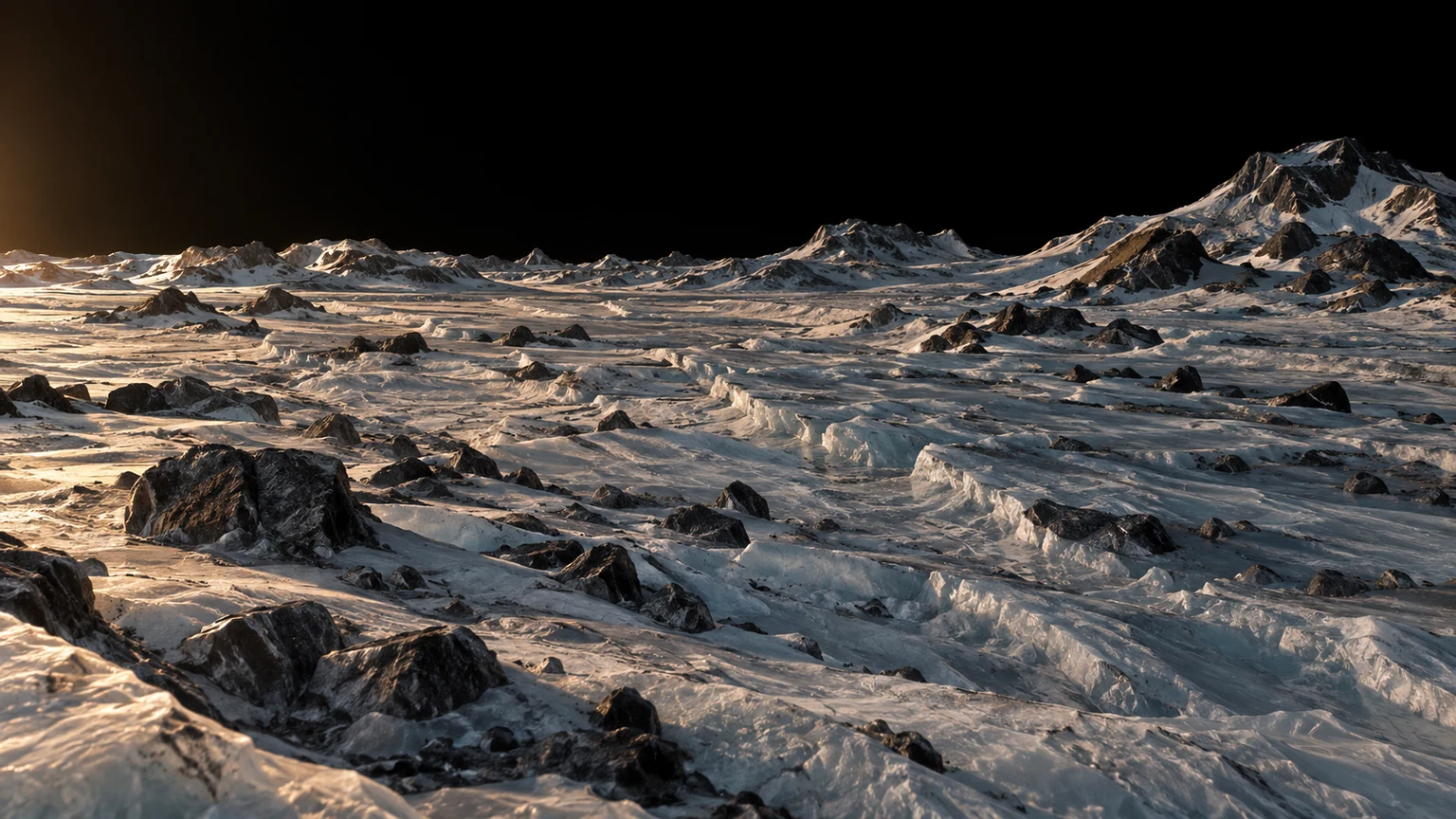
An imagined view of hypothetical blue-gray ice, dark rock inclusions and deep fractures. The ice and frost are hypothetical; water has not been detected on this surface. An airless sky is an illustration assumption, not a measured atmospheric state. No landing site has been mapped here.

Across the frozen ridges

An imagined view of hypothetical blue-gray ice, dark rock inclusions and deep fractures. The ice and frost are hypothetical; water has not been detected on this surface. An airless sky is an illustration assumption, not a measured atmospheric state. No landing site has been mapped here.

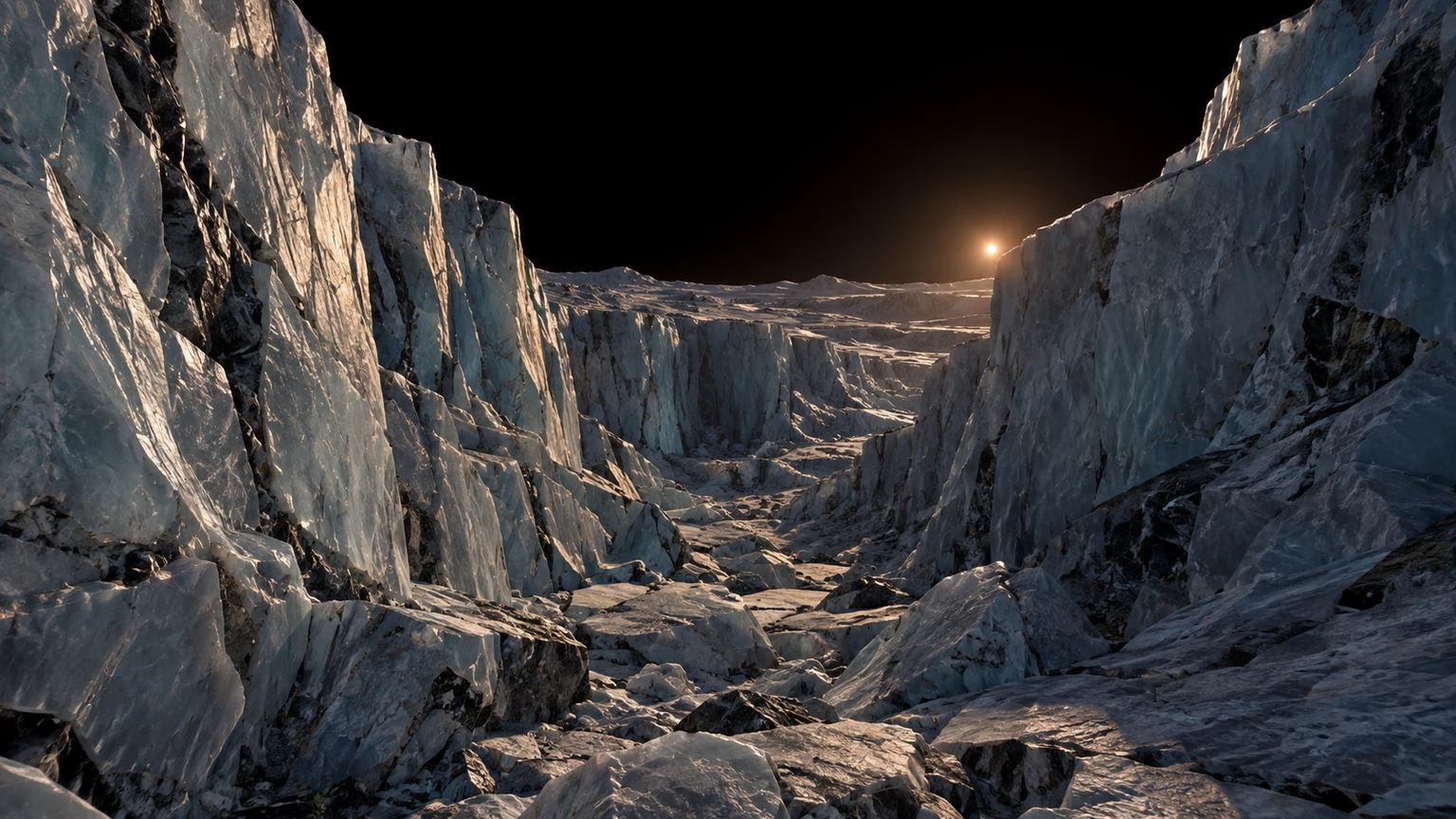
An imagined view of hypothetical blue-gray ice, dark rock inclusions and deep fractures. The ice and frost are hypothetical; water has not been detected on this surface. An airless sky is an illustration assumption, not a measured atmospheric state. No landing site has been mapped here.

Within the ice fracture

An imagined view of hypothetical blue-gray ice, dark rock inclusions and deep fractures. The ice and frost are hypothetical; water has not been detected on this surface. An airless sky is an illustration assumption, not a measured atmospheric state. No landing site has been mapped here.

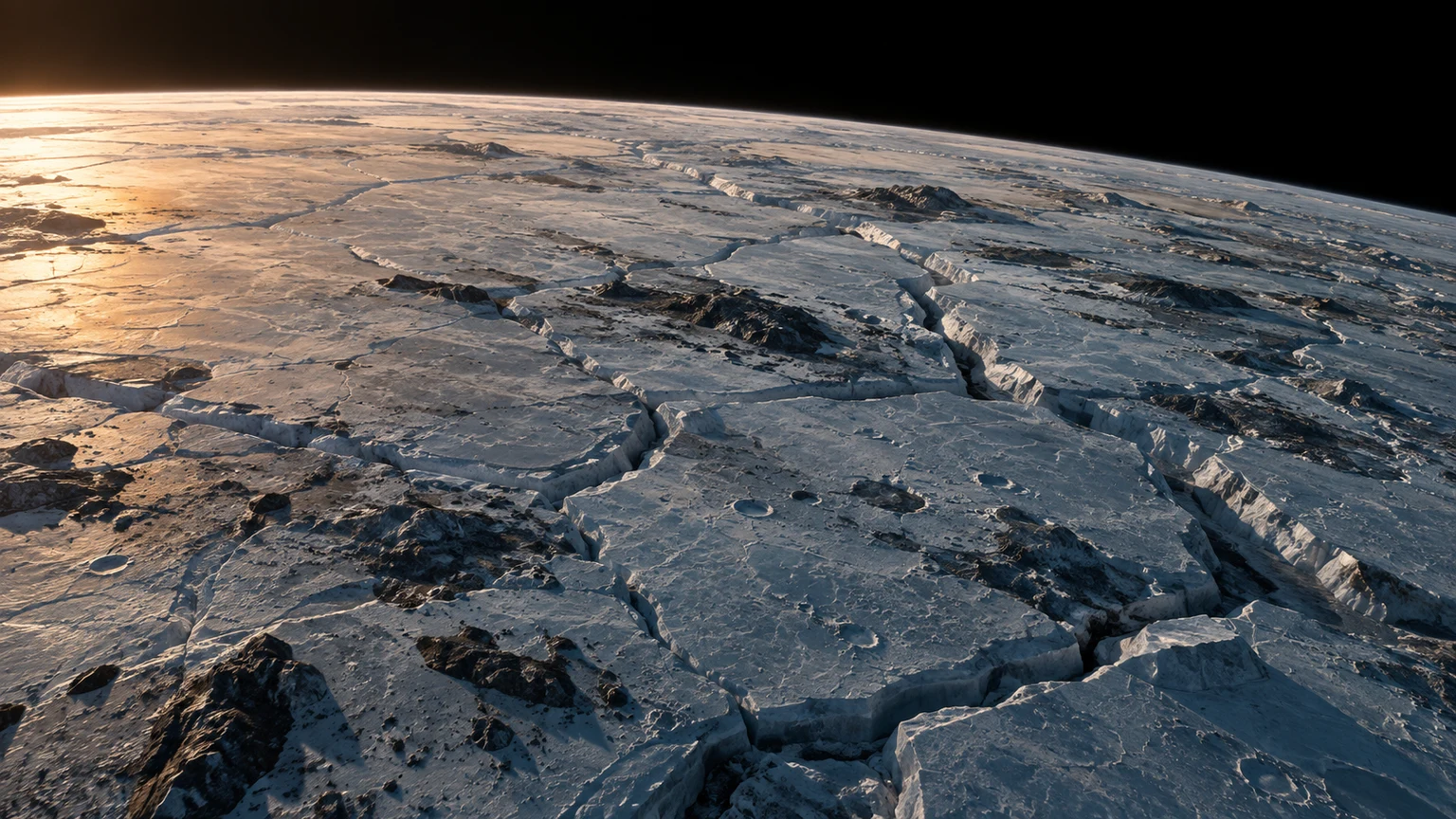
An imagined view of hypothetical blue-gray ice, dark rock inclusions and deep fractures. The ice and frost are hypothetical; water has not been detected on this surface. An airless sky is an illustration assumption, not a measured atmospheric state. No landing site has been mapped here.

The polygonal ice horizon

An imagined view of hypothetical blue-gray ice, dark rock inclusions and deep fractures. The ice and frost are hypothetical; water has not been detected on this surface. An airless sky is an illustration assumption, not a measured atmospheric state. No landing site has been mapped here.

Planet and landscape images are hypothetical artistic interpretations.