SOL SYSTEM / SPACE PROBE DOSSIER

Voyager 2

The only spacecraft to visit all four giant planets. Voyager 2 carried its discoveries beyond Neptune and into interstellar space.
INTERSTELLAR SPACE

Calculated position ·

Space probes ↗
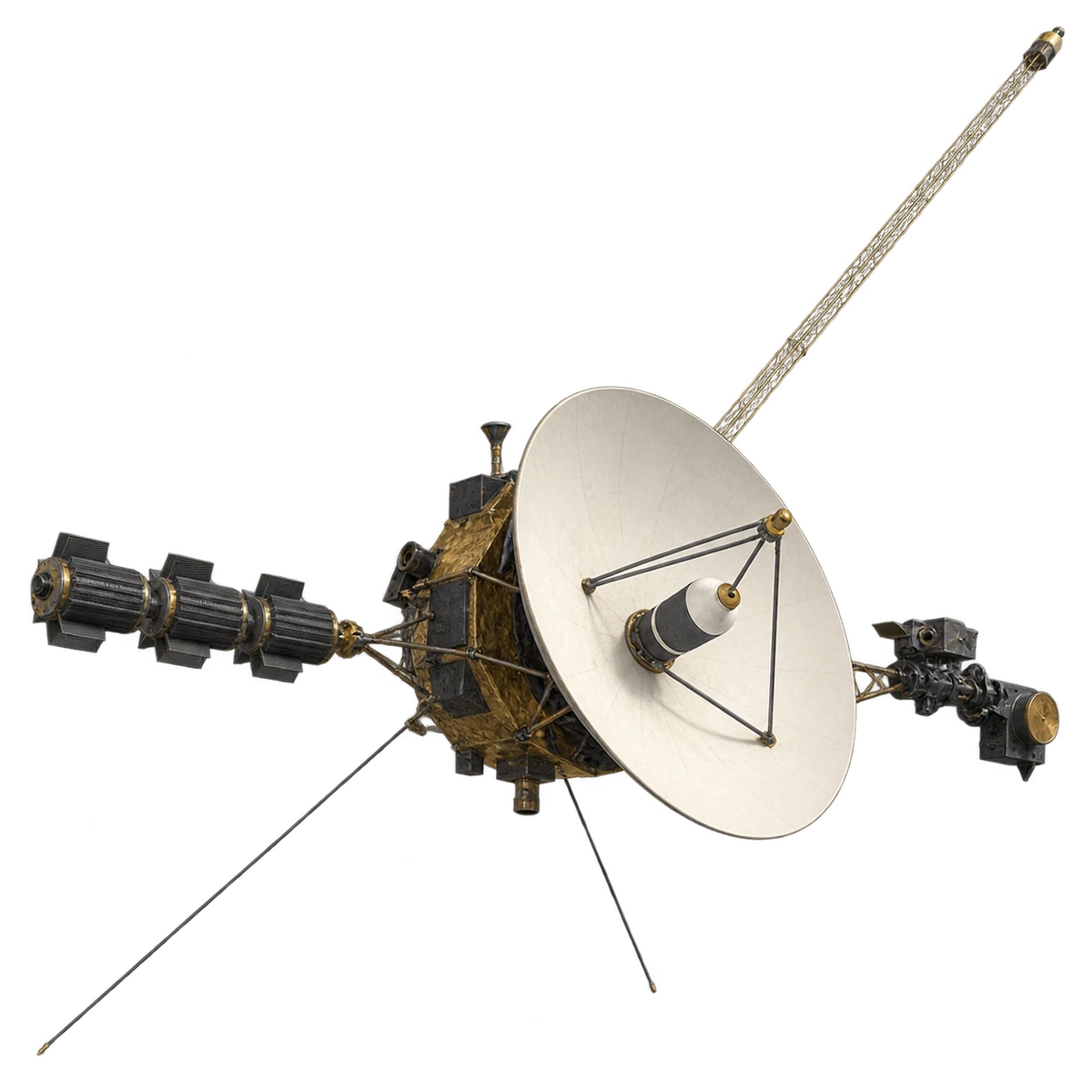
Artist’s illustration of Voyager 2
SPACE PROBEARTIST’S IMPRESSION

Distance from home ↗

02
DISTANCE FROM SOL143.99 AU

About 21.54 billion kilometres from the Sun.

Calculated position · 20 Sep 2026

Signal & speed ↗

03
SPEED RELATIVE TO THE SUN15.3 km/s

Travelling at 15.3 km/s relative to the Sun.

Calculated from the dated trajectory

Mission field log ↗

04
  1. 1977Launch
  2. 1979Jupiter
  3. 1981Saturn
  4. 1986Uranus
  5. 1989Neptune
  6. 2018Interstellar space

A message from Earth ↗

05
The Golden Record

Sounds, images and greetings from Earth.

Sources & image notes ↗

06
MISSION REFERENCESNASA / JPL

Mission history, spacecraft design and the dated position used on the map.

Illustration, not a mission photograph.
VOYAGER 2

Instrument detail

Artist’s impression of Voyager 2

Research-informed artist’s impression. Not an engineering drawing or mission photograph.

A twin with a different route.

Voyager 2 shares Voyager 1’s architecture: a large radio dish, long instrument booms and three radioisotope generators. It carries scientific instruments to measure its surroundings far beyond the planets.

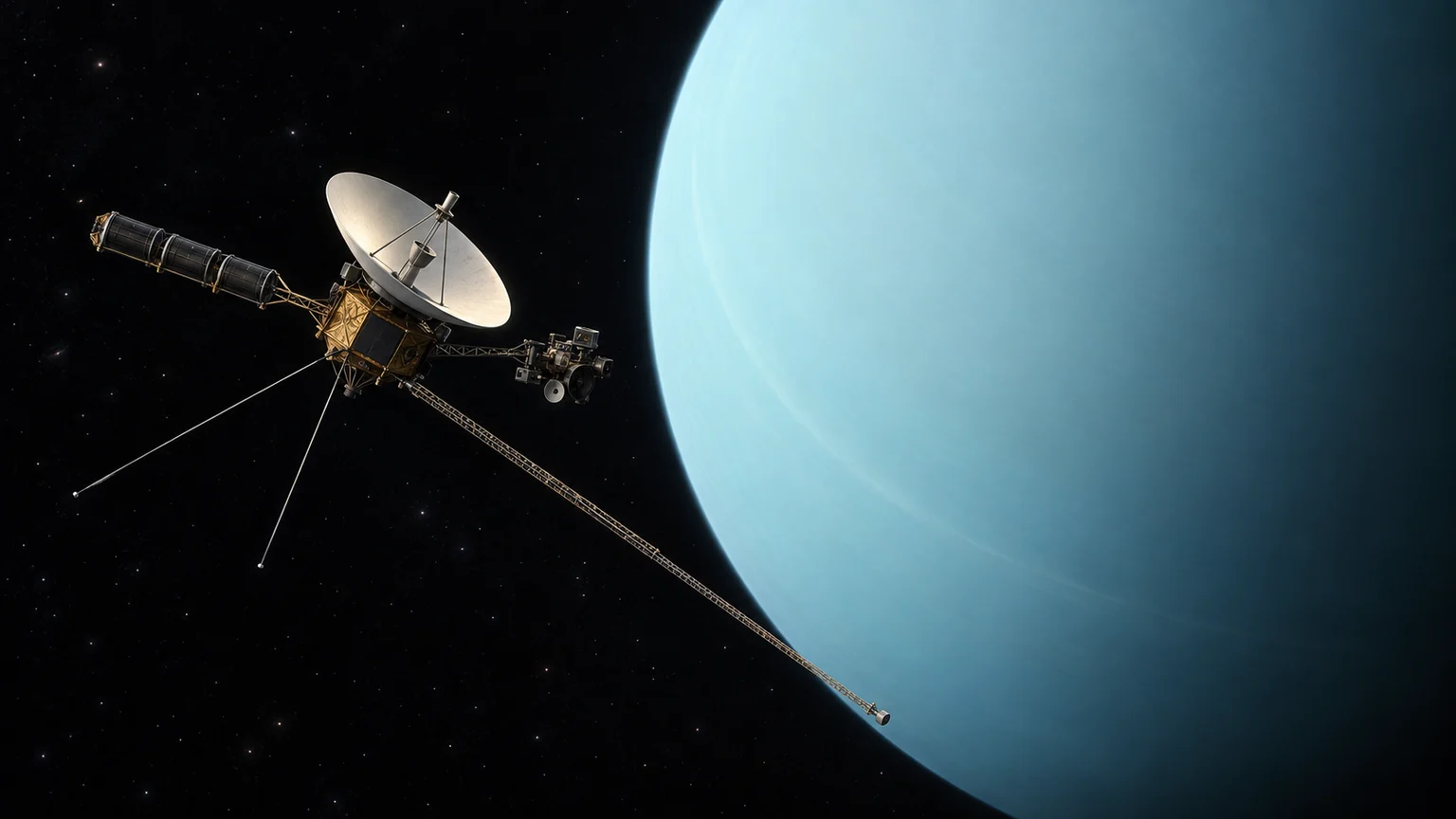
An imagined view of Voyager 2 near Uranus. Spacecraft position, lighting and cloud detail illustrate the encounter rather than reproduce a recorded view.

The pale blue encounter

An imagined view of Voyager 2 near Uranus. Spacecraft position, lighting and cloud detail illustrate the encounter rather than reproduce a recorded view.

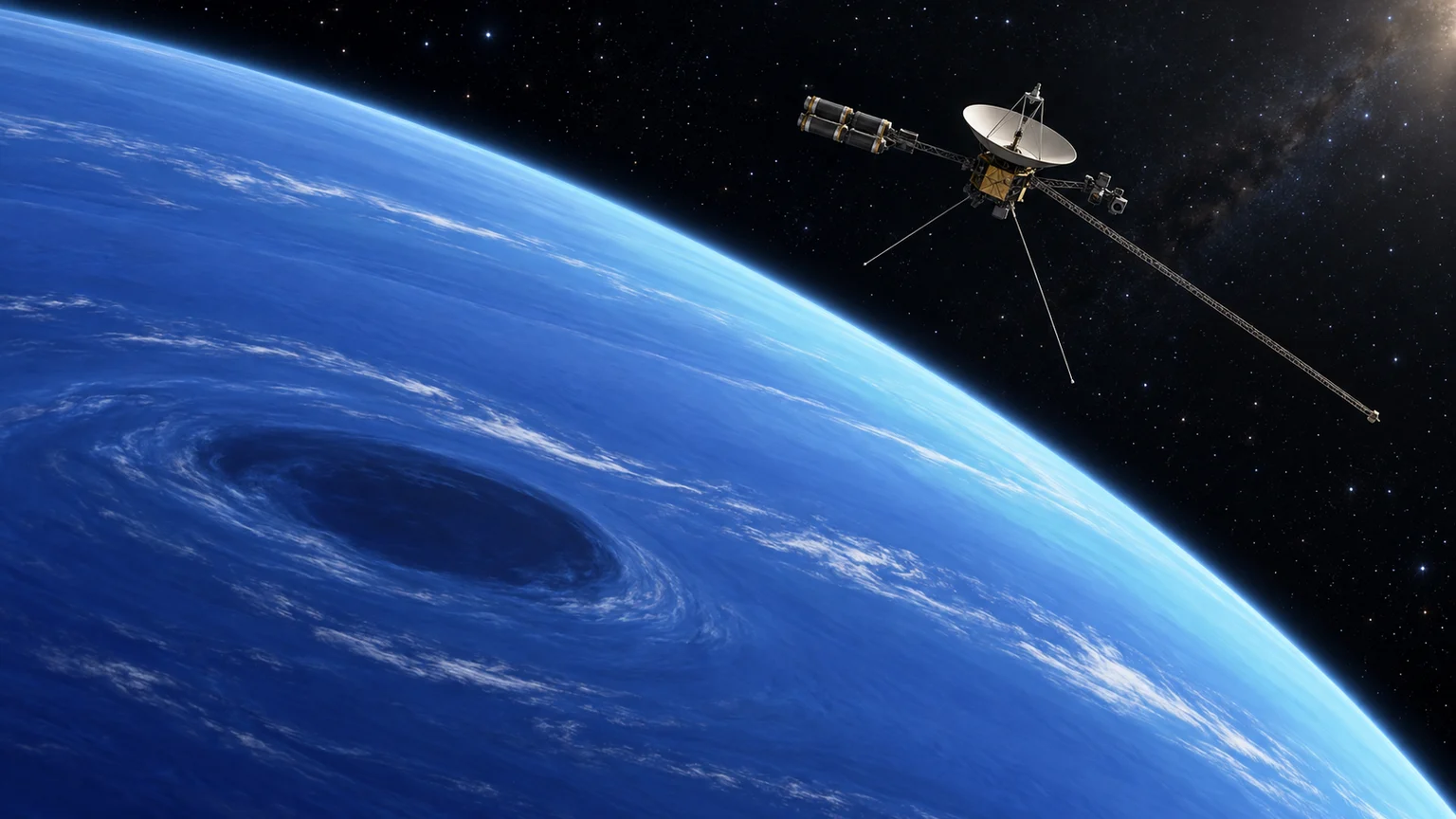
An artistic reconstruction of Voyager 2 passing Neptune. The composition and atmospheric details are illustrative.

Neptune at last

An artistic reconstruction of Voyager 2 passing Neptune. The composition and atmospheric details are illustrative.

An imagined scene beyond the heliopause. Enhanced exposure reveals Voyager 2; interstellar space has no visible dividing wall.

Beyond the solar wind

An imagined scene beyond the heliopause. Enhanced exposure reveals Voyager 2; interstellar space has no visible dividing wall.

A place on the distance scale.

This map places Voyager 2 at 143.99 AU from the Sun, about 21.54 billion kilometres. NASA/JPL Horizons trajectory calculation for 20 September 2026, 00:00 TDB. This is a modelled position, not live telemetry.

The marker shows distance along Starvium’s route, not a live sky position or flight direction. Voyager 2 continues moving; this dated marker stays fixed until the snapshot is updated.

Find Voyager 2 on the map ↗NASA / JPL · Position reference ↗

Motion beyond the planets.

The displayed speed is the magnitude of the heliocentric velocity in the dated NASA/JPL trajectory. It is not a live communications reading.

Speed relative to the Sun: 15.3 km/s. Position epoch: 20 Sep 2026.

NASA · Mission position and status ↗

ENTRY 01 / THE GRAND TOUR

Four worlds in one voyage.

Jupiter in 1979. Saturn in 1981. Uranus in 1986. Neptune in 1989. Voyager 2 remains the only spacecraft to have visited Uranus and Neptune; its images still shape our understanding of those distant systems.

ENTRY 02 / BEYOND THE SOLAR WIND

A second crossing.

Voyager 2 entered interstellar space on 5 November 2018. It crossed the heliopause in a different direction from Voyager 1, providing another set of measurements beyond the solar wind’s protective bubble.

A record for the long journey.

Like its twin, Voyager 2 carries a Golden Record: music, natural sounds, images and spoken greetings. A small account of life on Earth travels with the spacecraft.

Mission references.

The spacecraft image is a research-informed artistic illustration. Map distance, speed and signal travel time refer to the snapshot dated 20 Sep 2026.