SOL SYSTEM / SPACE PROBE DOSSIER

Voyager 1

Built to visit the giant planets. Still travelling into the space between stars. Voyager 1 carries a small piece of Earth farther than any other human-made object.

INTERSTELLAR SPACE

Distance snapshot ·

Space probes ↗
Artist’s illustration of Voyager 1
SPACE PROBEARTIST’S IMPRESSION

Distance from home ↗

02
DISTANCE FROM SOL171.81 AU

About 25.70 billion kilometres from the Sun.

Distance snapshot · 20 Sep 2026

Signal & speed ↗

03
ONE-WAY LIGHT TIME TO EARTH23 h 50 min

Travelling at 16.9 km/s relative to the Sun.

Approximate values · 20 Sep 2026

Mission field log ↗

04
  1. 1977Departure from Earth
  2. 1979Jupiter encounter
  3. 1980Saturn & Titan
  4. 2012Interstellar space

A message from Earth ↗

05
The Golden Record

Sounds, images and greetings in 55 languages.

Sources & image notes ↗

06
MISSION REFERENCESNASA / JPL

Mission history, spacecraft design and the dated position used on the map.

Illustration, not a mission photograph.
VOYAGER 1

Instrument detail

Artist’s impression of Voyager 1

Research-informed artist’s impression. Not an engineering drawing or mission photograph.

A dish pointed back at home.

The pale radio dish is 3.7 metres across. It keeps the spacecraft connected to Earth while long instrument booms separate sensitive measurements from the main body. Three radioisotope generators supply electricity far beyond useful sunlight. There are no solar panels; the available electrical power gradually declines.

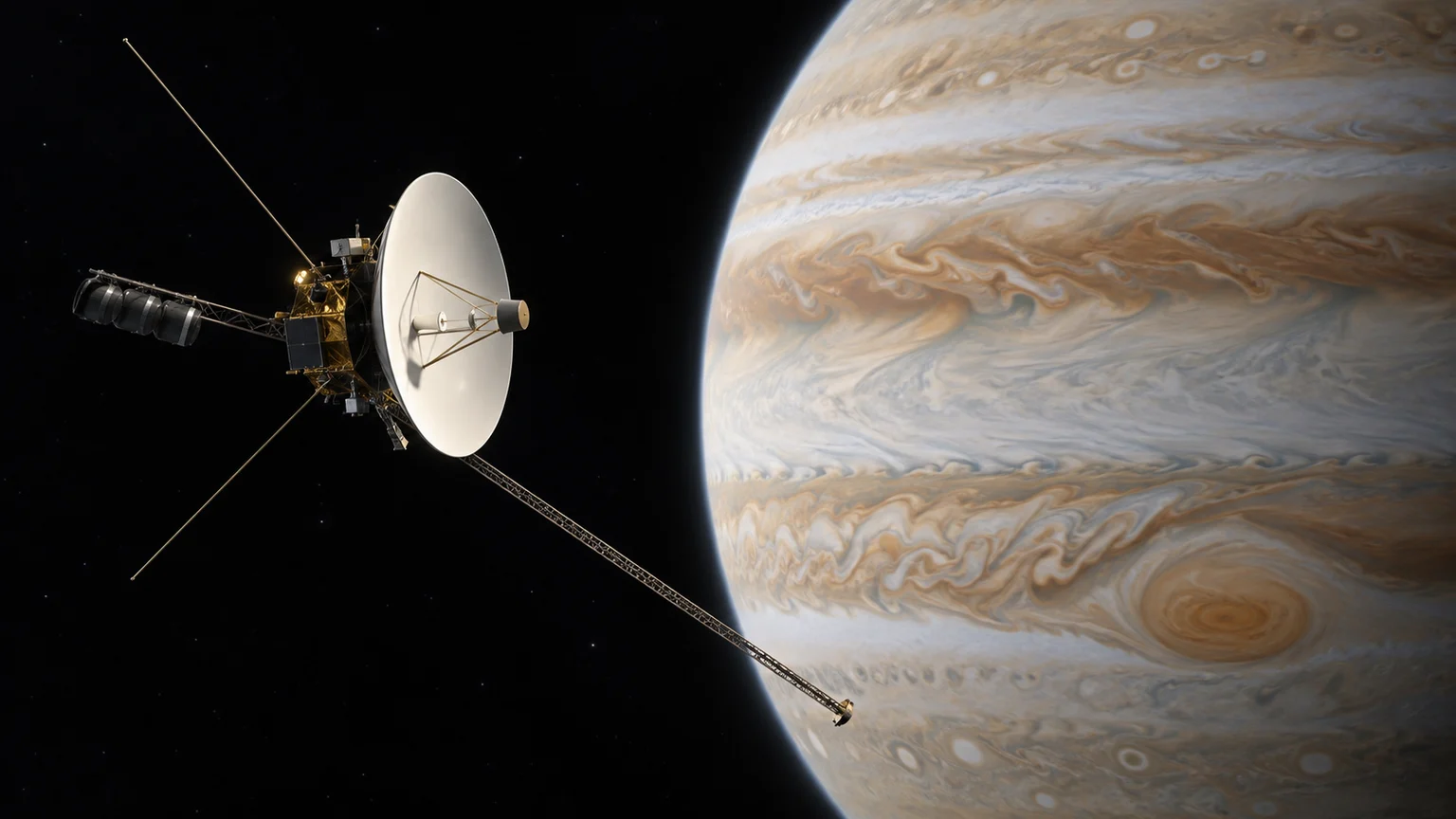
An artistic reconstruction of Voyager 1 near Jupiter. The spacecraft, cloud patterns, illumination and viewing geometry are illustrative, not a photograph of the encounter.

An encounter with Jupiter

An artistic reconstruction of Voyager 1 near Jupiter. The spacecraft, cloud patterns, illumination and viewing geometry are illustrative, not a photograph of the encounter.

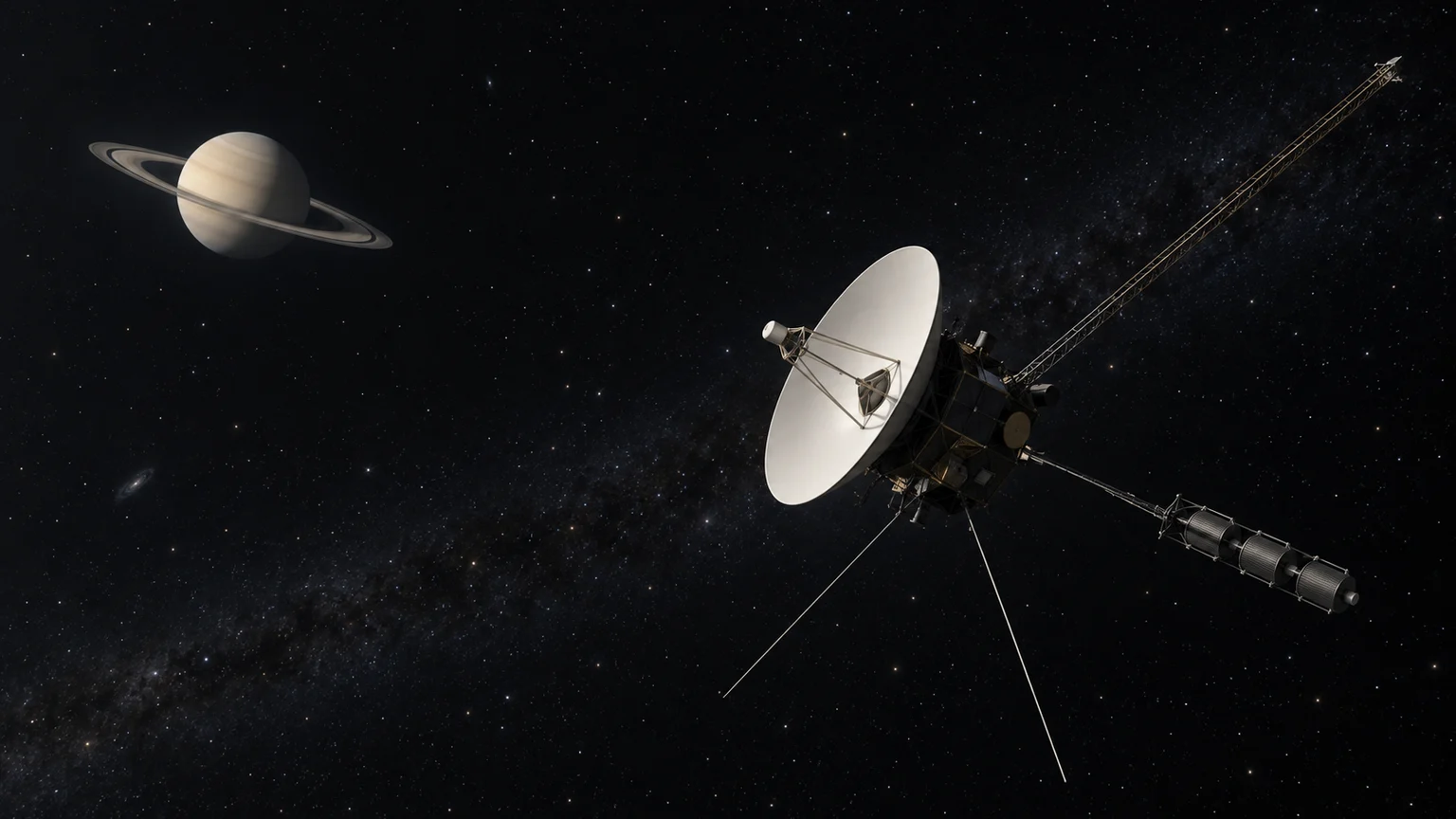
An imagined view of Voyager 1 departing Saturn. Ring geometry, spacecraft position and lighting evoke the planetary encounter without reconstructing a specific recorded viewpoint.

Beyond the ringed planet

An imagined view of Voyager 1 departing Saturn. Ring geometry, spacecraft position and lighting evoke the planetary encounter without reconstructing a specific recorded viewpoint.

An imagined view of Voyager 1 in interstellar space. Enhanced exposure reveals the spacecraft beneath weak distant sunlight. No visible boundary marks the heliopause.

A small light far from home

An imagined view of Voyager 1 in interstellar space. Enhanced exposure reveals the spacecraft beneath weak distant sunlight. No visible boundary marks the heliopause.

A place on the distance scale.

This map places Voyager 1 at 171.81 AU from the Sun, about 25.70 billion kilometres. NASA Eyes snapshot dated 20 September 2026.

The marker shows distance along Starvium’s route, not a live sky position or flight direction. Voyager 1 continues moving; this dated marker stays fixed until the snapshot is updated.

Find Voyager 1 on the map ↗NASA / JPL · Position reference ↗

Almost a day to reach home.

At this snapshot, Voyager 1 was about 25.73 billion kilometres from Earth. A radio signal took approximately 23 hours 50 minutes to cross that distance. This is the one-way travel time; map distance is measured from the Sun.

Speed relative to the Sun: 16.9 km/s. Position epoch: 20 Sep 2026.

NASA · Mission position and status ↗

ENTRY 01 / THE JOURNEY

Two planets. An open-ended voyage.

Voyager 1 left Earth in 1977, passed Jupiter in March 1979 and reached Saturn in November 1980. Its encounter with Titan helped send it out of the plane of the planets. The original planetary tour became a journey into an environment no spacecraft had measured before.

ENTRY 02 / BEYOND THE SOLAR WIND

A boundary you cannot see.

On 25 August 2012, Voyager 1 crossed the heliopause: the outer boundary of the bubble shaped by the solar wind. It entered interstellar space, but did not leave every part of the Solar System behind. The distant Oort Cloud still lies ahead. The boundary is a change in the surrounding plasma, not a visible wall.

Something of us goes with it.

Voyager carries a gold-plated record with images, natural sounds, music and greetings in 55 languages. It is a portrait of the world that built the spacecraft. Even after its instruments fall silent, Voyager will continue coasting through space, with that record still aboard.