Artist’s impression · structure and color are illustrative.
Another sun. A different setting.
Alpha Centauri A feels familiar for a reason: its effective temperature is close to Sol’s. Its larger diameter gives that warm light a bigger stage. Yet the setting is different. Instead of shining alone at the center of a planetary family, A shares a binary orbit with Alpha Centauri B. Their circuit takes roughly 80 years. Proxima belongs to the same system but lies much farther from the close pair.
There is no ground beneath the glow.
Like Sol, A is a main-sequence star, sustained by hydrogen fusion in its core. The photosphere is where most visible light escapes, not a crust to land on. The detailed granules in these pictures are a reconstruction inspired by the Sun: hot material rising and cooler material sinking. This is a place to observe from a distance, not a landscape to walk across.
A star that quietly rings.
Astronomers have detected tiny oscillations in Alpha Centauri A. Pressure waves travel through the star and make its outer layers move, shifting the light recorded by a spectrograph. Some of the measured rhythms have periods around seven minutes. Comparing those patterns with stellar models helps probe an interior we cannot see. This is asteroseismology: learning about a star by measuring how it vibrates.
A long chapter, not a permanent state.
Main sequence describes what powers the star now. When core hydrogen is depleted, a Sun-like star changes structure, expands into a giant and eventually leaves a white dwarf after shedding its outer layers. The stages above describe that broad path, not a countdown. A’s precise age and future timing depend on stellar models; its current classification tells us more reliably where it belongs in the story.


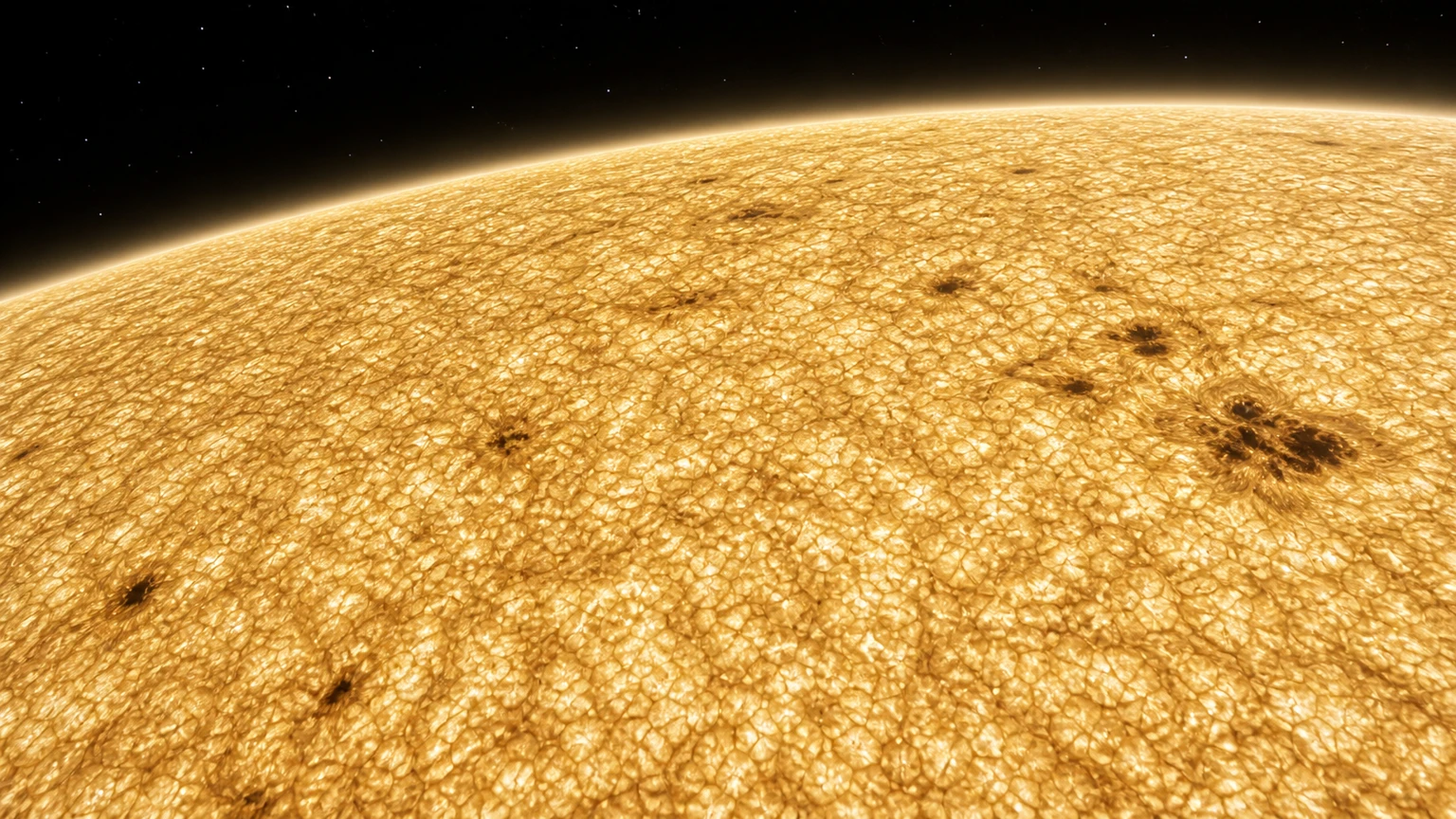 Across the photosphere ↗ ARTIST’S IMPRESSION · 3 VIEWS