ANTARES / STELLAR DOSSIER

Antares

553.75 light-years from Sol

An enormous, cool photosphere surrounds a massive evolved star with a turbulent extended atmosphere.

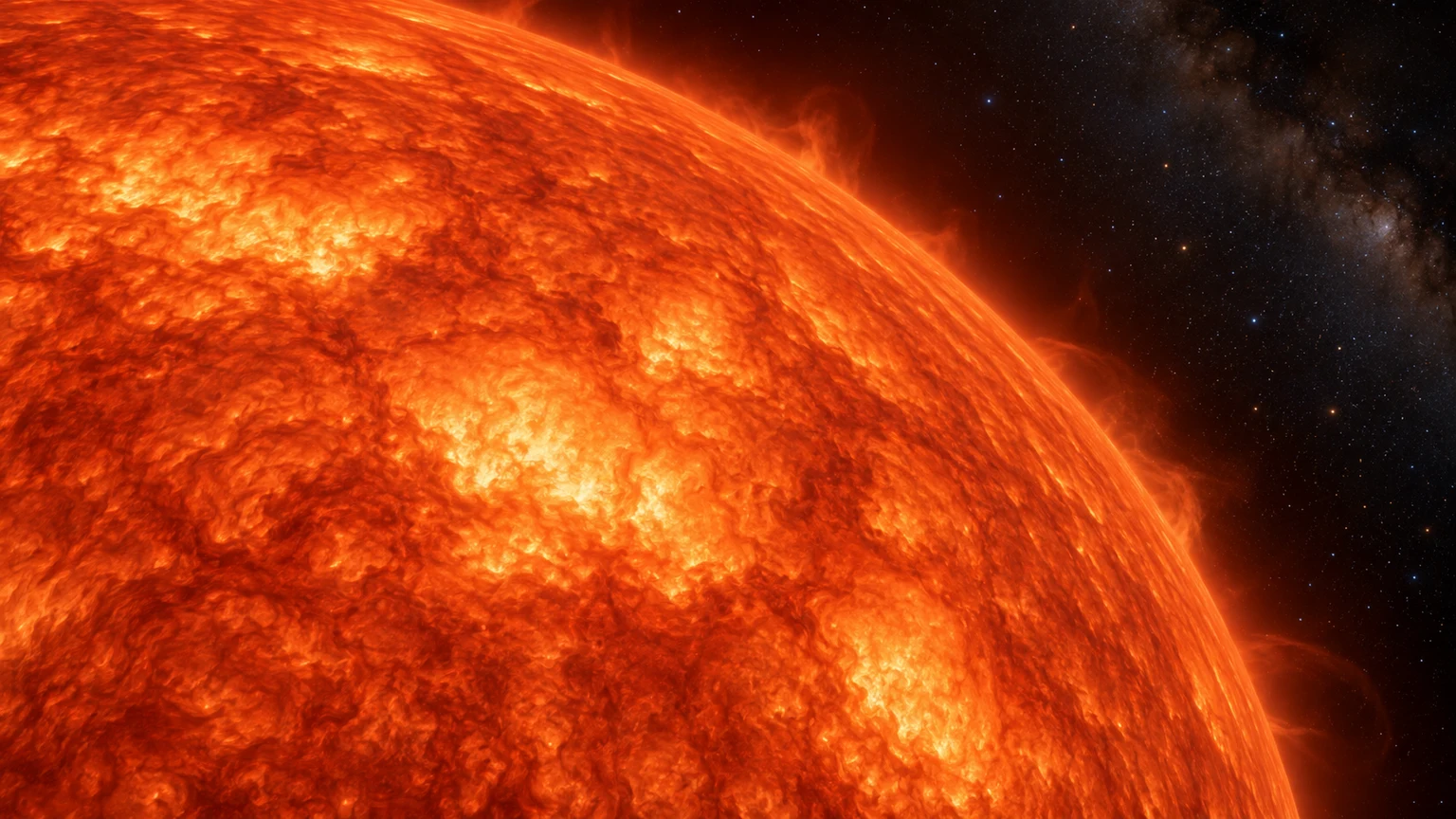
Artist’s impression of Antares
M-type · red supergiant A

A red supergiant shedding its outer layers.

Stellar conditions ↗

02
EFFECTIVE TEMPERATURE3,660 K

Light from the outer layers.

Antares3,660 K
Sol5,770 K
Shared scale 0–10,000 K · effective, not core temperature

Evolution ↗

03
CURRENT PHASE

Red supergiant.

  1. NOWRed supergiant
  2. PROCESSChanging internal structure
  3. OUTLOOKModel-dependent evolution
A physical sequence, not a lifetime scale or a countdown.
Artist’s impression. The curved luminous layers and detailed gas texture are illustrative, not a measured surface map.Across the luminous edge ↗ ARTIST’S IMPRESSION · 3 VIEWS

Diameter comparison ↗

06
680 × Sol
ANTARES

Instrument detail

Artist’s impression of Antares

Artist’s impression · structure and color are illustrative.

Watching gas move.

Interferometry and spectroscopy have mapped motion across Antares’s extended atmosphere. The result reveals a dynamic environment above the photosphere, rather than a stationary stellar surface. These illustrations are new artistic interpretations, not copies of those maps.

The bright red component.

This page describes Antares A. A much hotter blue companion, Antares B, belongs to the system. The small blue point in the wide illustration represents that companion; its placement and apparent size are illustrative.

An expanded late stage.

The red supergiant has expanded enormously and loses material to its surroundings. Its future involves further internal evolution toward core collapse. Neither its red color nor an atmospheric disturbance is a reliable countdown to an explosion.

A star in perspective.

DIAMETER / SOL680.00 ×

About 67900% wider than our Sun.

Circles compare diameter, not mass or luminosity. Approximate radius 680 solar radii, based on an angular diameter near 37.4 mas and parallax 5.89 ± 1.00 mas; distance dominates the scale uncertainty.

EFFECTIVE TEMPERATURE

Light from the outer layers.

  • Antares≈ 3,660 K
  • Sol≈ 5,770 K

Shared scale: 0–10,000 K. Effective temperature describes total emitted energy per unit surface area; it is not the core temperature. Effective temperature 3,660 ± 120 K from Ohnaka et al. (2013).

LIFE PHASE

Red supergiant.

  1. NOWRed supergiant
  2. PROCESSChanging internal structure
  3. OUTLOOKModel-dependent evolution

A physical sequence, not a lifetime scale or a countdown.

Research · size and temperature ↗
LIFE & HUMAN SURVIVAL / THE STAR ITSELF
POSSIBILITY FOR LIFEIncompatible with known life

The star’s hot gaseous layers cannot provide the cool, stable environment required by life as we know it. Conditions on any orbiting worlds are a separate question.

WITHOUT PROTECTIONNot survivable

No breathable air or solid ground. Extreme heat and radiation make a close encounter lethal; a meaningful survival timer depends on where you are.

NASA · stellar structure and evolution ↗

Red supergiant.

  1. NOWRed supergiant
  2. PROCESSChanging internal structure
  3. OUTLOOKModel-dependent evolution

A physical sequence, not a lifetime scale or a countdown.

Research ↗

The red supergiant has expanded enormously and loses material to its surroundings. Its future involves further internal evolution toward core collapse. Neither its red color nor an atmospheric disturbance is a reliable countdown to an explosion.

How much energy leaves the star?

≈ 74,900 × Sol

This compares total radiant power across all wavelengths, not just visible light or apparent brightness in our sky. The beams on the dashboard share a linear length scale.

The estimate combines this log’s diameter ratio (680 × Sol) and effective temperature (3,660 K): luminosity scales with radius squared and temperature to the fourth power. It is derived from rounded values, not an independent luminosity measurement.

Approximate radius 680 solar radii, based on an angular diameter near 37.4 mas and parallax 5.89 ± 1.00 mas; distance dominates the scale uncertainty.

Effective temperature 3,660 ± 120 K from Ohnaka et al. (2013).

Swinburne University · Stefan–Boltzmann law ↗

Watching gas move.

Interferometry and spectroscopy have mapped motion across Antares’s extended atmosphere. The result reveals a dynamic environment above the photosphere, rather than a stationary stellar surface. These illustrations are new artistic interpretations, not copies of those maps.

The bright red component.

This page describes Antares A. A much hotter blue companion, Antares B, belongs to the system. The small blue point in the wide illustration represents that companion; its placement and apparent size are illustrative.

An expanded late stage.

The red supergiant has expanded enormously and loses material to its surroundings. Its future involves further internal evolution toward core collapse. Neither its red color nor an atmospheric disturbance is a reliable countdown to an explosion.

Artist’s impression. The curved luminous layers and detailed gas texture are illustrative, not a measured surface map.

Across the luminous edge

Artist’s impression. The curved luminous layers and detailed gas texture are illustrative, not a measured surface map.

Artist’s impression. An imagined close view; geometry, fine structure and colors are illustrative.

Structure in perspective

Artist’s impression. An imagined close view; geometry, fine structure and colors are illustrative.

Artist’s impression of Antares A and its small blue companion B. Separation, exposure and relative apparent sizes are illustrative.

A wider view

Artist’s impression of Antares A and its small blue companion B. Separation, exposure and relative apparent sizes are illustrative.

Stellar images are artistic interpretations, not resolved photographs of this star.