Artist’s impression · structure and color are illustrative.
A star that challenges the idea of a surface.
The adopted model gives Betelgeuse a radius hundreds of times the Sun’s. Its photosphere is an extended, variable gaseous layer rather than a sharply defined edge. Radius estimates depend on wavelength and modeling, and distance estimates disagree. The displayed value is a documented reference choice, not a precise permanent size.
Dust crossed the view.
During the Great Dimming, the star became conspicuously fainter. Hubble observations supported a picture in which a substantial outflow cooled and formed obscuring dust. That was a dramatic change in the outer layers, not evidence that a supernova was already beginning. The plume scene illustrates mass loss without claiming to reproduce the observed event.
A faint neighbor in the glare.
ESO reported strong imaging evidence for a close stellar companion in July 2026, based on observations taken in December 2024. The likely companion, Betelgeuse B, is difficult to separate from the supergiant’s glare. The companion would make this a binary system, with the red supergiant as its overwhelmingly brighter member.
An eventual explosion is not a countdown.
Massive stars progress through later nuclear-burning stages before core collapse. Betelgeuse is an evolved red supergiant, but observations do not give a calendar date for its explosion. Its huge cool envelope and much hotter interior tell different parts of the story. The evolution display therefore shows stages rather than a timer.
A large star with an uncertain yardstick.
This atlas adopts the model-based distance of about 168 parsecs from Joyce and colleagues, approximately 550 light-years. The model gives asymmetric uncertainty and differs from some radio-astrometric estimates. The position on the distance route follows that adopted value; it should not be read as a measurement accurate to the route display’s last decimal.
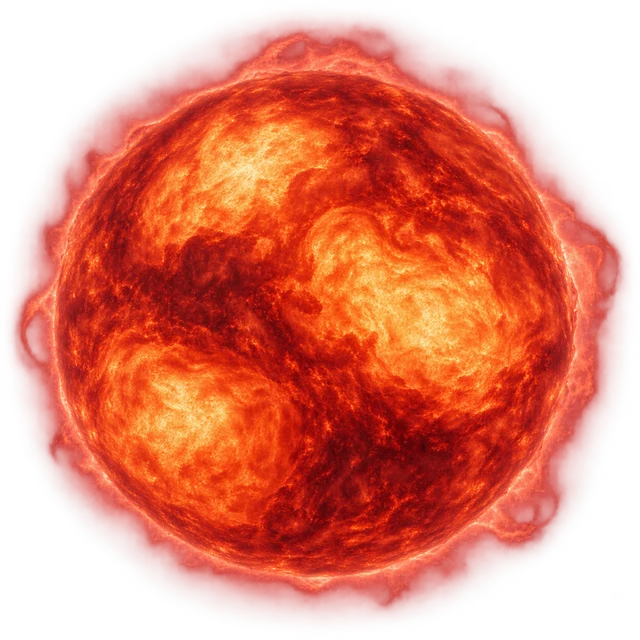
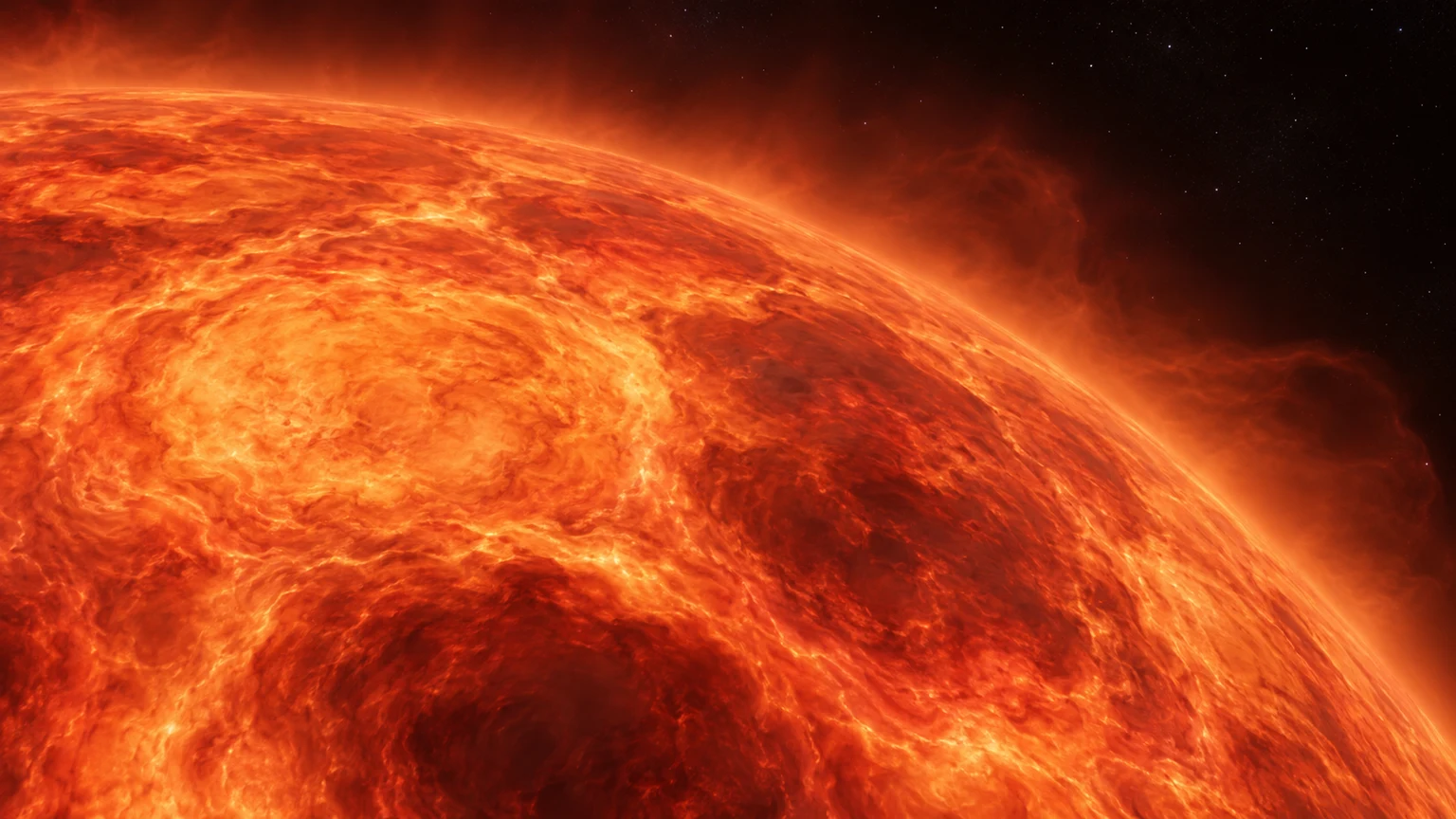 Above the enormous cells ↗ ARTIST’S IMPRESSION · 3 VIEWS