Artist’s impression · structure and color are illustrative.
The nearest star hides in plain sight.
Beyond Sol, Proxima is the closest star to us, about 4.25 light-years away. Yet it is too faint to see with the unaided eye. It belongs to the Alpha Centauri system, well apart from the brighter A–B pair. Nearness alone does not make a star conspicuous: Proxima’s small size and cool photosphere produce only a faint glow compared with our Sun.
Cool does not mean calm.
Proxima repeatedly releases energy in stellar flares. Observations across several wavelengths have caught intense, rapid outbursts, revealing a much more restless environment than its dim appearance suggests. Such radiation matters for nearby planets and their atmospheres. A flare tells us about the star’s magnetic activity; by itself it cannot settle whether any particular planet could support life.
Years measured in days.
The worlds featured here orbit remarkably close to their star: Proxima b takes about eleven days, and d about five. Around a dim red dwarf, the region receiving temperate levels of starlight lies much nearer the star than it does around Sol. Being in that region is not evidence of oceans or life. Atmosphere, stellar activity and the planet’s own history still determine what conditions might be possible.
A slow burn on a vast clock.
Very low-mass red dwarfs mix material deeply through their interiors. This brings more of their hydrogen supply into the fusion process, allowing them to shine for extraordinarily long spans. Models predict lifetimes measured in trillions of years, far beyond the present age of the universe. Proxima’s phase graphic therefore shows its long-lived mode of operation rather than borrowing the Sun’s path through a giant stage.


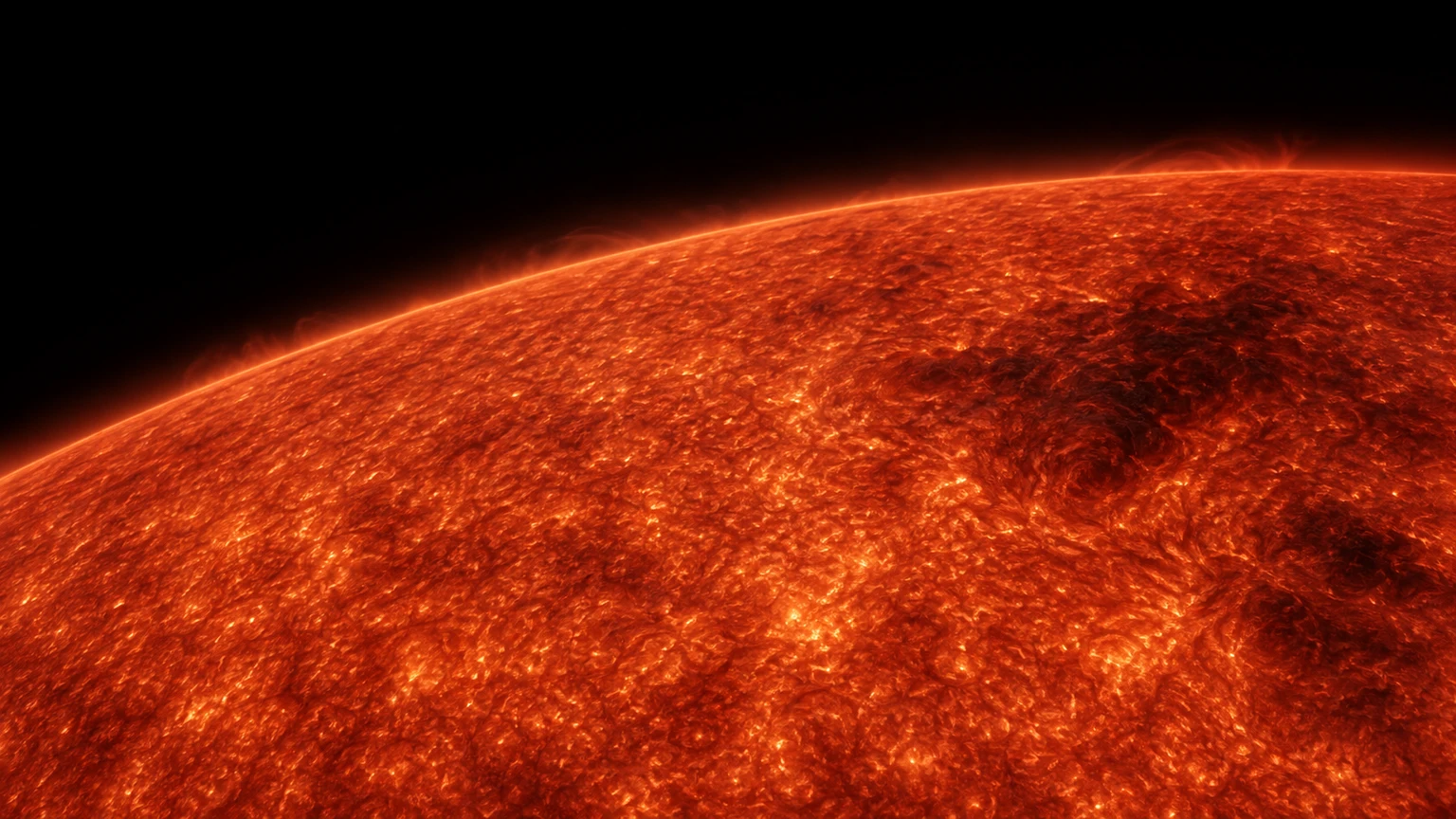 The quiet between outbursts ↗ ARTIST’S IMPRESSION · 3 VIEWS