SIRIUS / STELLAR DOSSIER

Sirius A

8.61 light-years from Sol

A brilliant nearby star with a much smaller companion and a very different stellar future.
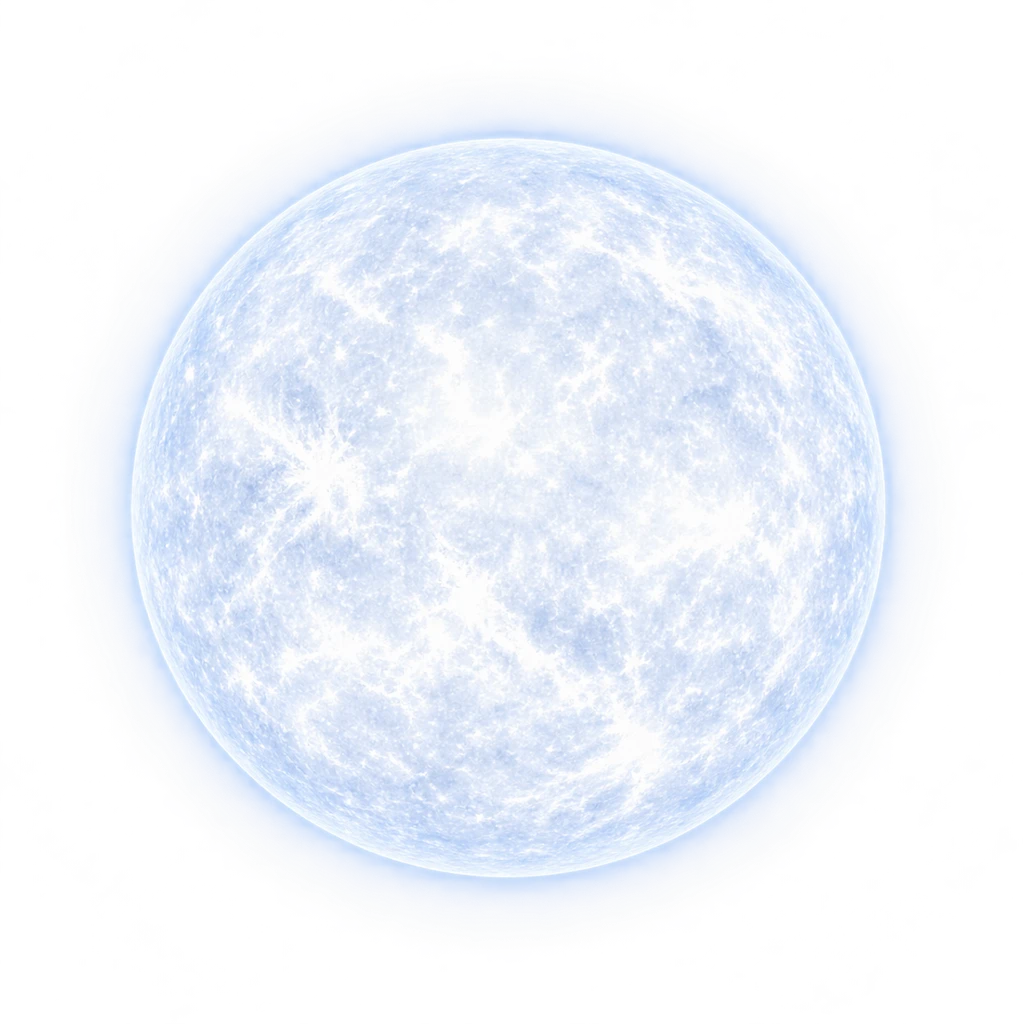
Artist’s impression of Sirius A
A1 V · main sequence

The brightest point in our night.

Stellar conditions ↗

02
EFFECTIVE TEMPERATURE9,845 K

A whiter, hotter light.

Sirius A9,845 K
Sol5,770 K
Shared scale 0–10,000 K · effective, not core temperature

Evolution ↗

03
CURRENT PHASE

Still powered by fusion.

  1. NOWHydrogen fusion
  2. LATERGiant phase
  3. REMNANTWhite dwarf
An evolutionary sequence, not a time scale or an estimate of remaining lifetime.

Stellar family

04
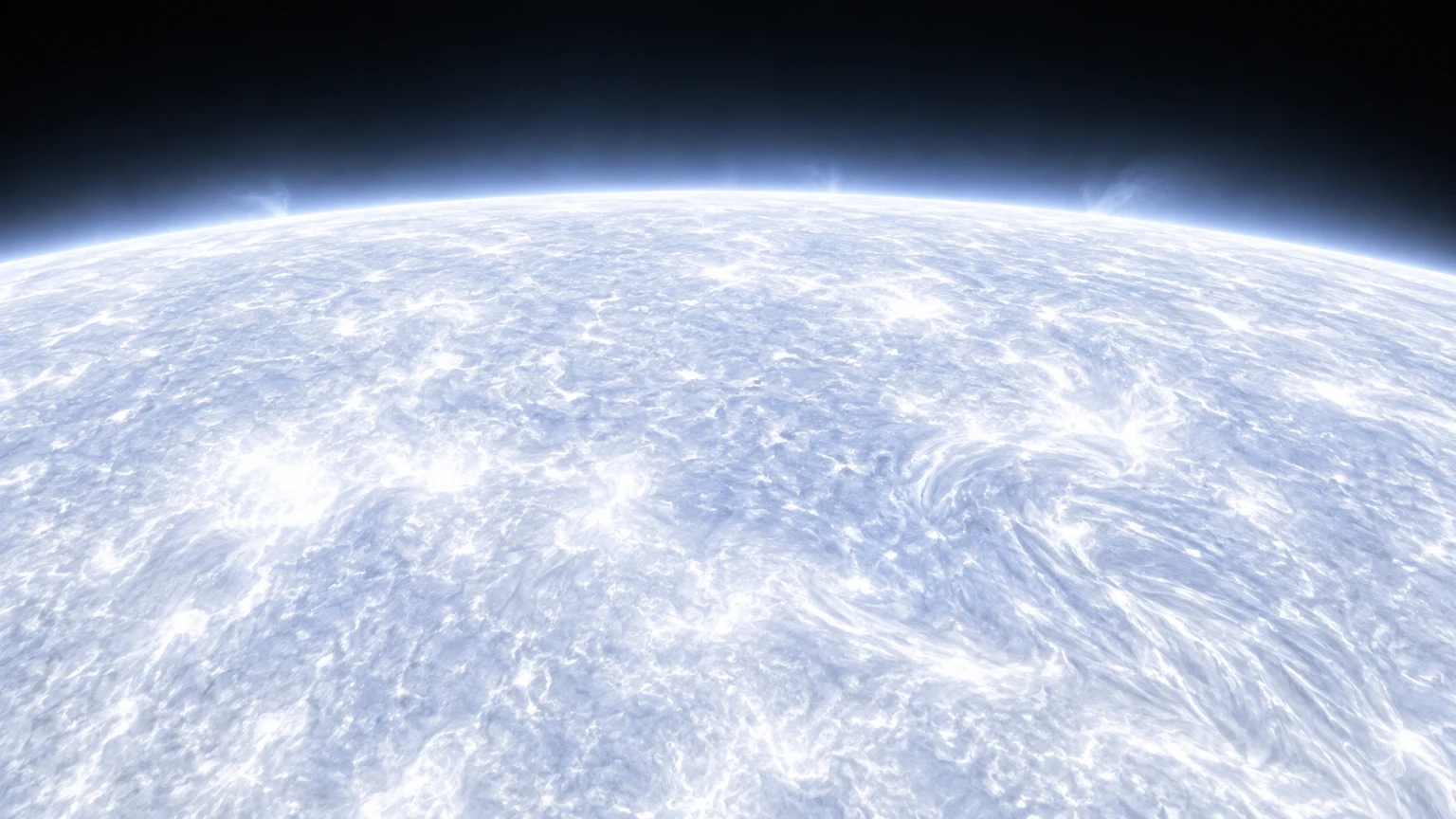
An imagined close approach to Sirius A’s luminous gaseous layers. Fine texture and the faint horizon glow are artistic interpretations, not mapped features. Exposure is reduced to reveal structure.Under a white stellar horizon ↗ ARTIST’S IMPRESSION · 3 VIEWS

Diameter comparison ↗

06
1.714 × Sol
SIRIUS A

Instrument detail

Artist’s impression of Sirius A

Artist’s impression · structure and color are illustrative.

A familiar point becomes a place.

From Earth, Sirius is the brightest star in the night sky. Most of that visible brilliance belongs to A. Hubble separates its faint companion from the glare, revealing that the familiar point of light is a pair. Our close views imagine what no telescope has photographed as a landscape.

No ground beneath the white glow.

Sirius A is a main-sequence star. Hydrogen fusion powers its interior; the visible photosphere is hot gas rather than a solid boundary. The bright patterns here invite a closer look, but they are not terrain. There is nowhere to put down a lander or step outside.

Two stars sharing one rhythm.

A and B complete a mutual orbit in about 50 years. Their motions let astronomers weigh them: A holds about twice Sol’s mass, while B holds roughly one. The little companion has a substantial gravitational role despite its faint appearance.

Its companion offers a glimpse ahead.

Fusion does not last forever. After a star like A exhausts its core hydrogen, it passes through expanded giant stages and eventually leaves a white dwarf. Sirius B already occupies that remnant phase. The sequence shown above describes the broad path, not a date for the next change.

A star in perspective.

DIAMETER / SOL1.71 ×

About 71% wider than our Sun.

Circles compare diameter, not mass or luminosity. Interferometric radius adopted by Bond et al. (2017); the diameter ratio is identical to the radius ratio.

MASS / SOL
2.063 ×
WHAT THAT MEANS
More mass than our Sun, packed into a hotter star.
EFFECTIVE TEMPERATURE

A whiter, hotter light.

  • Sirius A≈ 9,845 K
  • Sol≈ 5,770 K

Shared scale: 0–10,000 K. Effective temperature describes total emitted energy per unit surface area; it is not the core temperature.

LIFE PHASE

Still powered by fusion.

  1. NOWHydrogen fusion
  2. LATERGiant phase
  3. REMNANTWhite dwarf

An evolutionary sequence, not a time scale or an estimate of remaining lifetime.

Research · size and temperature ↗
LIFE & HUMAN SURVIVAL / THE STAR ITSELF
POSSIBILITY FOR LIFEIncompatible with known life

The star’s hot gaseous layers cannot provide the cool, stable environment required by life as we know it. Conditions on any orbiting worlds are a separate question.

WITHOUT PROTECTIONNot survivable

No breathable air or solid ground. Extreme heat and radiation make a close encounter lethal; a meaningful survival timer depends on where you are.

NASA · stellar structure and evolution ↗

Still powered by fusion.

  1. NOWHydrogen fusion
  2. LATERGiant phase
  3. REMNANTWhite dwarf

An evolutionary sequence, not a time scale or an estimate of remaining lifetime.

Research ↗

Fusion does not last forever. After a star like A exhausts its core hydrogen, it passes through expanded giant stages and eventually leaves a white dwarf. Sirius B already occupies that remnant phase. The sequence shown above describes the broad path, not a date for the next change.

How much energy leaves the star?

≈ 24.9 × Sol

This compares total radiant power across all wavelengths, not just visible light or apparent brightness in our sky. The beams on the dashboard share a linear length scale.

The estimate combines this log’s diameter ratio (1.7144 × Sol) and effective temperature (9,845 K): luminosity scales with radius squared and temperature to the fourth power. It is derived from rounded values, not an independent luminosity measurement.

Interferometric radius adopted by Bond et al. (2017); the diameter ratio is identical to the radius ratio.

Swinburne University · Stefan–Boltzmann law ↗

A familiar point becomes a place.

From Earth, Sirius is the brightest star in the night sky. Most of that visible brilliance belongs to A. Hubble separates its faint companion from the glare, revealing that the familiar point of light is a pair. Our close views imagine what no telescope has photographed as a landscape.

No ground beneath the white glow.

Sirius A is a main-sequence star. Hydrogen fusion powers its interior; the visible photosphere is hot gas rather than a solid boundary. The bright patterns here invite a closer look, but they are not terrain. There is nowhere to put down a lander or step outside.

Two stars sharing one rhythm.

A and B complete a mutual orbit in about 50 years. Their motions let astronomers weigh them: A holds about twice Sol’s mass, while B holds roughly one. The little companion has a substantial gravitational role despite its faint appearance.

Its companion offers a glimpse ahead.

Fusion does not last forever. After a star like A exhausts its core hydrogen, it passes through expanded giant stages and eventually leaves a white dwarf. Sirius B already occupies that remnant phase. The sequence shown above describes the broad path, not a date for the next change.

An imagined close approach to Sirius A’s luminous gaseous layers. Fine texture and the faint horizon glow are artistic interpretations, not mapped features. Exposure is reduced to reveal structure.

Under a white stellar horizon

An imagined close approach to Sirius A’s luminous gaseous layers. Fine texture and the faint horizon glow are artistic interpretations, not mapped features. Exposure is reduced to reveal structure.

A hypothetical oblique view of Sirius A’s photosphere against space. The cool white palette represents a hot star; local patterns and apparent brightness are illustrative, not a resolved photograph.

At the edge of the light

A hypothetical oblique view of Sirius A’s photosphere against space. The cool white palette represents a hot star; local patterns and apparent brightness are illustrative, not a resolved photograph.

An artistic view of Sirius A against space. The luminous disk and fine gaseous texture are illustrative; color and exposure are adjusted for visibility, not a resolved stellar photograph.

The star against space

An artistic view of Sirius A against space. The luminous disk and fine gaseous texture are illustrative; color and exposure are adjusted for visibility, not a resolved stellar photograph.

Stellar images are artistic interpretations, not resolved photographs of this star.