WOLF 359 / STELLAR DOSSIER

Wolf 359

7.86 light-years from Sol

A tiny red dwarf where magnetic activity makes the search for planets a demanding investigation.

Artist’s impression of Wolf 359
M6 V · flare star

A faint star with a restless light.

Stellar conditions ↗

02
EFFECTIVE TEMPERATURE2,750 K

Small, cool — and highly active.

Wolf 3592,750 K
Sol5,770 K
Shared scale 0–10,000 K · effective, not core temperature

Evolution ↗

03
H–R MAPBRIGHTER ↑
SOLHEREHOTTERCOOLER →
CURRENT PHASE

A long-lived hydrogen furnace.

  1. NOWHydrogen fusion
  2. INTERIORDeep mixing
  3. OUTLOOKLong main sequence
The low-mass red-dwarf outlook, not the Sun’s giant-stage sequence and not an estimate of remaining time.
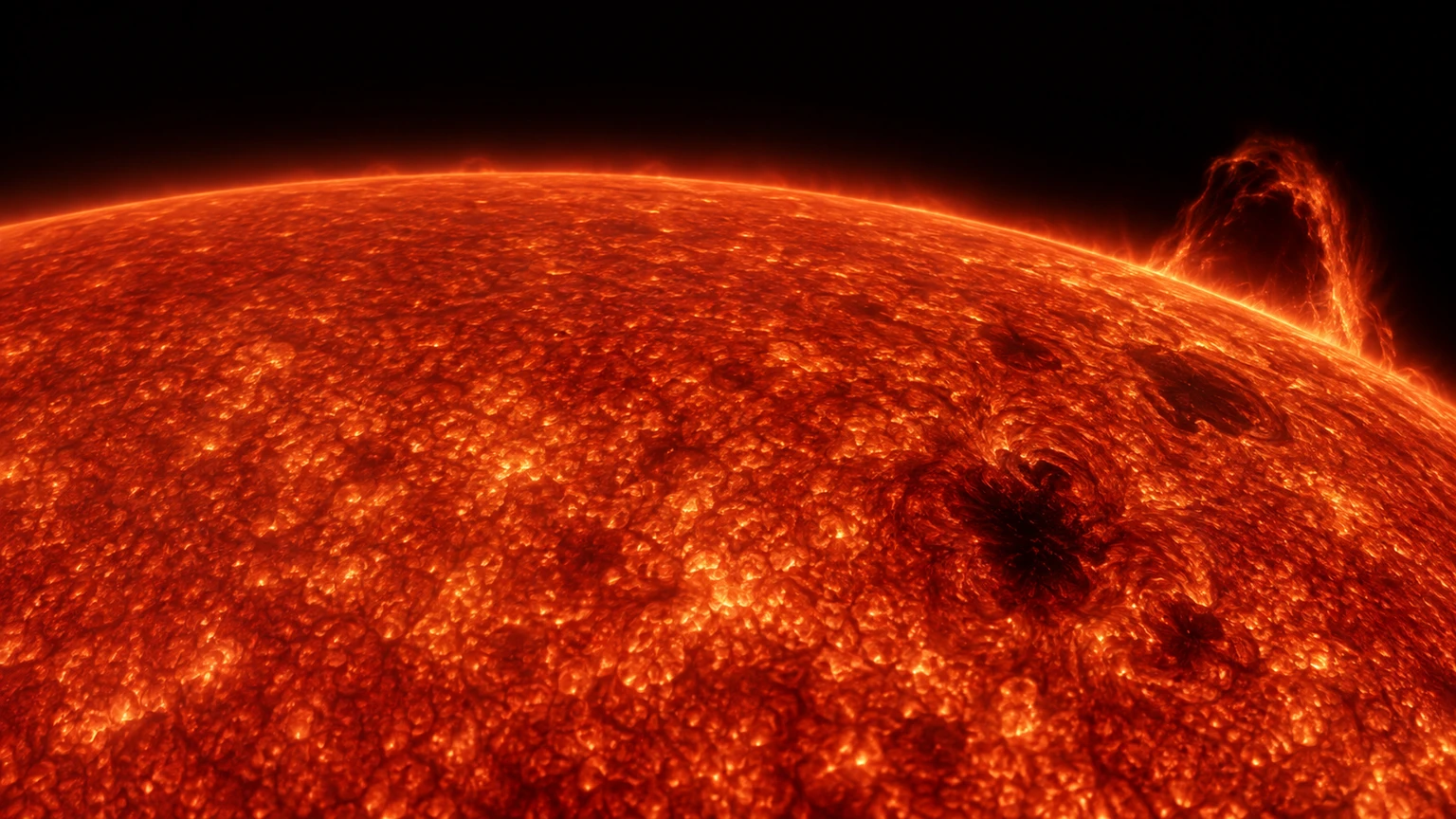
An imagined close view of Wolf 359’s glowing gas, magnetic patches and a prominence. Fine structure is inspired by stellar physics, not resolved observations of this star. Filtered color and exposure reveal the plasma.Above a restless photosphere ↗ ARTIST’S IMPRESSION · 3 VIEWS

Diameter comparison ↗

06
0.144 × Sol
WOLF 359

Instrument detail

Artist’s impression of Wolf 359

Artist’s impression · structure and color are illustrative.

A nearby star with very little bulk.

Wolf 359 is an M6 red dwarf roughly eight light-years away. Its estimated diameter is only about fourteen percent of Sol’s, and its photosphere is much cooler. Those modest dimensions do not make it quiet: it is an active flare star. The view above combines that measured identity with an imagined close-up.

The light has a source deep inside.

Wolf 359 belongs to the hydrogen-fusing main sequence. Low-mass red dwarfs consume their fuel slowly and mix material through their interiors, allowing very long lifetimes. The luminous outer layers are gas rather than a crust. A dark magnetic patch in an illustration therefore marks cooler stellar material, not a crater to land in.

A repeating signal is not always a planet.

Two planet candidates were proposed around Wolf 359. Follow-up work linked the short-period signal called c to the star’s rotation. The longer-period candidate b remained unconfirmed in a combined imaging and radial-velocity study. The distinction matters: stellar motion can suggest an orbit, while activity can imitate a planetary signal.

Looking beside a much brighter source.

Direct imaging separates light from a possible companion from the glare of its host. A coronagraph suppresses starlight, but the remaining contrast still limits what can be seen. An empty image can exclude some bright companions while leaving fainter ones undetected. That is why imaging limits and measured stellar motion are useful together.

A star in perspective.

DIAMETER / SOL0.144 ×

About 14.4% of our Sun’s diameter.

Circles compare diameter, not mass or luminosity. Estimated radius 0.144 ± 0.004 solar radii, from Pineda et al. (2021), compiled by Bowens-Rubin et al. (2023). The same ratio applies to diameter.

EFFECTIVE TEMPERATURE

Small, cool — and highly active.

  • Wolf 359≈ 2,750 K
  • Sol≈ 5,770 K

Shared scale: 0–10,000 K. Effective temperature describes total emitted energy per unit surface area; it is not the core temperature. Rounded from the compiled effective-temperature estimate of 2,749 K. A cooler photosphere does not prevent energetic magnetic flares.

LIFE PHASE

A long-lived hydrogen furnace.

  1. NOWHydrogen fusion
  2. INTERIORDeep mixing
  3. OUTLOOKLong main sequence

The low-mass red-dwarf outlook, not the Sun’s giant-stage sequence and not an estimate of remaining time.

Research · size and temperature ↗
LIFE & HUMAN SURVIVAL / THE STAR ITSELF
POSSIBILITY FOR LIFEIncompatible with known life

The star’s hot gaseous layers cannot provide the cool, stable environment required by life as we know it. Conditions on any orbiting worlds are a separate question.

WITHOUT PROTECTIONNot survivable

No breathable air or solid ground. Extreme heat and radiation make a close encounter lethal; a meaningful survival timer depends on where you are.

NASA · stellar structure and evolution ↗
10⁵1,000100.10.00110⁻⁵30,00010,0005,0002,500LUMINOSITY / SOL · BRIGHTER →HOTTER ← EFFECTIVE TEMPERATURE (K) → COOLERSUPERGIANTSGIANTSWHITE DWARFSMAIN SEQUENCESOLWolf 359
Wolf 3592,750 K · ≈ 0.00107 × Sol
Sol / reference5,770 K · 1 × Sol

Estimated from size & temperature. Both axes are logarithmic; equal steps represent equal ratios.

Small points are other worlds in this atlas. The soft band marks the main sequence; region labels are broad guides, not a path through time.

A long-lived hydrogen furnace.

  1. NOWHydrogen fusion
  2. INTERIORDeep mixing
  3. OUTLOOKLong main sequence

The low-mass red-dwarf outlook, not the Sun’s giant-stage sequence and not an estimate of remaining time.

Research ↗

How much energy leaves the star?

≈ 0.00107 × Sol

This compares total radiant power across all wavelengths, not just visible light or apparent brightness in our sky. The beams on the dashboard share a linear length scale.

The estimate combines this log’s diameter ratio (0.144 × Sol) and effective temperature (2,750 K): luminosity scales with radius squared and temperature to the fourth power. It is derived from rounded values, not an independent luminosity measurement.

Estimated radius 0.144 ± 0.004 solar radii, from Pineda et al. (2021), compiled by Bowens-Rubin et al. (2023). The same ratio applies to diameter.

Rounded from the compiled effective-temperature estimate of 2,749 K. A cooler photosphere does not prevent energetic magnetic flares.

Swinburne University · Stefan–Boltzmann law ↗

A nearby star with very little bulk.

Wolf 359 is an M6 red dwarf roughly eight light-years away. Its estimated diameter is only about fourteen percent of Sol’s, and its photosphere is much cooler. Those modest dimensions do not make it quiet: it is an active flare star. The view above combines that measured identity with an imagined close-up.

The light has a source deep inside.

Wolf 359 belongs to the hydrogen-fusing main sequence. Low-mass red dwarfs consume their fuel slowly and mix material through their interiors, allowing very long lifetimes. The luminous outer layers are gas rather than a crust. A dark magnetic patch in an illustration therefore marks cooler stellar material, not a crater to land in.

A repeating signal is not always a planet.

Two planet candidates were proposed around Wolf 359. Follow-up work linked the short-period signal called c to the star’s rotation. The longer-period candidate b remained unconfirmed in a combined imaging and radial-velocity study. The distinction matters: stellar motion can suggest an orbit, while activity can imitate a planetary signal.

Looking beside a much brighter source.

Direct imaging separates light from a possible companion from the glare of its host. A coronagraph suppresses starlight, but the remaining contrast still limits what can be seen. An empty image can exclude some bright companions while leaving fainter ones undetected. That is why imaging limits and measured stellar motion are useful together.

An imagined close view of Wolf 359’s glowing gas, magnetic patches and a prominence. Fine structure is inspired by stellar physics, not resolved observations of this star. Filtered color and exposure reveal the plasma.

Above a restless photosphere

An imagined close view of Wolf 359’s glowing gas, magnetic patches and a prominence. Fine structure is inspired by stellar physics, not resolved observations of this star. Filtered color and exposure reveal the plasma.

A fictional flare structure above the stellar limb. The loop and its bright footpoints illustrate magnetic activity, not a particular observed eruption. There is no solid surface beneath the glowing layers.

Following a magnetic arc

A fictional flare structure above the stellar limb. The loop and its bright footpoints illustrate magnetic activity, not a particular observed eruption. There is no solid surface beneath the glowing layers.

An artistic view of Wolf 359 against space. The luminous disk and fine gaseous texture are illustrative; color and exposure are adjusted for visibility, not a resolved stellar photograph.

The star against space

An artistic view of Wolf 359 against space. The luminous disk and fine gaseous texture are illustrative; color and exposure are adjusted for visibility, not a resolved stellar photograph.

Stellar images are artistic interpretations, not resolved photographs of this star.