SOLAR NEIGHBORHOOD / SUBSTELLAR DOSSIER

WISE 0855−0714

7.43 light-years from Sol

An isolated, ultracool neighbor whose atmosphere reveals itself in infrared light.

Artist’s impression of WISE 0855−0714
Y-type · planetary-mass brown dwarf

A world almost lost in the dark.

Atmospheric conditions ↗

02
EFFECTIVE TEMPERATURE280 K

A surprisingly cool neighbor.

WISE 0855−0714280 K
Sol5,770 K
Shared scale 0–10,000 K · effective, not core temperature

Evolution ↗

03
H–R MAPBRIGHTER ↑
SOLHEREHOTTERCOOLER →
CURRENT PHASE

A slow release of internal heat.

  1. NOWUltracool atmosphere
  2. ENERGYInternal warmth
  3. OUTLOOKGradual cooling
A cooling substellar object without sustained core hydrogen fusion. The diagram is not a measured age or a countdown.
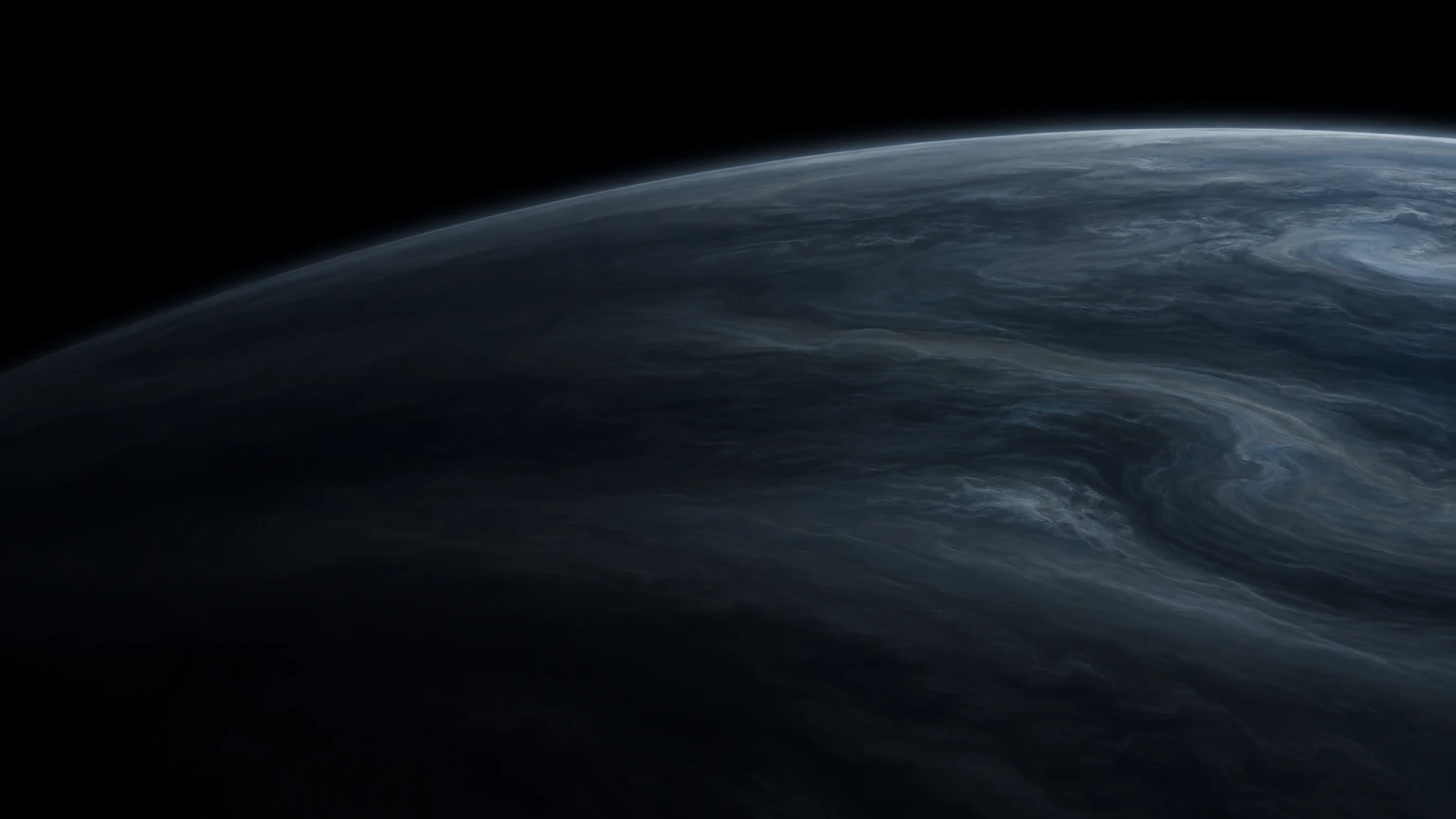
A possible view above WISE 0855’s atmosphere. Haze structure, color and illumination are invented to make an almost lightless object visible. This is not evidence for water-ice clouds or a measured view of its weather.An atmosphere without a sunrise ↗ ARTIST’S IMPRESSION · 3 VIEWS

Diameter comparison ↗

06
≈ 0.1 × Sol
WISE 0855−0714

Instrument detail

Artist’s impression of WISE 0855−0714

Artist’s impression · structure and color are illustrative.

Nearby does not mean easy to see.

WISE 0855 is an isolated substellar object whose faint radiation is studied in the infrared. JWST’s NIRSpec instrument opened a much more detailed window into that light. The result is a spectrum, not a landscape photograph. Our atmospheric scenes make an otherwise almost invisible setting explorable, with lighting deliberately enhanced.

A familiar number in an unfamiliar place.

Its effective temperature falls near temperatures familiar on Earth, but it describes radiation from the whole object. It is not a weather report from a surface. Models fitted to the spectrum and models of long-term evolution give somewhat different estimates, so the profile uses a rounded value rather than false precision.

Water in the light, questions in the clouds.

JWST observations reveal water, methane and ammonia in the atmosphere. Analysis also finds less water higher up, consistent with condensation. Yet that is different from securely identifying water-ice clouds themselves. Molecular absorption tells us what light passed through; it does not automatically provide a picture of cloud cover.

Could something smaller cross its glow?

Researchers have searched an eleven-hour JWST observation for the tiny dimming a transiting moon could produce. That dataset yielded no statistically significant moon transit. It does not prove WISE 0855 has no moons: an orbit must be aligned, a transit must occur during the observation, and the signal must be strong enough.

Between planets and stars.

DIAMETER / SOL≈ 0.10 ×

About 10.0% of our Sun’s diameter.

Circles compare diameter, not mass or luminosity. Approximate Jupiter-scale diameter for orientation, not a directly measured disk. Atmospheric models give different radius estimates; a single precise radius would hide that model dependence.

EFFECTIVE TEMPERATURE

A surprisingly cool neighbor.

  • WISE 0855−0714≈ 280 K
  • Sol≈ 5,770 K

Shared scale: 0–10,000 K. Effective temperature describes total emitted energy per unit surface area; it is not the core temperature. Rounded guide value. Estimates depend on the atmospheric and evolutionary model; a NIRSpec fit gives 285 K, while an evolutionary estimate in the same study is about 20 K lower. This is not a measured temperature at a landing site.

LIFE PHASE

A slow release of internal heat.

  1. NOWUltracool atmosphere
  2. ENERGYInternal warmth
  3. OUTLOOKGradual cooling

A cooling substellar object without sustained core hydrogen fusion. The diagram is not a measured age or a countdown.

Research · size and temperature ↗Research · radius estimates and models ↗
ATMOSPHERE / SPECTRAL EVIDENCE

Molecules detected. Clouds still uncertain.

WATER VAPOR · H₂O
Detected
METHANE · CH₄
Detected
AMMONIA · NH₃
Detected
WATER-ICE CLOUDS
Not securely identified

These labels report spectral evidence, not gas percentages. Abundances vary with height and depend on the atmospheric model.

Research · atmospheric spectrum ↗
LIFE & HUMAN SURVIVAL / GASEOUS ATMOSPHERE
POSSIBILITY FOR LIFEUnknown · temperature is not enough

A familiar temperature range does not establish a habitat. No life or liquid-water environment has been detected. Conditions vary with atmospheric depth, and the presence of water vapor is not evidence of habitability.

WITHOUT PROTECTIONNot survivable

No breathable atmosphere or solid landing surface has been established. This is a gaseous object with pressure changing through its atmosphere; a mild effective temperature does not make unprotected entry survivable.

NASA · stellar structure and evolution ↗
10⁵1000.110⁻⁴10⁻⁷30,00010,0003,0001,000300LUMINOSITY / SOL · BRIGHTER →HOTTER ← EFFECTIVE TEMPERATURE (K) → COOLERSUPERGIANTSGIANTSWHITE DWARFSCOOLING DWARFSMAIN SEQUENCESOLWISE 0855−0714
WISE 0855−0714280 K · ≈ 0.0000000555 × Sol
Sol / reference5,770 K · 1 × Sol

Model-dependent size & temperature estimate. Both axes are logarithmic; equal steps represent equal ratios.

Small points are other worlds in this atlas. The soft band marks the main sequence; region labels are broad guides, not a path through time. The axes extend into the cooler, fainter substellar range. Brown dwarfs cool without sustained core hydrogen fusion.

A slow release of internal heat.

  1. NOWUltracool atmosphere
  2. ENERGYInternal warmth
  3. OUTLOOKGradual cooling

A cooling substellar object without sustained core hydrogen fusion. The diagram is not a measured age or a countdown.

Research ↗

How much energy leaves the star?

≈ 0.0000000555 × Sol

This compares total radiant power across all wavelengths, not just visible light or apparent brightness in our sky. The beams on the dashboard share a linear length scale.

The estimate combines this log’s diameter ratio (0.1 × Sol) and effective temperature (280 K): luminosity scales with radius squared and temperature to the fourth power. It is derived from rounded values, not an independent luminosity measurement.

Approximate Jupiter-scale diameter for orientation, not a directly measured disk. Atmospheric models give different radius estimates; a single precise radius would hide that model dependence.

Rounded guide value. Estimates depend on the atmospheric and evolutionary model; a NIRSpec fit gives 285 K, while an evolutionary estimate in the same study is about 20 K lower. This is not a measured temperature at a landing site.

Swinburne University · Stefan–Boltzmann law ↗

Nearby does not mean easy to see.

WISE 0855 is an isolated substellar object whose faint radiation is studied in the infrared. JWST’s NIRSpec instrument opened a much more detailed window into that light. The result is a spectrum, not a landscape photograph. Our atmospheric scenes make an otherwise almost invisible setting explorable, with lighting deliberately enhanced.

A familiar number in an unfamiliar place.

Its effective temperature falls near temperatures familiar on Earth, but it describes radiation from the whole object. It is not a weather report from a surface. Models fitted to the spectrum and models of long-term evolution give somewhat different estimates, so the profile uses a rounded value rather than false precision.

Water in the light, questions in the clouds.

JWST observations reveal water, methane and ammonia in the atmosphere. Analysis also finds less water higher up, consistent with condensation. Yet that is different from securely identifying water-ice clouds themselves. Molecular absorption tells us what light passed through; it does not automatically provide a picture of cloud cover.

Could something smaller cross its glow?

Researchers have searched an eleven-hour JWST observation for the tiny dimming a transiting moon could produce. That dataset yielded no statistically significant moon transit. It does not prove WISE 0855 has no moons: an orbit must be aligned, a transit must occur during the observation, and the signal must be strong enough.

A possible view above WISE 0855’s atmosphere. Haze structure, color and illumination are invented to make an almost lightless object visible. This is not evidence for water-ice clouds or a measured view of its weather.

An atmosphere without a sunrise

A possible view above WISE 0855’s atmosphere. Haze structure, color and illumination are invented to make an almost lightless object visible. This is not evidence for water-ice clouds or a measured view of its weather.

An imagined passage through atmospheric wisps. Enhanced lighting reveals hypothetical layers rather than the naked-eye appearance of this isolated object. No solid ground, specific cloud species or actual location is represented.

Through imagined layers

An imagined passage through atmospheric wisps. Enhanced lighting reveals hypothetical layers rather than the naked-eye appearance of this isolated object. No solid ground, specific cloud species or actual location is represented.

An imagined atmospheric swirl on WISE 0855−0714, seen from above. Cloud structure and color are hypothetical; enhanced exposure makes the layers visible.

An atmospheric whirl

An imagined atmospheric swirl on WISE 0855−0714, seen from above. Cloud structure and color are hypothetical; enhanced exposure makes the layers visible.

Stellar images are artistic interpretations, not resolved photographs of this star.