LUHMAN 16 / SUBSTELLAR DOSSIER

Luhman 16 A

6.50 light-years from Sol

A nearby brown dwarf, glowing with internal heat beneath a changing veil of clouds.

Artist’s impression of Luhman 16 A
L-type · brown dwarf

Clouds in the warmth of a fading world.

Atmospheric conditions ↗

02
EFFECTIVE TEMPERATURE1,310 K

Warm clouds. Mostly invisible light.

Luhman 16 A1,310 K
Sol5,770 K
Shared scale 0–10,000 K · effective, not core temperature

Evolution ↗

03
CURRENT PHASE

Cooling, rather than burning steadily.

  1. ENERGYStored internal heat
  2. NOWCloudy atmosphere
  3. OUTLOOKCooling and fading
Brown dwarfs cannot sustain core hydrogen fusion like Sol. This describes their gradual cooling, not a stellar giant-stage sequence or a countdown.

Companion system

04
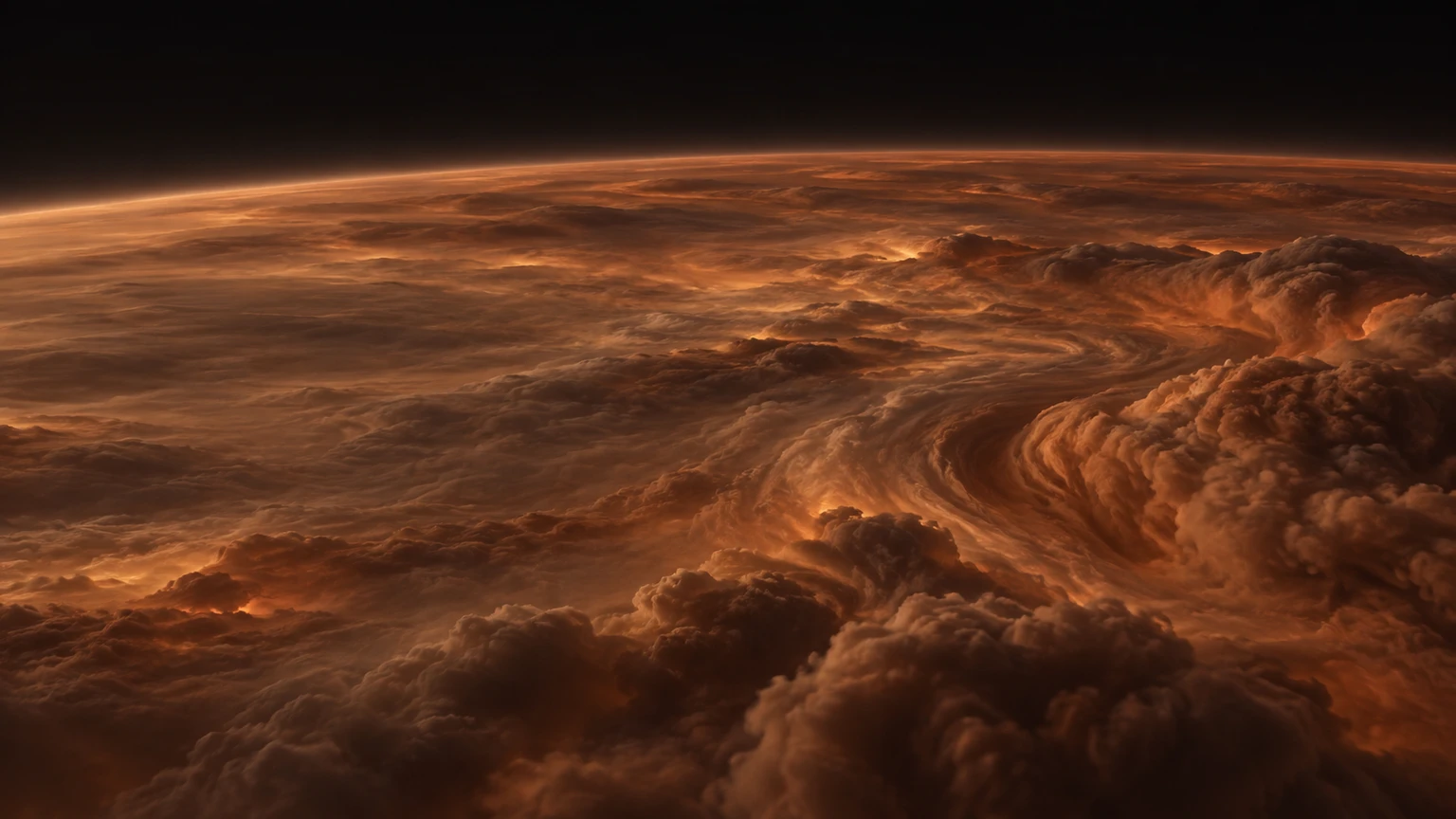
An imagined panorama above A’s condensate clouds. Cloud heights, shapes and colors are not directly mapped. Exposure is enhanced to reveal a warm atmosphere whose radiation emerges mainly in the infrared.Over the cloud deck ↗ ARTIST’S IMPRESSION · 3 VIEWS

Diameter comparison ↗

06
≈ 0.1 × Sol
LUHMAN 16 A

Instrument detail

Artist’s impression of Luhman 16 A

Artist’s impression · structure and color are illustrative.

Too small to shine like Sol.

Luhman 16 A occupies the space between giant planets and hydrogen-fusing stars. It is a brown dwarf: an object without enough mass to sustain the core hydrogen fusion that keeps Sol shining. Yet it is far from cold or dark. Stored internal heat escapes through its atmosphere as it gradually cools. Together with B, it forms one of our nearest systems beyond the Sun.

An atmosphere with mineral weather.

These clouds are not the familiar water clouds of Earth. At brown-dwarf temperatures, refractory material can condense into atmospheric particles. Spectroscopic models investigate which cloud species and vertical structures best reproduce the escaping light. The scene turns that idea into a cloud-filled environment, but its billows are illustrative. Spectra constrain the atmosphere without providing a photograph of each individual cloud.

Brightness depends on where you look.

A and B have similar estimated effective temperatures, but their spectra differ. In some near-infrared windows, B can appear brighter despite being the slightly cooler component in the adopted estimates. Cloud opacity helps determine how deeply we see into each atmosphere. Comparing the pair is useful because shared surroundings do not force their cloud decks to behave identically.

A long release of stored warmth.

A brown dwarf does not settle into the same sustained hydrogen-burning chapter as a main-sequence star. Its energy budget instead follows gradual cooling and contraction. The atmosphere changes along with that cooling, altering the wavelengths that escape and the appearance of its clouds. There is no precise end date in the graphic above: it captures the direction of change, not a measured timetable for Luhman 16 A.

Between planets and stars.

DIAMETER / SOL≈ 0.10 ×

About 10.0% of our Sun’s diameter.

Circles compare diameter, not mass or luminosity. Illustrative estimate: about one Jupiter radius, or roughly 0.10 solar diameters. A 2025 atmosphere study adopts 1 ± 0.1 Jupiter radii for both components as a model prior, not a direct radius measurement.

EFFECTIVE TEMPERATURE

Warm clouds. Mostly invisible light.

  • Luhman 16 A≈ 1,310 K
  • Sol≈ 5,770 K

Shared scale: 0–10,000 K. Effective temperature describes total emitted energy per unit surface area; it is not the core temperature. Bolometric estimate from Faherty et al. (2014): 1,310 ± 30 K. This is an effective temperature, not a uniform cloud-layer temperature.

LIFE PHASE

Cooling, rather than burning steadily.

  1. ENERGYStored internal heat
  2. NOWCloudy atmosphere
  3. OUTLOOKCooling and fading

Brown dwarfs cannot sustain core hydrogen fusion like Sol. This describes their gradual cooling, not a stellar giant-stage sequence or a countdown.

Research · size and temperature ↗Research · radius estimates and models ↗
LIFE & HUMAN SURVIVAL / CLOUD LAYERS
POSSIBILITY FOR LIFEIncompatible with known life

The hot cloud layers depicted here are incompatible with known life. This describes these atmospheric layers, not every conceivable environment around a brown dwarf.

WITHOUT PROTECTIONNot survivable

No breathable air or solid ground. Intense heat and increasing pressure make descent into these cloud layers unsurvivable without protection; there is no single meaningful survival timer.

NASA · stellar structure and evolution ↗

Cooling, rather than burning steadily.

  1. ENERGYStored internal heat
  2. NOWCloudy atmosphere
  3. OUTLOOKCooling and fading

Brown dwarfs cannot sustain core hydrogen fusion like Sol. This describes their gradual cooling, not a stellar giant-stage sequence or a countdown.

Research ↗

A brown dwarf does not settle into the same sustained hydrogen-burning chapter as a main-sequence star. Its energy budget instead follows gradual cooling and contraction. The atmosphere changes along with that cooling, altering the wavelengths that escape and the appearance of its clouds. There is no precise end date in the graphic above: it captures the direction of change, not a measured timetable for Luhman 16 A.

How much energy leaves the star?

≈ 0.0000266 × Sol

This compares total radiant power across all wavelengths, not just visible light or apparent brightness in our sky. The beams on the dashboard share a linear length scale.

The estimate combines this log’s diameter ratio (0.1 × Sol) and effective temperature (1,310 K): luminosity scales with radius squared and temperature to the fourth power. It is derived from rounded values, not an independent luminosity measurement.

Illustrative estimate: about one Jupiter radius, or roughly 0.10 solar diameters. A 2025 atmosphere study adopts 1 ± 0.1 Jupiter radii for both components as a model prior, not a direct radius measurement.

Bolometric estimate from Faherty et al. (2014): 1,310 ± 30 K. This is an effective temperature, not a uniform cloud-layer temperature.

Swinburne University · Stefan–Boltzmann law ↗

Too small to shine like Sol.

Luhman 16 A occupies the space between giant planets and hydrogen-fusing stars. It is a brown dwarf: an object without enough mass to sustain the core hydrogen fusion that keeps Sol shining. Yet it is far from cold or dark. Stored internal heat escapes through its atmosphere as it gradually cools. Together with B, it forms one of our nearest systems beyond the Sun.

An atmosphere with mineral weather.

These clouds are not the familiar water clouds of Earth. At brown-dwarf temperatures, refractory material can condense into atmospheric particles. Spectroscopic models investigate which cloud species and vertical structures best reproduce the escaping light. The scene turns that idea into a cloud-filled environment, but its billows are illustrative. Spectra constrain the atmosphere without providing a photograph of each individual cloud.

Brightness depends on where you look.

A and B have similar estimated effective temperatures, but their spectra differ. In some near-infrared windows, B can appear brighter despite being the slightly cooler component in the adopted estimates. Cloud opacity helps determine how deeply we see into each atmosphere. Comparing the pair is useful because shared surroundings do not force their cloud decks to behave identically.

A long release of stored warmth.

A brown dwarf does not settle into the same sustained hydrogen-burning chapter as a main-sequence star. Its energy budget instead follows gradual cooling and contraction. The atmosphere changes along with that cooling, altering the wavelengths that escape and the appearance of its clouds. There is no precise end date in the graphic above: it captures the direction of change, not a measured timetable for Luhman 16 A.

An imagined panorama above A’s condensate clouds. Cloud heights, shapes and colors are not directly mapped. Exposure is enhanced to reveal a warm atmosphere whose radiation emerges mainly in the infrared.

Over the cloud deck

An imagined panorama above A’s condensate clouds. Cloud heights, shapes and colors are not directly mapped. Exposure is enhanced to reveal a warm atmosphere whose radiation emerges mainly in the infrared.

An imagined descent between cloud layers, illuminated by heat from deeper gas. The composition is inspired by brown-dwarf atmosphere studies; this particular weather and viewing altitude are fictional. There is no solid landscape here.

Inside the haze

An imagined descent between cloud layers, illuminated by heat from deeper gas. The composition is inspired by brown-dwarf atmosphere studies; this particular weather and viewing altitude are fictional. There is no solid landscape here.

An imagined atmospheric swirl on Luhman 16 A, seen from above. Cloud structure and color are hypothetical; enhanced exposure makes the layers visible.

An atmospheric whirl

An imagined atmospheric swirl on Luhman 16 A, seen from above. Cloud structure and color are hypothetical; enhanced exposure makes the layers visible.

Stellar images are artistic interpretations, not resolved photographs of this star.