SATURN SYSTEM / SATELLITE DOSSIER

Mimas

Mimas is Saturn’s small, cratered inner moon, with orbital evidence for an ocean beneath its icy shell.

DIAMETER / EARTH0.03×
EARTHMIMAS
ATMOSPHERE
No substantial atmosphere detectedEffectively airless
SURFACE TEMPERATURE
Deeply cold icy surface
SURFACE PRESSURE
Effectively airless
HABITABILITYOcean inferred
UNPROTECTED HUMANSNot survivable

Interior ↗

03
Mimas interiorMimas's internal structure is unresolved.Unresolved

Moon system ↗

04
Saturn moon orbitsSelected moons, ordered outward. Orbit sizes and positions are schematic; relative periods are preserved.SATURNPANDAPHNISATLASPROMETHEUSPANDORAEPIMETHEUSJANUSMIMASENCELADUSTETHYSTELESTOCALYPSODIONEHELENERHEATITANHYPERIONIAPETUSPHOEBE
MIMAS

Instrument detail

THE SKY FROM MIMAS

Saturn, in perspective.

SHARED ANGULAR SCALE
Saturn compared with Luna in Earth's skyAt semimajor-axis distance, Saturn spans approximately 37.84 degrees, 73.07 times the apparent diameter of Luna at its mean distance from Earth. Both disks share one angular scale.SATURNOUR MOON≈ 0.52°
Idealized size study · full disks · decorative lighting · rings excluded
ANGULAR DIAMETER
37.84°
OUR MOON'S APPARENT DIAMETER
73.07 ×
CENTER-TO-CENTER DISTANCE
186,000 km

The viewpoint is on Mimas’s nominal spherical surface, directly facing Saturn. The reference is Luna seen from Earth’s center at its mean distance. The reference distance is the orbit’s semimajor axis. Rounded body diameters and orbital elements set the disk sizes; terrain, phases, rings and the actual sky position are not modeled.

Explore Saturn ↗
Mimas orbitElliptical orbit viewed along the orbital axis, relative to Saturn. Motion is accelerated, not a live position. Distances are center to center.SATURNMIMAS≈ 186,000 km
ONE ORBIT0.9424 Earth days around Saturn
Closest to Saturn
182,280 km
Farthest from Saturn
189,720 km

Mimas circles Saturn. Distances are measured between the centers of the two bodies.

Mimas rotation compared with EarthThe markers follow equal elapsed time on both worlds. Equal elapsed time and sidereal rotation rates. Polar schematic: sizes, axial tilt and seasons are not shown. Illumination uses a circular mean orbit, not a live sky prediction.SAME ELAPSED TIME · POLAR SCHEMATICMIMAS22.6 hoursSIDEREAL ROTATIONPrograde spinEARTH23.9 hoursSIDEREAL ROTATION≈ 24 h · solar day
Marked longitude · equal time on both worlds
ONE SIDEREAL ROTATION22.6 hours

Turning through space

Mimas turns once in each orbit, so roughly the same hemisphere faces Saturn. The spin period is 0.9424 Earth days; this is not the interval between sunrises.

0 Earth hoursShared clock

Spin comparison only; no solar day is inferred. Sizes and starting longitudes are schematic, not live positions.

Satellite atlasMoons
Saturn moon orbitsSelected moons, ordered outward. Orbit sizes and positions are schematic; relative periods are preserved.SATURNPANDAPHNISATLASPROMETHEUSPANDORAEPIMETHEUSJANUSMIMASENCELADUSTETHYSTELESTOCALYPSODIONEHELENERHEATITANHYPERIONIAPETUSPHOEBE
FEATURED MOONS19
  1. 01Pan ↗0.575051 days
  2. 02Daphnis ↗0.59408 days
  3. 03Atlas ↗0.604602 days
  4. 04Prometheus ↗0.615878 days
  5. 05Pandora ↗0.631369 days
  6. 06Epimetheus ↗0.697012 days
  7. 07Janus ↗0.697353 days
  8. 08Mimas0.9424 days
  9. 09Enceladus ↗1.37 days
  10. 10Tethys ↗1.8878 days
  11. 11Telesto ↗1.887802 days
  12. 12Calypso ↗1.887803 days
  13. 13Dione ↗2.7369 days
  14. 14Helene ↗2.736916 days
  15. 15Rhea ↗4.5175 days
  16. 16Titan ↗15.95 days
  17. 17Hyperion ↗21.2767 days
  18. 18Iapetus ↗79.331 days
  19. 19Phoebe ↗550.3039 days

Saturn’s moon system includes hazy Titan and icy Enceladus. Methane lakes on Titan and water jets from Enceladus make these worlds compelling destinations in their own right. Saturn itself takes about 29.4 Earth years to complete an orbit.

Janus and Epimetheus share nearly the same orbital distance and exchange inner and outer positions. Their separated tracks here are schematic; this view does not simulate that exchange. Telesto and Calypso share Tethys’s orbit, roughly 60 degrees ahead and behind. Their tracks and positions are also separated schematically here; co-orbital libration is not simulated. Helene similarly shares Dione’s orbit in the leading region.

Mimas gravityEqual launches at 2 m/s; shared metre scale; air resistance ignored.0 m20 m40 m60 mEARTH9.80 m/s²MIMAS0.06 m/s²
MIMAS / EARTH GRAVITY0.0065 ×

Same push, different gravity

Both balls launch at 2 m/s, using the same height and time scales. Weaker gravity gives a higher jump and a longer time in the air. Air resistance is ignored. This idealized comparison uses constant spherical gravity GM/r²; local terrain, tides and rotation are excluded. Playback runs 6× faster for both balls.

Earth · height / airtime
0.20 m / 0.41 s
Mimas · height / airtime
31.38 m / 62.77 s
Mimas interiorMimas's internal structure is unresolved.Unresolved

Beyond the surface

A 2024 analysis of Cassini orbital data supports a global ocean beneath roughly 20–30 kilometers of ice. The inferred structure is model-dependent; its boundaries have not been directly mapped and habitability remains unknown.

    Artist’s impression of Mimas

    One impact defines a small world.

    Mimas is the innermost of Saturn’s major moons. Its slightly elongated, ice-rich body is crowded with impact craters. Herschel, about 130 kilometers across, cuts into a world only about 396 kilometers in mean diameter; a prominent central peak rises within its bowl.

    Old scars survive in the ice.

    Smaller craters cover much of the surrounding terrain. The enormous Herschel impact may also have fractured the opposite side of Mimas. Its battered exterior offers little obvious sign of the active resurfacing seen on neighboring Enceladus, making the evidence from its interior especially surprising.

    An ocean revealed through motion.

    A 2024 analysis of Cassini observations found that Mimas’s orbital evolution is best explained by a global ocean beneath roughly 20–30 kilometers of ice. The study inferred a geologically young ocean, less than about 25 million years old. This is evidence from dynamics and modeling, not a direct view of liquid water; habitability remains unknown.

    Around Saturn in less than a day.

    Mimas completes an orbit in about 0.9424 Earth days at a mean orbital scale of 186,000 kilometers from Saturn’s center. Its slightly eccentric path varies the gravitational pull it experiences. The moon rotates synchronously, keeping approximately the same face toward Saturn.
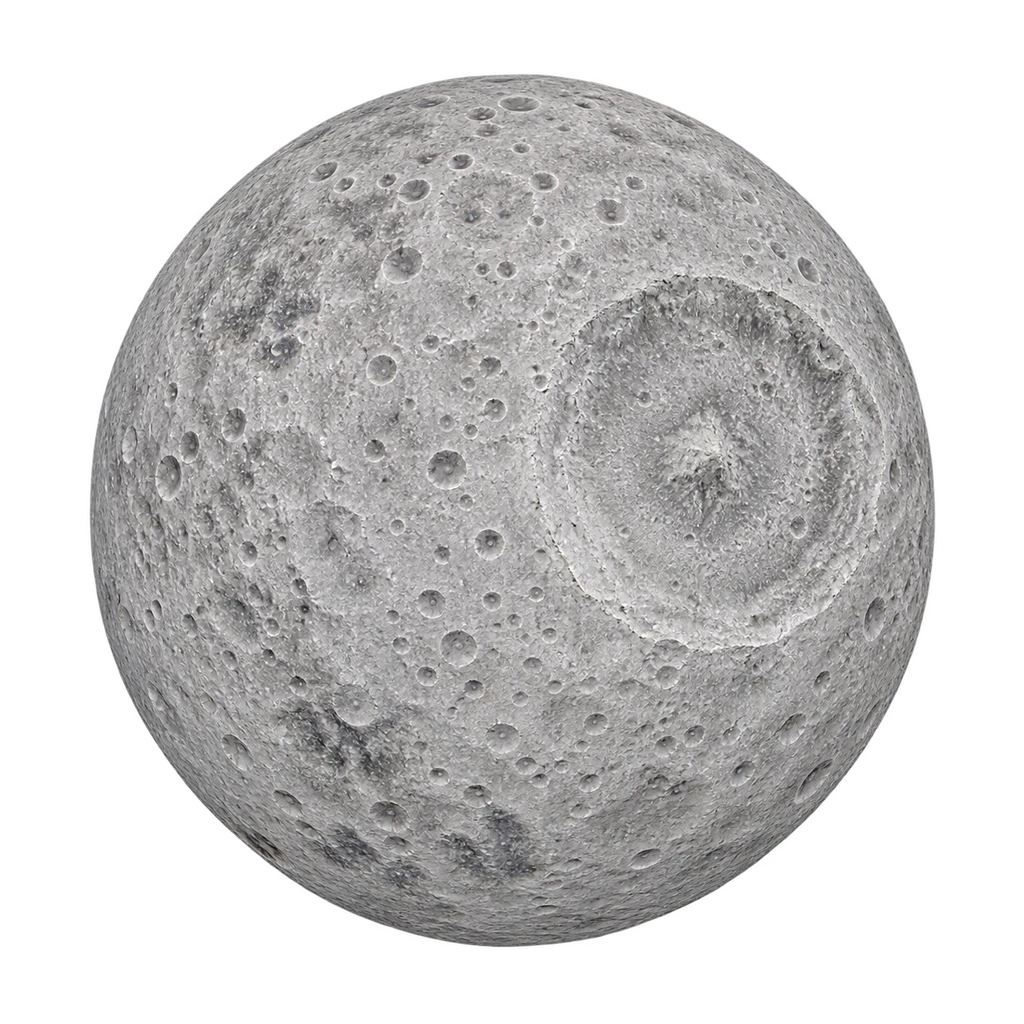
    DIAMETER / EARTH0.03×
    EARTHMIMAS
    EARTH
    12,742 km
    MIMAS
    396.4 km
    Mean diameters · circles share one scale
    ATMOSPHERE
    No substantial atmosphere detectedEffectively airless

    Mimas has no substantial atmosphere to provide surface pressure or breathable air.

    SURFACE TEMPERATURE
    Deeply cold icy surface
    SURFACE PRESSURE
    Effectively airless
    HABITABILITYOcean inferred

    Orbital evidence supports a buried ocean, but its chemistry and habitability remain uncertain. No life has been detected.

    UNPROTECTED HUMANSNot survivable

    The exposed surface requires oxygen, pressure protection and thermal control.

    Planet and landscape images are artistic interpretations.

    • NASA ↗
      • Classification and orbital data
      • Size, physical data and atmospheric constraints
      • Landscape
      • History
    • NASA ↗
      • Parent-body diameter for the angular sky comparison
    • NASA / JPL ↗
      • GM and mean radius; spherical gravity estimate GM/r²
    • NASA / JPL ↗
      • Mean orbital dimensions; distances from parent center
      • Orbit
    • NASA ↗
      • Rotation and internal structure constraints
      • Natural conditions and human survival
      • Interior
    An artist’s reconstruction inspired by Herschel crater. The terraced walls, distant central peak and ground-level viewpoint are imagined, not a surveyed landing site.

    Inside a giant impact scar

    An artist’s reconstruction inspired by Herschel crater. The terraced walls, distant central peak and ground-level viewpoint are imagined, not a surveyed landing site.

    An imagined view from Mimas’s ancient icy terrain. Local craters, illumination and Saturn’s position are artistic reconstructions; the rings are seen nearly edge-on.

    Saturn over the crater fields

    An imagined view from Mimas’s ancient icy terrain. Local craters, illumination and Saturn’s position are artistic reconstructions; the rings are seen nearly edge-on.

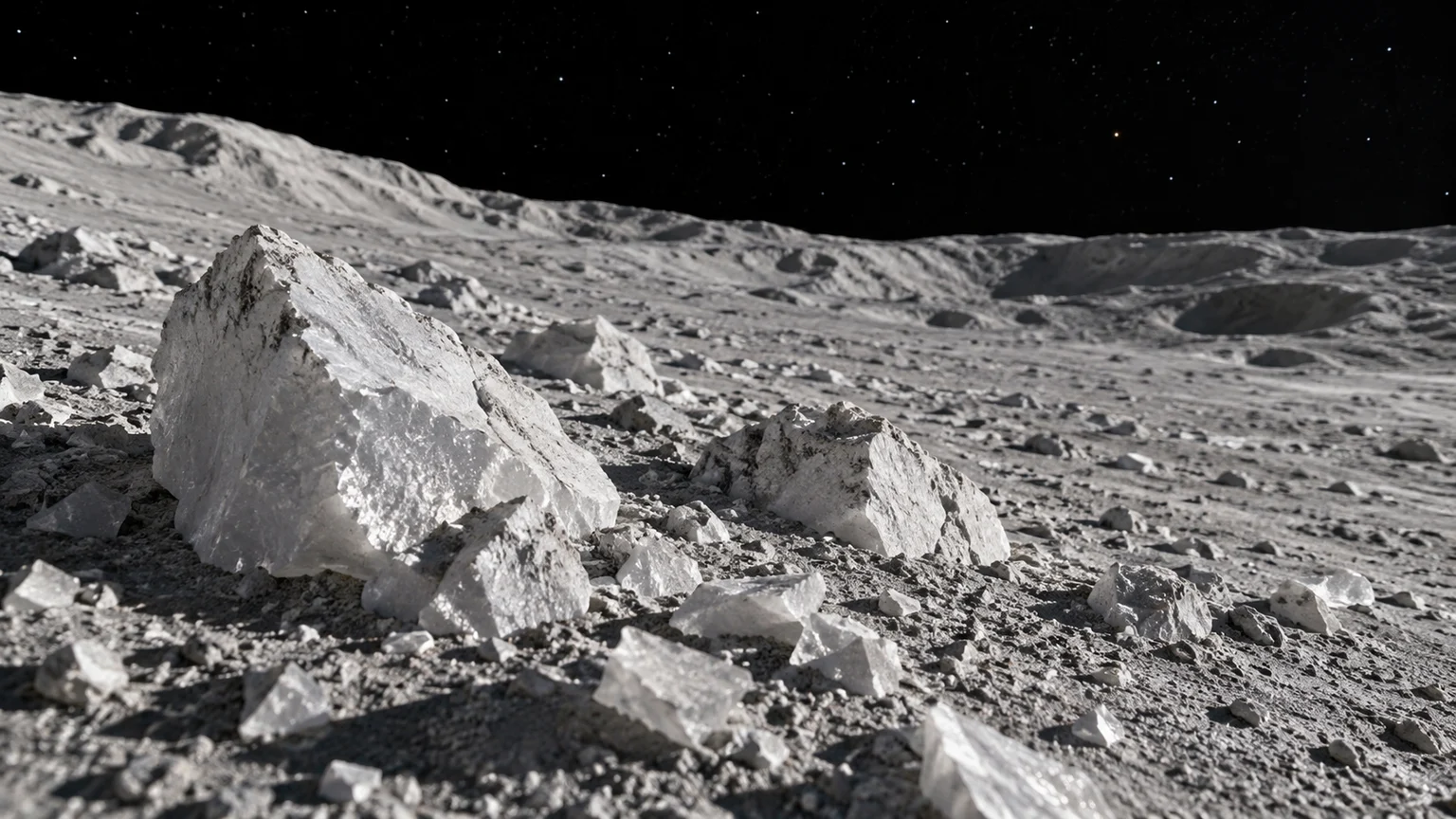
    Angular pale ice-rich impact debris casting crisp shadows on gray powdery regolith. An artistic reconstruction of Mimas; local detail, lighting and viewpoint are imagined.

    Ice fragments under hard light

    Angular pale ice-rich impact debris casting crisp shadows on gray powdery regolith. An artistic reconstruction of Mimas; local detail, lighting and viewpoint are imagined.