SOL SYSTEM / PLANETARY DOSSIER

Jupiter

Jupiter is the largest planet in the solar system, a gas giant with swirling cloud bands.

Artist’s impression of Jupiter

Beyond the cloud bands, four very different moons invite you to look closer.

DIAMETER / EARTH10.96×
EARTHJUPITER
ATMOSPHERE / COMPOSITION
H₂Hydrogen≈ 89.8%
HeHelium≈ 10.2%
TEMPERATURE / 1 BAR
≈ −108°C at 1 bar
PRESSURE
Rises rapidly with depth
HABITABILITYNo known habitat
UNPROTECTED HUMANSNot survivable

Interior ↗

03
Jupiter interiorSimplified interior model. Layer thicknesses and boundaries are illustrative, not measured to scale.AtmosphereLiquid hydrogenMetallic hydrogenDeep core

Moons Orbit ↗

04
Jupiter moon orbitsSelected moons, ordered outward. Orbit sizes and positions are schematic; relative periods are preserved.JUPITERMETISADRASTEAAMALTHEATHEBEIOEUROPAGANYMEDECALLISTOLEDAHIMALIALYSITHEAELARA
JUPITER

Instrument detail

Jupiter orbitElliptical orbit viewed along the orbital axis, relative to Sun. Motion is accelerated, not a live position. Distances are center to center.SUNJUPITER5.46 AU4.95 AU
ONE ORBIT11.86 Earth years
Closest to the Sun
4.95 AU
Farthest from the Sun
5.46 AU

The Sun sits at a focus of the orbit. Jupiter moves faster near the Sun and more slowly farther away.

Jupiter rotationEqual elapsed time, with sidereal rotation rates and directions. Axial tilt and relative sizes are not shown.JUPITER9.9 hoursEARTH23.9 hours
ONE ROTATION9.9 hours

Turning through space

Jupiter turns in roughly ten hours. Different cloud bands move at different speeds; the value represents the planet’s bulk rotation.

Satellite atlasMoons
Jupiter moon orbitsSelected moons, ordered outward. Orbit sizes and positions are schematic; relative periods are preserved.JUPITERMETISADRASTEAAMALTHEATHEBEIOEUROPAGANYMEDECALLISTOLEDAHIMALIALYSITHEAELARA
FEATURED MOONS12
  1. 01Metis ↗0.294779 days
  2. 02Adrastea ↗0.29826 days
  3. 03Amalthea ↗0.499918 days
  4. 04Thebe ↗0.676105 days
  5. 05Io ↗1.77 days
  6. 06Europa ↗3.55 days
  7. 07Ganymede ↗7.15 days
  8. 08Callisto ↗16.69 days
  9. 09Leda ↗240.3264 days
  10. 10Himalia ↗249.909 days
  11. 11Lysithea ↗258.5035 days
  12. 12Elara ↗258.8861 days

Io is volcanic, while the other Galilean moons are icy worlds that may conceal oceans. Each has its own environment; Jupiter’s atmospheric conditions do not describe its moons.

Jupiter gravityEqual launches at 2 m/s; shared metre scale; air resistance ignored. Hypothetical comparison at the 1-bar level, not a solid surface.0.0 m0.1 m0.2 m0.3 mEARTH9.8 m/s²JUPITER23.1 m/s²1 BAR
JUPITER / EARTH GRAVITY2.36 ×

Same push, different gravity

Both balls launch at 2 m/s, using the same height and time scales. This is a hypothetical comparison at the 1-bar atmospheric level; there is no solid ground. Air resistance is ignored.

Earth · height / airtime
0.20 m / 0.41 s
Jupiter · height / airtime
0.09 m / 0.17 s
Jupiter interiorSimplified interior model. Layer thicknesses and boundaries are illustrative, not measured to scale.01020304
  1. 01

    Atmosphere

    Hydrogen and helium dominate the outer envelope. There is no solid surface.

  2. 02

    Liquid hydrogen

    Increasing pressure gradually compresses hydrogen into a dense fluid.

  3. 03

    Metallic hydrogen

    At greater depths, hydrogen becomes electrically conducting.

  4. 04

    Deep core

    Juno measurements suggest an extended, dilute core, mixed with the surrounding material rather than separated by a sharp edge.

Simplified interior model · layer thicknesses are illustrative.

Artist’s impression of Jupiter

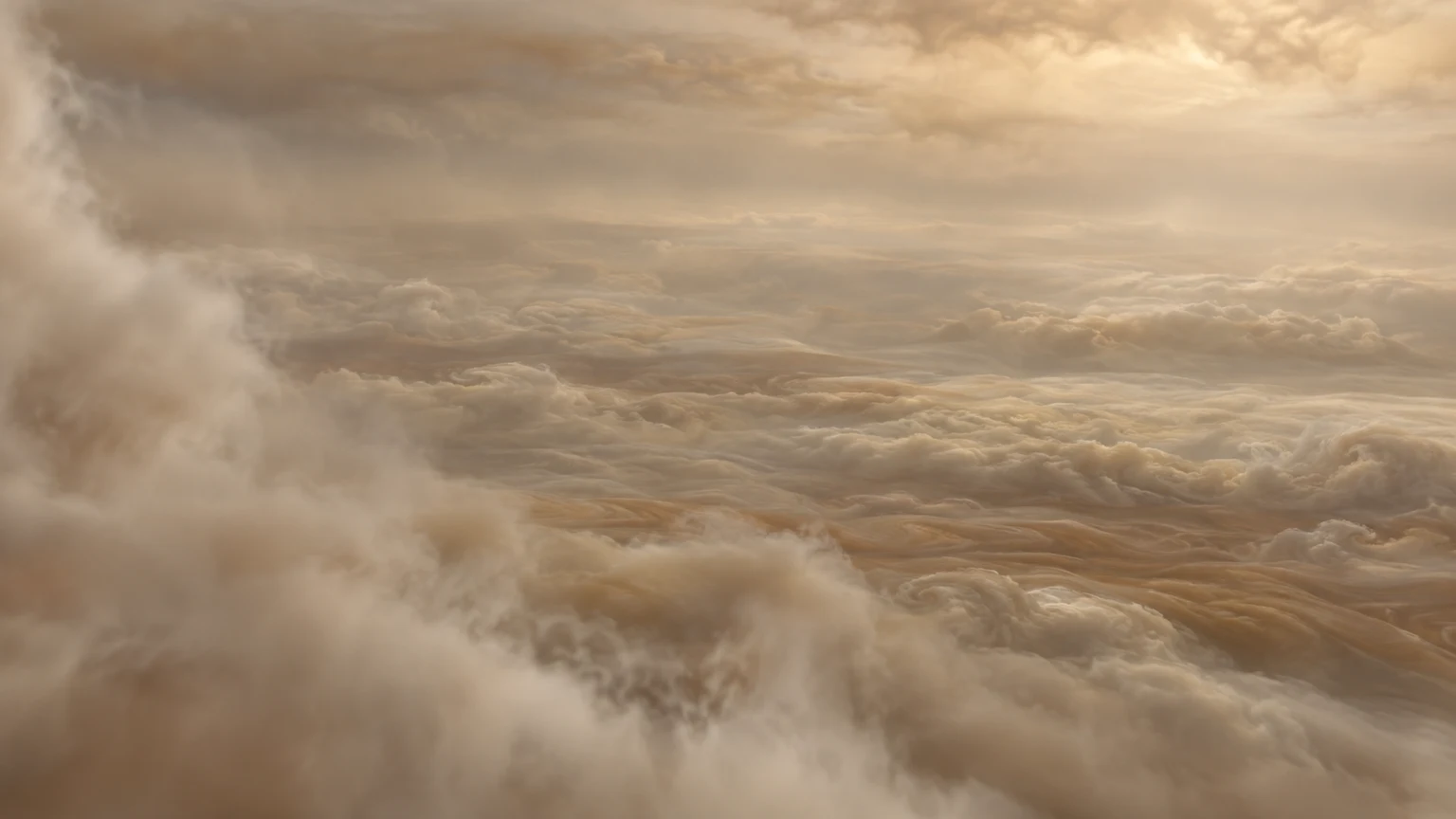
There is no ground here.

Jupiter is made mostly of hydrogen and helium. Its cloud bands and large storms sit above an atmosphere that becomes denser with depth, with no solid surface to land on.

Into an ocean of gas.

Pressure and temperature increase deeper in the atmosphere. The cloud formations are atmospheric structures, not mountains or solid terrain.

A system within a system.

Jupiter’s gravity holds a large family of moons. The four largest—Io, Europa, Ganymede and Callisto—are known as the Galilean moons.

Four very different destinations.

Io is volcanic, while the other Galilean moons are icy worlds that may conceal oceans. Each has its own environment; Jupiter’s atmospheric conditions do not describe its moons.

DIAMETER / EARTH10.96×
EARTHJUPITER
EARTH
12,756 km
JUPITER
139,822 km
mean planet diameter / equatorial Earth diameter · rings excluded
ATMOSPHERE / COMPOSITION
H₂Hydrogen≈ 89.8%
HeHelium≈ 10.2%

Approximate major-gas volume fractions. Methane, ammonia and water occur in smaller amounts and vary with depth. Rounded values and measurement uncertainty mean these bars are a summary, not a complete chemical inventory.

TEMPERATURE / 1 BAR
≈ −108°C at 1 bar
PRESSURE
Rises rapidly with depth
HABITABILITYNo known habitat

No life has been detected on Jupiter. Its changing temperatures, pressures and atmospheric chemistry provide no established habitat for known life. The possible oceans of some moons are separate environments and do not make Jupiter itself habitable.

UNPROTECTED HUMANSNot survivable

There is no breathable air or solid surface to stand on. Even where pressure resembles Earth’s, the air is extremely cold and oxygen-poor; deeper layers become much hotter and denser.

Planet and landscape images are artistic interpretations.

  • NASA ↗
    • Classification and orbital data
    • Simplified interior model
    • Natural conditions and human survival
    • Overview
    • Atmosphere
    • Gravity
    • Moons
  • NASA ↗
    • Rotation, gravity and orbital distances
  • NASA ↗
    • Gravity reference level and diagram definitions
  • NASA / JPL ↗
    • Satellite orbital periods
  • NASA ↗
    • Size, physical data and atmospheric constraints
An orbital reconstruction of Jupiter’s cream and brown cloud bands. Fine weather patterns are imagined, not a specific spacecraft observation.

Above the cloud belts

An orbital reconstruction of Jupiter’s cream and brown cloud bands. Fine weather patterns are imagined, not a specific spacecraft observation.

An imagined viewpoint among Jupiter’s upper cloud layers. Muted cream and tan clouds fade into haze; altitude, lighting and small-scale cloud forms are interpretive. There is no solid ground.

Inside the cloudscape

An imagined viewpoint among Jupiter’s upper cloud layers. Muted cream and tan clouds fade into haze; altitude, lighting and small-scale cloud forms are interpretive. There is no solid ground.

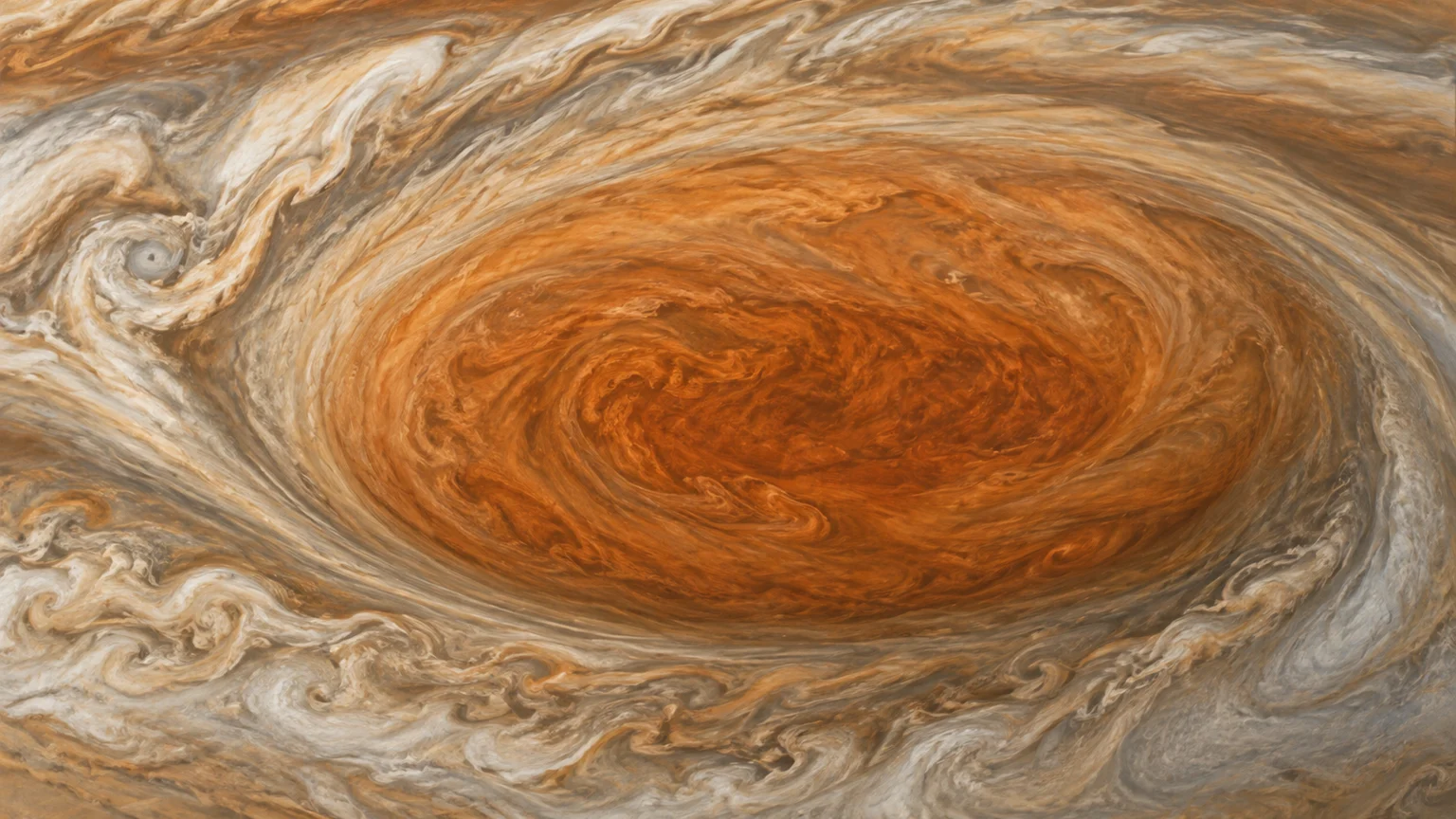
A large oval rust-colored atmospheric vortex with curved cream filaments wrapping around it. An artistic reconstruction of Jupiter; local detail, lighting and viewpoint are imagined.

A storm seen from above

A large oval rust-colored atmospheric vortex with curved cream filaments wrapping around it. An artistic reconstruction of Jupiter; local detail, lighting and viewpoint are imagined.

Open moon atlas ↗