A year before two weeks have passed.
Proxima b completes an orbit in about eleven Earth days. It travels much closer to its star than Earth does to Sol, but its host is also far fainter. Distance from a star only tells part of a climate story: the star’s energy output matters too. The familiar phrase “habitable zone” describes possible heating conditions, not a discovery of a second Earth.
We know the tug, not the terrain.
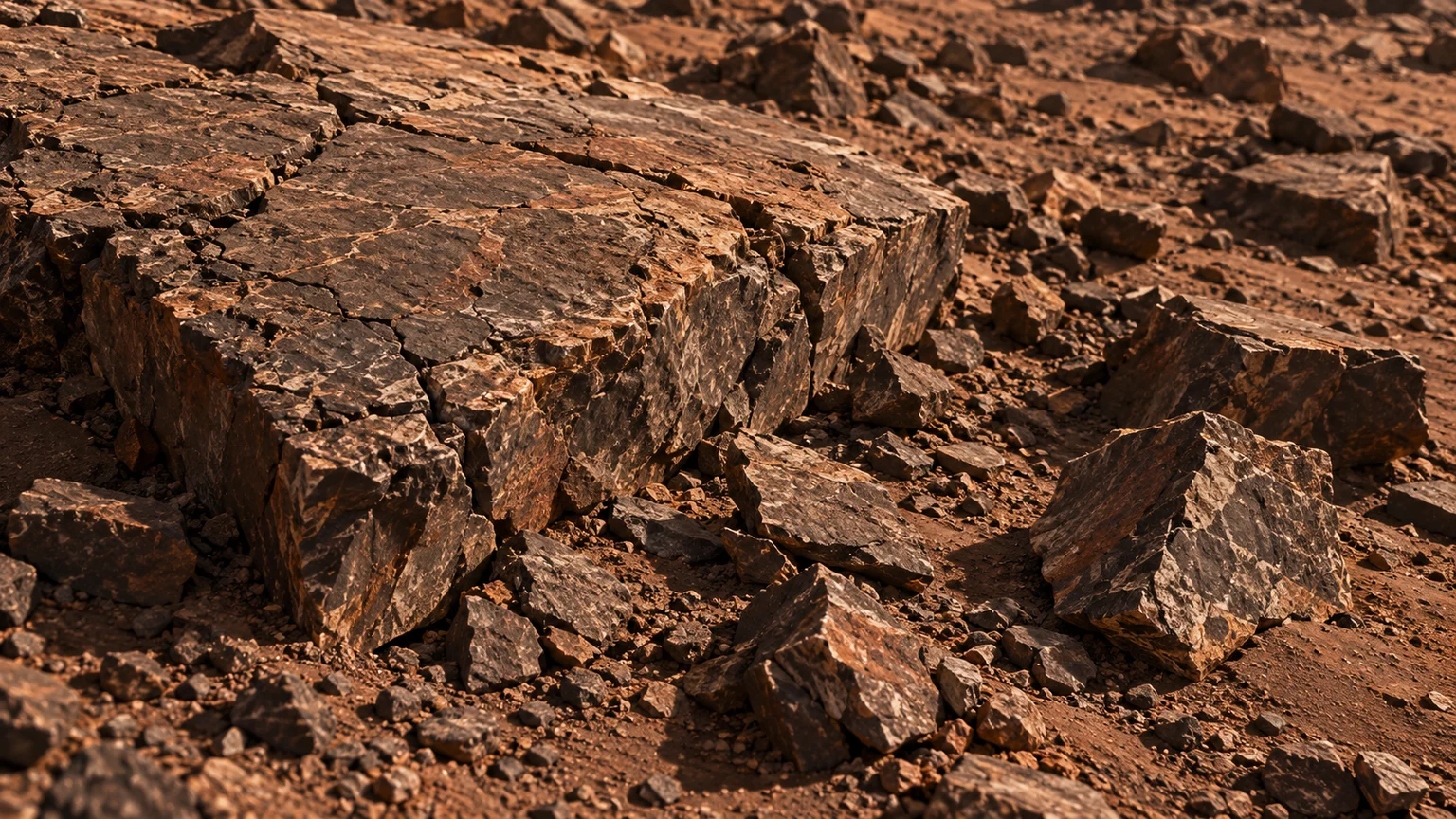
The planet reveals itself through a repeating shift in Proxima’s light as the star moves toward and away from us. That motion constrains the orbit and a minimum mass. It does not reveal the planet’s diameter, mountains or oceans. Even an Earth-like mass would allow different interiors and surface conditions. The landscapes here explore one possible rocky scenario rather than filling those unknowns with facts.
The missing layer changes everything.
An atmosphere could move heat, alter surface temperatures and shield the ground from some radiation. We do not know whether Proxima b has one. Models that placed an Earth-like atmosphere in this orbit found that the host star could drive rapid atmospheric escape. That result describes a scenario, not a measurement proving that the real planet has lost all its air.
An invitation to investigate.
Proxima b is compelling because it is nearby and receives a potentially temperate amount of starlight. Neither fact tells us whether liquid water is present, much less living organisms. Its environment depends on atmospheric history, composition and its active host. Until those questions can be answered, “unknown” is the useful conclusion: there is a world here to study, not yet a place we can call habitable.