EPSILON ERIDANI / STELLAR DOSSIER

Epsilon Eridani

10.50 light-years from Sol

Warm stellar light, a giant planet and dusty remnants of a planetary system.
Stellar conditions ↗

02
EFFECTIVE TEMPERATURE5,039 K

A gentler stellar color.

Epsilon Eridani5,039 K
Sol5,770 K
Shared scale 0–10,000 K · effective, not core temperature

Evolution ↗

03
H–R MAPBRIGHTER ↑
SOLHEREHOTTERCOOLER →
CURRENT PHASE

A working stellar engine.

  1. NOWHydrogen fusion
  2. LATERGiant phase
  3. REMNANTWhite dwarf
An evolutionary sequence, not a time scale or an estimate of remaining lifetime.
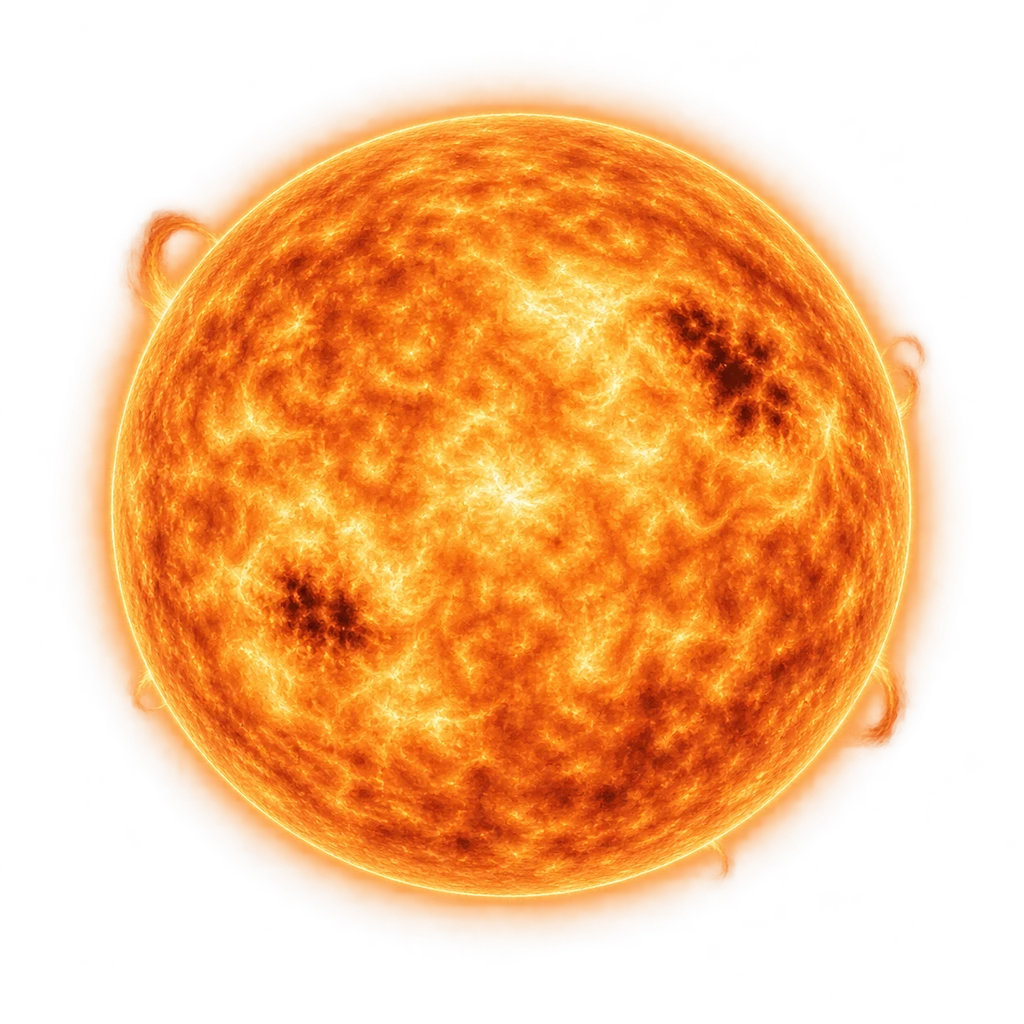
An imagined close view of Epsilon Eridani’s photosphere. Granulation and magnetic patches borrow from solar physics; their locations are invented. Reduced exposure and warm filtered color make the luminous gas visible.Across the golden glow ↗ ARTIST’S IMPRESSION · 3 VIEWS

Diameter comparison ↗

06
0.74 × Sol
EPSILON ERIDANI

Instrument detail

Artist’s impression of Epsilon Eridani

Artist’s impression · structure and color are illustrative.

Familiar, but not a twin.

Epsilon Eridani is smaller and cooler than Sol. Interferometry measures its apparent diameter by combining light from separated telescopes; distance then turns that tiny angle into a physical size. The resulting radius is about three quarters of the Sun’s. It emits roughly a third as much total energy, so a planet at the same orbital distance would receive less starlight than it would here.

The horizon is made of gas.

The star is in its main-sequence chapter, powered by hydrogen fusion deep inside. Its visible boundary is a photosphere: a layer where light escapes, rather than ground. Our golden panorama imagines rising and sinking gas. Magnetic fields can shape plasma above such layers, inspiring the arch in the second scene without establishing that particular feature on this star.

Dust remembers the building process.

Infrared observations reveal dust around Epsilon Eridani. SOFIA measurements helped distinguish warm material in belts from a broad, continuous distribution. Such debris gives astronomers clues about the system’s architecture and the smaller bodies feeding it. A dusty belt is not a photograph of individual asteroids, nor proof of another planet hiding inside it.

A giant moves the star.

Planet b makes a slow circuit around Epsilon Eridani. Its gravitational pull moves the star both along our line of sight and across the sky. Combining those motions lets astronomers constrain the orbital tilt and the planet’s true mass. Follow the companion above to leave the stellar photosphere behind and explore an imagined giant-planet atmosphere.

A star in perspective.

DIAMETER / SOL0.74 ×

About 74.0% of our Sun’s diameter.

Circles compare diameter, not mass or luminosity. Radius: 0.74 ± 0.01 solar radii, Baines & Armstrong (2012), Table 3. Diameter has the same relative ratio.

EFFECTIVE TEMPERATURE

A gentler stellar color.

  • Epsilon Eridani≈ 5,039 K
  • Sol≈ 5,770 K

Shared scale: 0–10,000 K. Effective temperature describes total emitted energy per unit surface area; it is not the core temperature. Effective temperature: 5,039 ± 126 K from the same interferometric study. This describes the photosphere, not the core.

LIFE PHASE

A working stellar engine.

  1. NOWHydrogen fusion
  2. LATERGiant phase
  3. REMNANTWhite dwarf

An evolutionary sequence, not a time scale or an estimate of remaining lifetime.

Research · size and temperature ↗
LIFE & HUMAN SURVIVAL / THE STAR ITSELF
POSSIBILITY FOR LIFEIncompatible with known life

The star’s hot gaseous layers cannot provide the cool, stable environment required by life as we know it. Conditions on any orbiting worlds are a separate question.

WITHOUT PROTECTIONNot survivable

No breathable air or solid ground. Extreme heat and radiation make a close encounter lethal; a meaningful survival timer depends on where you are.

NASA · stellar structure and evolution ↗
10⁵1,000100.10.00110⁻⁵30,00010,0005,0002,500LUMINOSITY / SOL · BRIGHTER →HOTTER ← EFFECTIVE TEMPERATURE (K) → COOLERSUPERGIANTSGIANTSWHITE DWARFSMAIN SEQUENCESOLEpsilon Eridani
Epsilon Eridani5,039 K · ≈ 0.319 × Sol
Sol / reference5,770 K · 1 × Sol

Estimated from size & temperature. Both axes are logarithmic; equal steps represent equal ratios.

Small points are other worlds in this atlas. The soft band marks the main sequence; region labels are broad guides, not a path through time.

A working stellar engine.

  1. NOWHydrogen fusion
  2. LATERGiant phase
  3. REMNANTWhite dwarf

An evolutionary sequence, not a time scale or an estimate of remaining lifetime.

Research ↗

How much energy leaves the star?

≈ 0.319 × Sol

This compares total radiant power across all wavelengths, not just visible light or apparent brightness in our sky. The beams on the dashboard share a linear length scale.

The estimate combines this log’s diameter ratio (0.74 × Sol) and effective temperature (5,039 K): luminosity scales with radius squared and temperature to the fourth power. It is derived from rounded values, not an independent luminosity measurement.

Radius: 0.74 ± 0.01 solar radii, Baines & Armstrong (2012), Table 3. Diameter has the same relative ratio.

Effective temperature: 5,039 ± 126 K from the same interferometric study. This describes the photosphere, not the core.

Swinburne University · Stefan–Boltzmann law ↗

Familiar, but not a twin.

Epsilon Eridani is smaller and cooler than Sol. Interferometry measures its apparent diameter by combining light from separated telescopes; distance then turns that tiny angle into a physical size. The resulting radius is about three quarters of the Sun’s. It emits roughly a third as much total energy, so a planet at the same orbital distance would receive less starlight than it would here.

The horizon is made of gas.

The star is in its main-sequence chapter, powered by hydrogen fusion deep inside. Its visible boundary is a photosphere: a layer where light escapes, rather than ground. Our golden panorama imagines rising and sinking gas. Magnetic fields can shape plasma above such layers, inspiring the arch in the second scene without establishing that particular feature on this star.

Dust remembers the building process.

Infrared observations reveal dust around Epsilon Eridani. SOFIA measurements helped distinguish warm material in belts from a broad, continuous distribution. Such debris gives astronomers clues about the system’s architecture and the smaller bodies feeding it. A dusty belt is not a photograph of individual asteroids, nor proof of another planet hiding inside it.

A giant moves the star.

Planet b makes a slow circuit around Epsilon Eridani. Its gravitational pull moves the star both along our line of sight and across the sky. Combining those motions lets astronomers constrain the orbital tilt and the planet’s true mass. Follow the companion above to leave the stellar photosphere behind and explore an imagined giant-planet atmosphere.

An imagined close view of Epsilon Eridani’s photosphere. Granulation and magnetic patches borrow from solar physics; their locations are invented. Reduced exposure and warm filtered color make the luminous gas visible.

Across the golden glow

An imagined close view of Epsilon Eridani’s photosphere. Granulation and magnetic patches borrow from solar physics; their locations are invented. Reduced exposure and warm filtered color make the luminous gas visible.

A hypothetical magnetic prominence beyond the stellar edge. Its geometry and position are artistic choices, not a mapped feature of Epsilon Eridani. There is no solid terrain beneath the glow.

An arch above the limb

A hypothetical magnetic prominence beyond the stellar edge. Its geometry and position are artistic choices, not a mapped feature of Epsilon Eridani. There is no solid terrain beneath the glow.

An artistic view of Epsilon Eridani against space. The luminous disk and fine gaseous texture are illustrative; color and exposure are adjusted for visibility, not a resolved stellar photograph. The surrounding debris belt is schematic; distances and particle sizes are not to scale.

The star against space

An artistic view of Epsilon Eridani against space. The luminous disk and fine gaseous texture are illustrative; color and exposure are adjusted for visibility, not a resolved stellar photograph. The surrounding debris belt is schematic; distances and particle sizes are not to scale.

Stellar images are artistic interpretations, not resolved photographs of this star.