URANUS SYSTEM / SATELLITE DOSSIER

Oberon

Oberon is Uranus’s second-largest moon, an icy world marked by a dense record of ancient impacts.

Artist’s impression of Oberon

A heavily cratered moon beyond Titania, preserving an ancient surface above an uncertain interior.

DIAMETER / EARTH0.12×
EARTHOBERON
ATMOSPHERE
No substantial atmosphere detectedEffectively airless
SURFACE TEMPERATURE
Deeply cold outer-system surface
SURFACE PRESSURE
Effectively airless
HABITABILITYPossible ocean
UNPROTECTED HUMANSNot survivable

Interior ↗

03
Unresolvedinternal structure

Moon system ↗

04
Uranus moon orbitsSelected moons, ordered outward. Orbit sizes and positions are schematic; relative periods are preserved.URANUSCORDELIAOPHELIABIANCACRESSIDADESDEMONAJULIETPORTIAROSALINDCUPIDBELINDAPERDITAPUCKMABMIRANDAARIELUMBRIELTITANIAOBERON
OBERON

Instrument detail

Oberon orbitElliptical orbit viewed along the orbital axis, relative to Uranus. Motion is accelerated, not a live position. Distances are center to center.URANUSOBERON≈ 583,511 km
ONE ORBIT13.4632 Earth days around Uranus
Closest to Uranus
582,344 km
Farthest from Uranus
584,678 km

Oberon circles Uranus. Distances are measured between the centers of the two bodies.

Oberon rotationEqual elapsed time, with sidereal rotation rates and directions. Axial tilt and relative sizes are not shown.OBERON13.5 daysEARTH23.9 hours
ONE ROTATION13.5 days

One turn per orbit

Oberon turns once in each orbit, so roughly the same hemisphere faces Uranus. The spin period is 13.4632 Earth days; this is not the interval between sunrises.

Satellite atlasMoons
Uranus moon orbitsSelected moons, ordered outward. Orbit sizes and positions are schematic; relative periods are preserved.URANUSCORDELIAOPHELIABIANCACRESSIDADESDEMONAJULIETPORTIAROSALINDCUPIDBELINDAPERDITAPUCKMABMIRANDAARIELUMBRIELTITANIAOBERON
FEATURED MOONS18
  1. 01Cordelia ↗0.3347 days
  2. 02Ophelia ↗0.3764 days
  3. 03Bianca ↗0.4347 days
  4. 04Cressida ↗0.4639 days
  5. 05Desdemona ↗0.4736 days
  6. 06Juliet ↗0.4931 days
  7. 07Portia ↗0.5132 days
  8. 08Rosalind ↗0.5583 days
  9. 09Cupid ↗0.6125 days
  10. 10Belinda ↗0.6236 days
  11. 11Perdita ↗0.6382 days
  12. 12Puck ↗0.761833 days
  13. 13Mab ↗0.9229 days
  14. 14Miranda ↗1.41 days
  15. 15Ariel ↗2.5204 days
  16. 16Umbriel ↗4.1442 days
  17. 17Titania ↗8.7059 days
  18. 18Oberon13.4632 days

Faint rings and a family of moons surround Uranus. Many of those moons take their names from characters in Shakespeare and Alexander Pope. One journey around the Sun lasts about 84 Earth years.

Oberon gravityEqual launches at 2 m/s; shared metre scale; air resistance ignored.0 m2 m4 m6 mEARTH9.80 m/s²OBERON0.35 m/s²
OBERON / EARTH GRAVITY0.04 ×

Same push, different gravity

Both balls launch at 2 m/s, using the same height and time scales. Weaker gravity gives a higher jump and a longer time in the air. Air resistance is ignored. This idealized comparison uses constant spherical gravity GM/r²; local terrain, tides and rotation are excluded.

Earth · height / airtime
0.20 m / 0.41 s
Oberon · height / airtime
5.65 m / 11.30 s
Unresolvedinternal structure

Beyond the surface

Models permit a possible ocean beneath an icy exterior and above rock-rich material. The ocean and internal layer boundaries have not been confirmed.

    Artist’s impression of Oberon

    Impacts written over impacts.

    Oberon is Uranus’s second-largest moon. Its densely cratered surface preserves a long impact history, with less obvious resurfacing than on several neighboring moons. Voyager 2 also revealed a mountain rising about six kilometers above the surrounding surface, a striking landmark on this distant world.

    Beyond the other major moons.

    Oberon is the outermost of Uranus’s five major moons. Its nearly circular orbit lies about 583,511 kilometers from the planet’s center, and one circuit takes about 13.463 Earth days. Smaller, irregular moons travel much farther out; Oberon is not the edge of the entire satellite system.

    Old terrain does not settle what lies below.

    Thermal models allow an ocean beneath Oberon’s icy exterior. Heat retained inside the moon, together with dissolved substances that lower water’s freezing point, could preserve liquid. This remains a model-based possibility, not a confirmed ocean or evidence of life.

    A brief encounter, an incomplete map.

    Voyager 2 passed the Uranian system in 1986, providing the close-up images behind much of our picture of Oberon. The northern hemispheres of the major moons were largely unobserved during that encounter. Another spacecraft could examine the missing terrain and test ideas about their interiors.
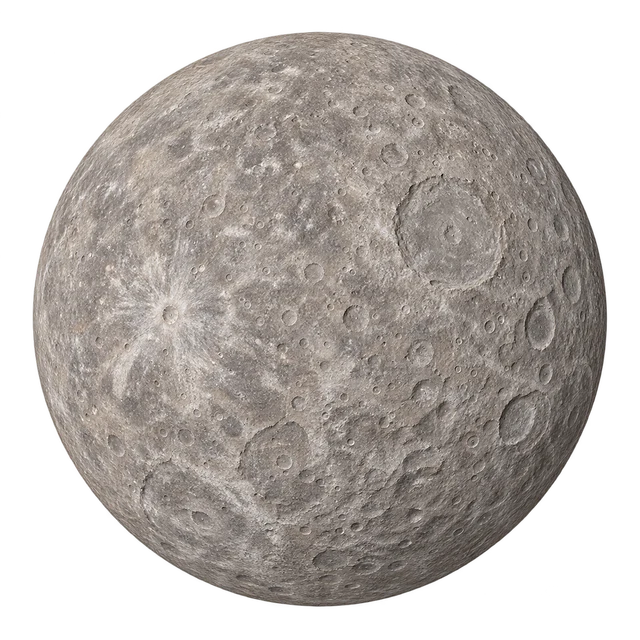
    DIAMETER / EARTH0.12×
    EARTHOBERON
    EARTH
    12,742 km
    OBERON
    1,522.8 km
    Mean diameters · circles share one scale
    ATMOSPHERE
    No substantial atmosphere detectedEffectively airless

    No substantial atmosphere is known around Oberon. Its exposed surface does not support Earth-like weather or breathable air.

    SURFACE TEMPERATURE
    Deeply cold outer-system surface
    SURFACE PRESSURE
    Effectively airless
    HABITABILITYPossible ocean

    Models permit a buried ocean, but its existence and habitability are unconfirmed. No life has been detected.

    UNPROTECTED HUMANSNot survivable

    The cold surface offers no breathable air. Pressure protection, oxygen and thermal control would be required.

    Planet and landscape images are artistic interpretations.

    • NASA ↗
      • Classification and orbital data
      • Landscape
    • NASA / JPL ↗
      • GM and mean radius; spherical gravity estimate GM/r²
      • Size, physical data and atmospheric constraints
    • NASA / JPL ↗
      • Mean orbital dimensions; distances from parent center
      • Orbit
    • NASA ↗
      • Rotation and internal structure constraints
      • Natural conditions and human survival
      • Interior
    • ntrs.nasa.gov ↗
      • Exploration
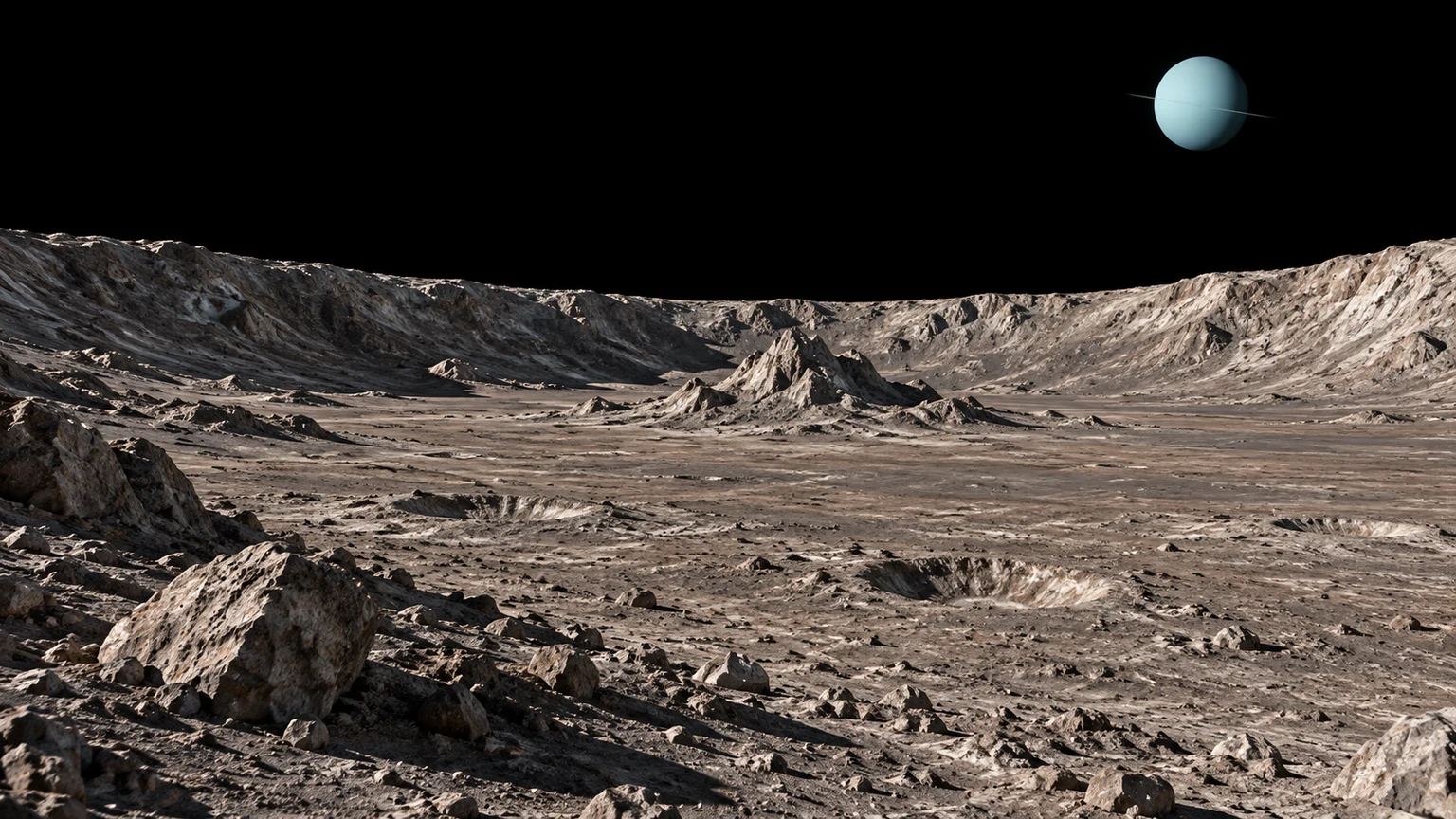
    An imagined landscape inspired by Oberon’s heavily cratered surface and the high mountain seen by Voyager 2. The local terrain, mountain shape and viewpoint are artistic reconstructions.

    An ancient crater country

    An imagined landscape inspired by Oberon’s heavily cratered surface and the high mountain seen by Voyager 2. The local terrain, mountain shape and viewpoint are artistic reconstructions.

    An artist’s reconstruction of an impact basin on Oberon’s Uranus-facing side. The crater, nearby blocks, lighting and appearance of Uranus are illustrative rather than a mapped surface view.

    Uranus beyond the rim

    An artist’s reconstruction of an impact basin on Oberon’s Uranus-facing side. The crater, nearby blocks, lighting and appearance of Uranus are illustrative rather than a mapped surface view.

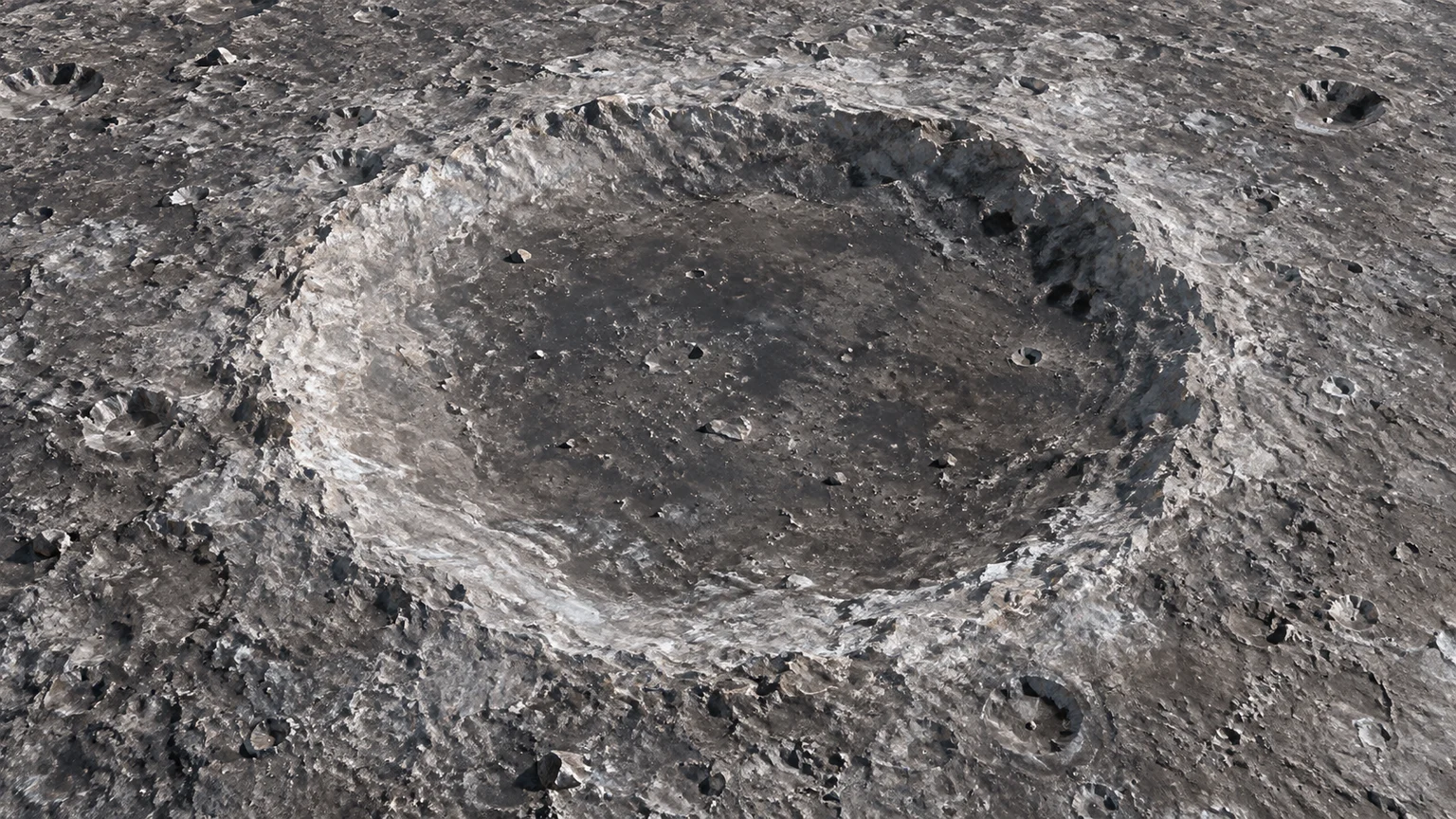
    An old small icy impact crater with a muted dark floor and pale weathered rim. An artistic reconstruction of Oberon; local detail, lighting and viewpoint are imagined.

    Dark material in an impact hollow

    An old small icy impact crater with a muted dark floor and pale weathered rim. An artistic reconstruction of Oberon; local detail, lighting and viewpoint are imagined.