SOL SYSTEM / PLANETARY DOSSIER

Uranus

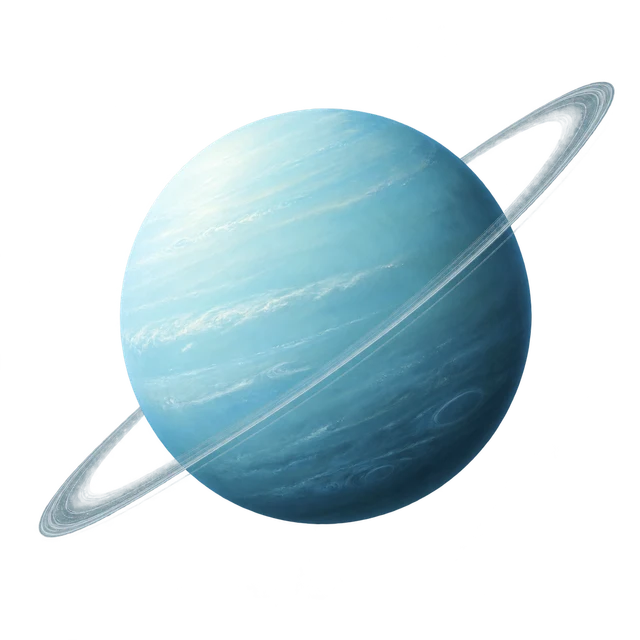
Uranus is a blue-green ice giant that rotates almost on its side.

Artist’s impression of Uranus

A distant ice giant whose seasons unfold across decades.

DIAMETER / EARTH4.01×
EARTHURANUS
ATMOSPHERE / COMPOSITION
H₂Hydrogen≈ 82.5%
HeHelium≈ 15.2%
CH₄Methane≈ 2.3%
TEMPERATURE / 1 BAR
≈ −197°C at 1 bar
PRESSURE
Rises with depth
HABITABILITYNo known habitat
UNPROTECTED HUMANSNot survivable

Interior ↗

03
Uranus interiorSchematic material regions · transitions and depths are illustrative. Atmosphere, Dense fluids, Rocky core.AtmosphereDense fluidsRocky core

Moons Orbit ↗

04
Uranus moon orbitsSelected moons, ordered outward. Orbit sizes and positions are schematic; relative periods are preserved.URANUSCORDELIAOPHELIABIANCACRESSIDADESDEMONAJULIETPORTIAROSALINDCUPIDBELINDAPERDITAPUCKMABMIRANDAARIELUMBRIELTITANIAOBERON
URANUS

Instrument detail

Uranus orbitElliptical orbit viewed along the orbital axis, relative to Sun. Motion is accelerated, not a live position. Distances are center to center.SUNURANUS20.06 AU18.27 AU
ONE ORBIT84 Earth years
Closest to the Sun
18.27 AU
Farthest from the Sun
20.06 AU

The Sun sits at a focus of the orbit. Uranus moves faster near the Sun and more slowly farther away.

Uranus rotation compared with EarthA marked longitude moves between the day and night sides. Equal elapsed time and sidereal rotation rates. Polar schematic: sizes, axial tilt and seasons are not shown. Illumination uses a circular mean orbit, not a live sky prediction.SAME ELAPSED TIME · POLAR SCHEMATICURANUS17.2 hoursSIDEREAL ROTATION17.2 hours · solar dayEARTH23.9 hoursSIDEREAL ROTATION≈ 24 h · solar day
Marked longitude in a reference rotation frame · equal time on both worlds
ONE SIDEREAL ROTATION17.2 hours

A reverse spin

Uranus rotates in about 17.2 hours and is tilted by about 98 degrees. Its nearly sideways axis creates exceptionally long polar seasons. The spin comparison shows rotation rate and direction, not axial tilt.

Mean solar day
≈ 17.2 hours
One orbit
84 Earth years

A sidereal rotation is one turn relative to the stars. A solar day follows the Sun: the marked longitude crosses the illuminated and dark halves as rotation and orbital motion combine.

0 Earth hoursMarker · daylight

Mean clock model with a circular orbit. Axial tilt, seasons and local sunrise times are omitted. The marker is a reference longitude, not a solid surface feature. Sizes and starting longitudes are schematic, not live positions.

Satellite atlasMoons
Uranus moon orbitsSelected moons, ordered outward. Orbit sizes and positions are schematic; relative periods are preserved.URANUSCORDELIAOPHELIABIANCACRESSIDADESDEMONAJULIETPORTIAROSALINDCUPIDBELINDAPERDITAPUCKMABMIRANDAARIELUMBRIELTITANIAOBERON
FEATURED MOONS18
  1. 01Cordelia ↗0.3347 days
  2. 02Ophelia ↗0.3764 days
  3. 03Bianca ↗0.4347 days
  4. 04Cressida ↗0.4639 days
  5. 05Desdemona ↗0.4736 days
  6. 06Juliet ↗0.4931 days
  7. 07Portia ↗0.5132 days
  8. 08Rosalind ↗0.5583 days
  9. 09Cupid ↗0.6125 days
  10. 10Belinda ↗0.6236 days
  11. 11Perdita ↗0.6382 days
  12. 12Puck ↗0.761833 days
  13. 13Mab ↗0.9229 days
  14. 14Miranda ↗1.41 days
  15. 15Ariel ↗2.5204 days
  16. 16Umbriel ↗4.1442 days
  17. 17Titania ↗8.7059 days
  18. 18Oberon ↗13.4632 days

Faint rings and a family of moons surround Uranus. Many of those moons take their names from characters in Shakespeare and Alexander Pope. One journey around the Sun lasts about 84 Earth years.
Uranus gravityEqual launches at 2 m/s; shared metre scale; air resistance ignored. Hypothetical comparison at the 1-bar level, not a solid surface.0.0 m0.1 m0.2 m0.3 mEARTH9.8 m/s²URANUS8.7 m/s²1 BAR
URANUS / EARTH GRAVITY0.89 ×

Same push, different gravity

Both balls launch at 2 m/s, using the same height and time scales. This is a hypothetical comparison at the 1-bar atmospheric level; there is no solid ground. Air resistance is ignored.

Earth · height / airtime
0.20 m / 0.41 s
Uranus · height / airtime
0.23 m / 0.46 s
Uranus interiorSchematic material regions · transitions and depths are illustrative. Atmosphere, Dense fluids, Rocky core. Select a layer below to highlight it.010203
Schematic material regions · transitions and depths are illustrative.
EXPLORE THE LAYERS
  1. 01

    An outer envelope of hydrogen and helium, with methane.

  2. 02

    Models place hot, dense water-rich material beneath the atmosphere, mixed with ammonia and methane. This is not a frozen surface.

  3. 03

    A rocky central region is inferred. Its size and the boundaries between layers remain uncertain.

Select a material to connect its description with the cutaway. Colors and textures identify regions; they do not show measured temperature.

Artist’s impression of Uranus

An unusual way to turn.

Uranus has an axial tilt of about 98 degrees. It appears to roll around the Sun on its side. This orientation gives its poles prolonged periods of sunlight and darkness: a polar winter can last about 21 Earth years.

A small ingredient, a visible difference.

Hydrogen and helium dominate the atmosphere, with a smaller amount of methane. A gas need not be abundant to change what we see: methane absorbs red light, helping give the planet its pale blue-green appearance.

No frozen ground below.

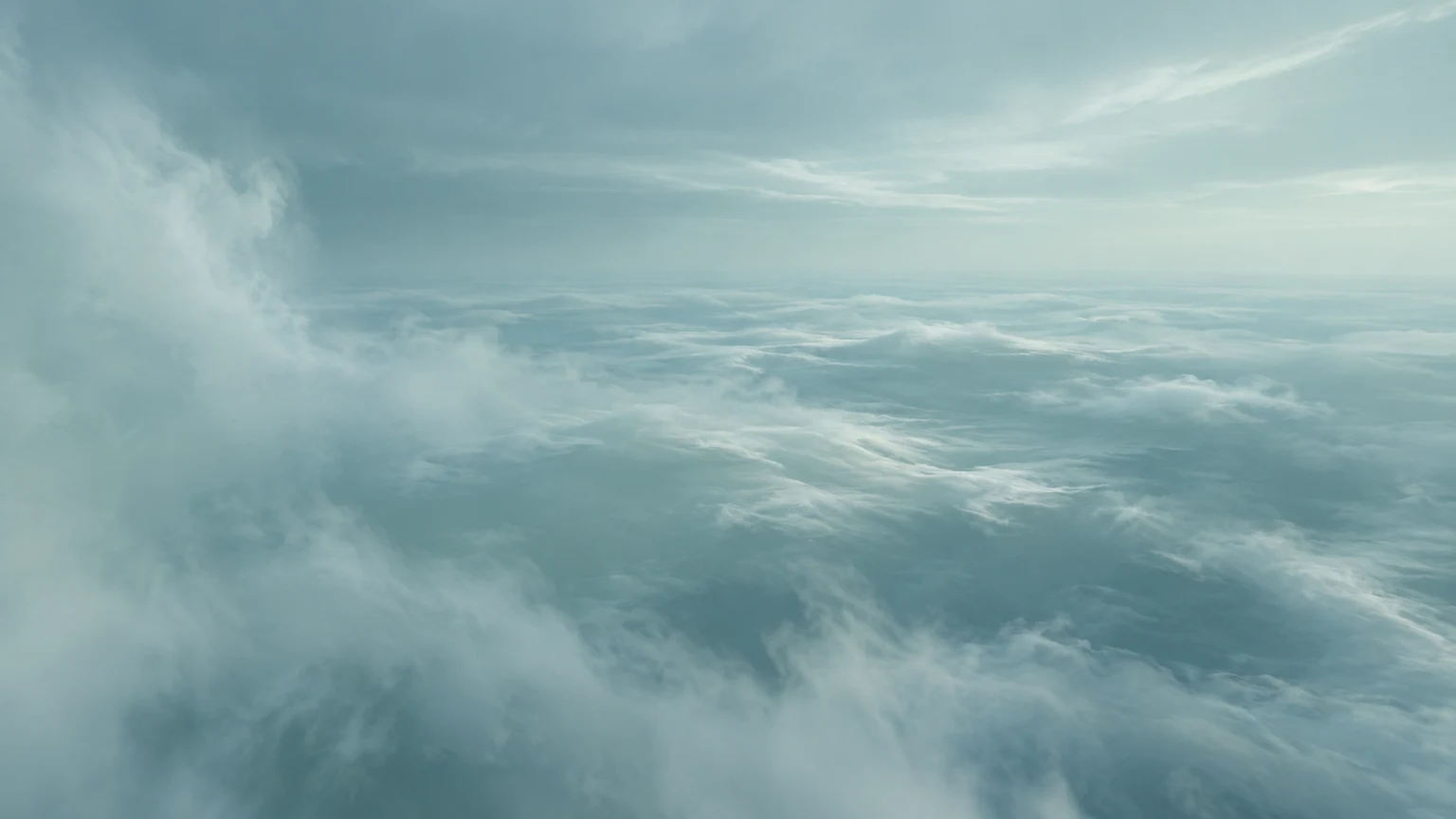
The name ice giant does not mean a globe with an icy surface to stand on. Uranus has a deep atmosphere over a dense interior. The scenes here imagine views above and among its upper cloud layers, where haze can hide much of the detail.

A quieter system in the distance.

Faint rings and a family of moons surround Uranus. Many of those moons take their names from characters in Shakespeare and Alexander Pope. One journey around the Sun lasts about 84 Earth years.
DIAMETER / EARTH4.01×
EARTHURANUS
EARTH
12,756 km
URANUS
51,118 km
equatorial planet diameter / equatorial Earth diameter · rings excluded
ATMOSPHERE / COMPOSITION
H₂Hydrogen≈ 82.5%
HeHelium≈ 15.2%
CH₄Methane≈ 2.3%

Approximate atmospheric volume fractions with measurement uncertainty. Methane absorbs red light and helps shape the planet’s color. The term ice giant describes its composition, not a frozen surface available for landing.

TEMPERATURE / 1 BAR
≈ −197°C at 1 bar
PRESSURE
Rises with depth
HABITABILITYNo known habitat

No life has been detected. The frigid upper atmosphere and increasingly extreme conditions deeper down provide no established habitat for known life. Water-rich material in the interior should not be mistaken for a temperate, accessible ocean.

UNPROTECTED HUMANSNot survivable

There is no breathable air or solid surface. Upper atmospheric layers are extremely cold; going deeper exchanges that cold for rising pressure and heat rather than a safe place to stand.

Planet and landscape images are artistic interpretations.

  • NASA ↗
    • Classification and orbital data
    • Simplified interior model
    • Natural conditions and human survival
    • Orientation
    • Composition
    • Atmosphere
    • Companions
  • NASA ↗
    • Rotation, gravity and orbital distances
  • NASA ↗
    • Gravity reference level and diagram definitions
  • NASA / JPL ↗
    • Satellite orbital periods
  • NASA ↗
    • Size, physical data and atmospheric constraints
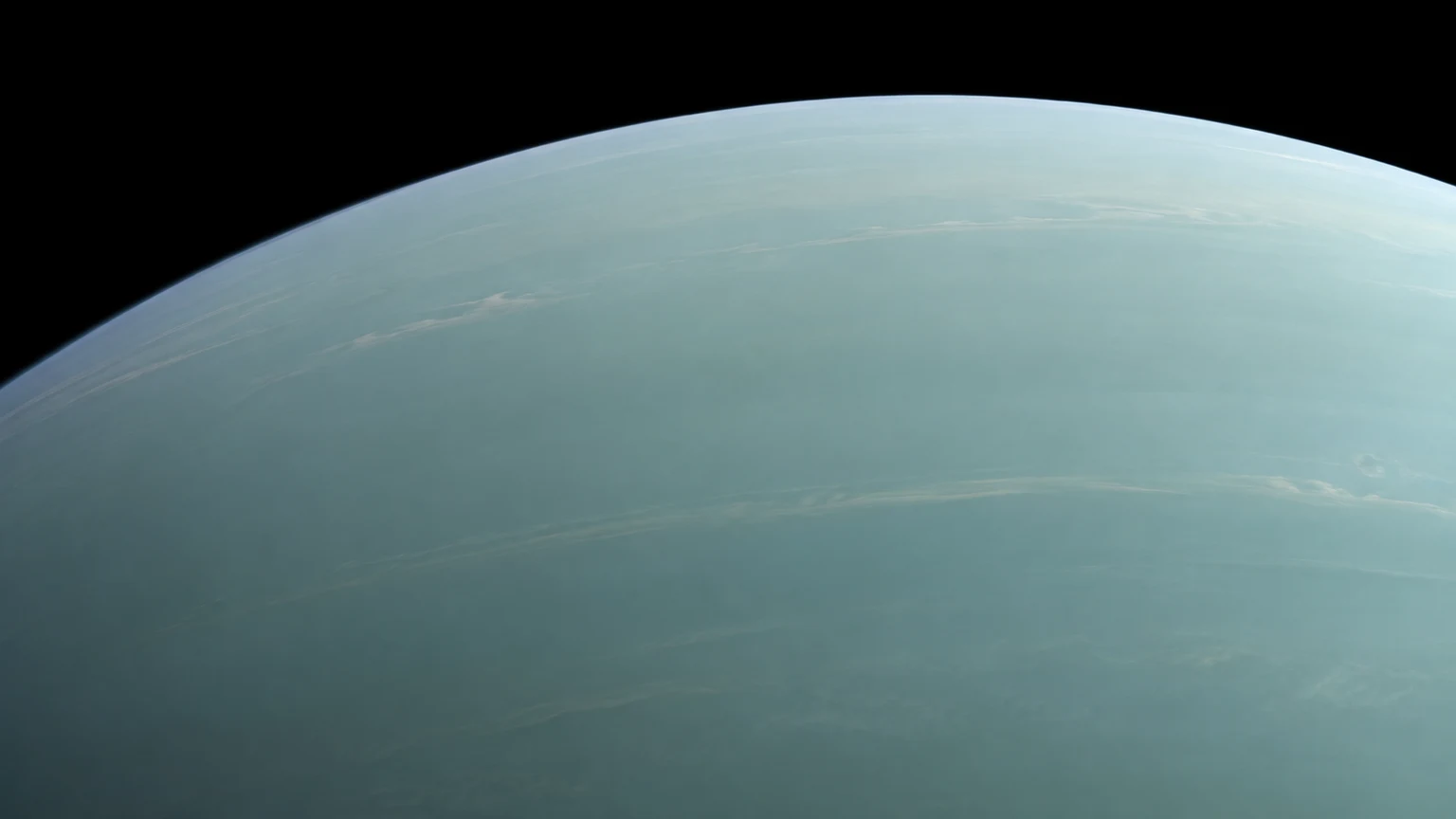
An orbital reconstruction of Uranus’s pale blue-green haze and subtle cloud bands. Colors are guided by natural-color research; small-scale weather is interpretive.

The pale atmospheric limb

An orbital reconstruction of Uranus’s pale blue-green haze and subtle cloud bands. Colors are guided by natural-color research; small-scale weather is interpretive.

An imagined viewpoint near Uranus’s upper cloud layers. Pale haze and sparse clouds limit visibility. This is an uncertain atmospheric reconstruction, not a measured view from a probe.

Within the haze

An imagined viewpoint near Uranus’s upper cloud layers. Pale haze and sparse clouds limit visibility. This is an uncertain atmospheric reconstruction, not a measured view from a probe.

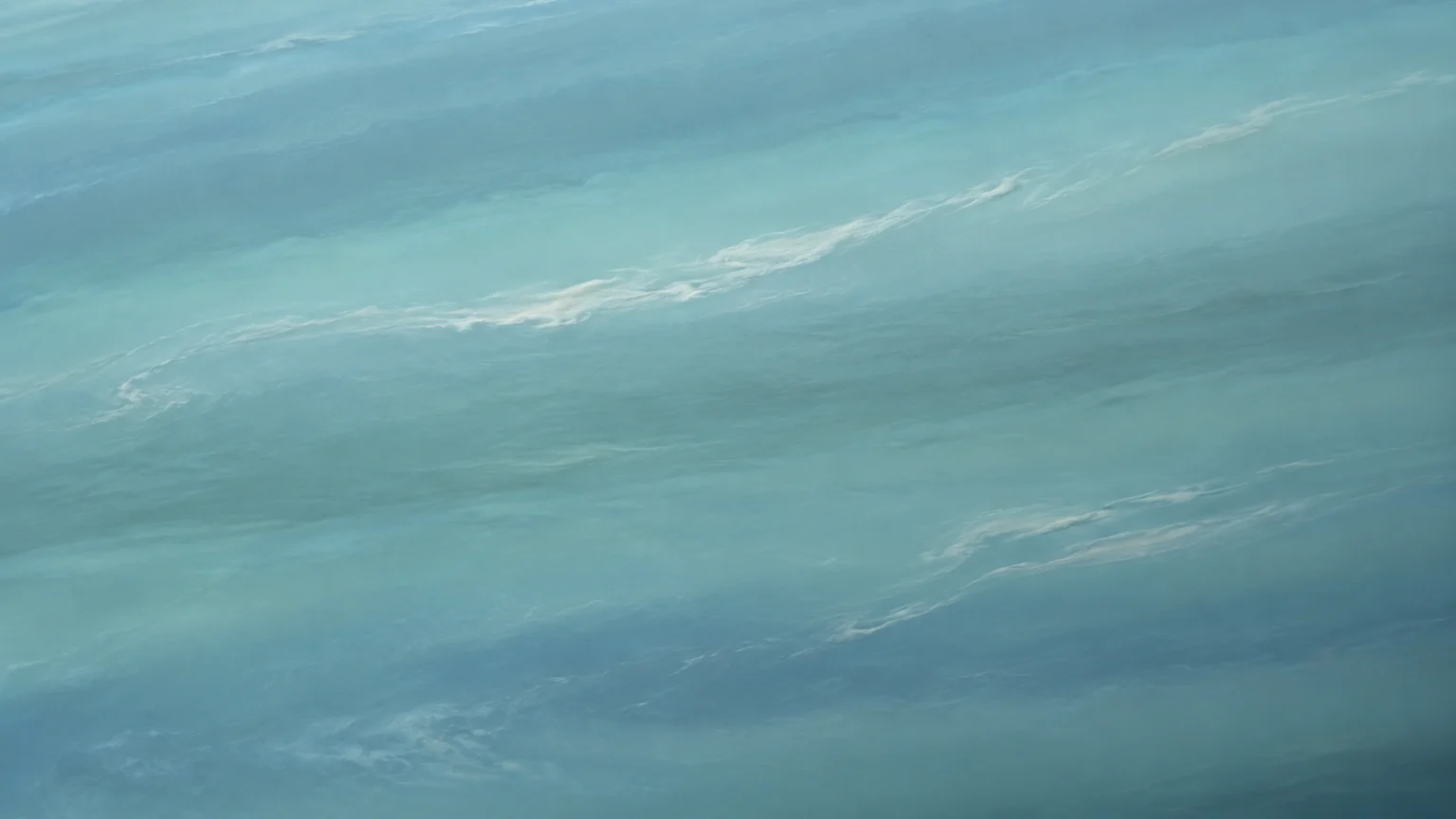
A few delicate pale cloud streaks crossing subtle blue-green bands. An artistic reconstruction of Uranus; local detail, lighting and viewpoint are imagined.

Cloud streaks from above

A few delicate pale cloud streaks crossing subtle blue-green bands. An artistic reconstruction of Uranus; local detail, lighting and viewpoint are imagined.

Open moon atlas ↗