JUPITER SYSTEM / SATELLITE DOSSIER

Thebe

Thebe is a dark, cratered inner moon of Jupiter that contributes dust to the faint gossamer ring.

Artist’s impression of Thebe

Thebe is a dark, irregular inner moon of Jupiter, marked by outsized impact craters and linked to the planet’s faint gossamer ring.

DIAMETER / EARTH0.0077×
EARTHTHEBE
ATMOSPHERE
No substantial atmosphere detectedEffectively airless
SURFACE TEMPERATURE
Cold exposed surface
SURFACE PRESSURE
Effectively airless
HABITABILITYNo life detected
UNPROTECTED HUMANSNot survivable

Interior ↗

03
Unresolvedinternal structure

Moon system ↗

04
Jupiter moon orbitsSelected moons, ordered outward. Orbit sizes and positions are schematic; relative periods are preserved.JUPITERMETISADRASTEAAMALTHEATHEBEIOEUROPAGANYMEDECALLISTOLEDAHIMALIALYSITHEAELARA
THEBE

Instrument detail

Thebe orbitElliptical orbit viewed along the orbital axis, relative to Jupiter. Motion is accelerated, not a live position. Distances are center to center.JUPITERTHEBE≈ 221,900 km
ONE ORBIT0.676105 Earth days around Jupiter
Closest to Jupiter
217,906 km
Farthest from Jupiter
225,894 km

Thebe circles Jupiter. Distances are measured between the centers of the two bodies.

Thebe rotationEqual elapsed time, with sidereal rotation rates and directions. Axial tilt and relative sizes are not shown.THEBE16.2 hoursEARTH23.9 hours
ONE ROTATION16.2 hours

One turn per orbit

Thebe turns once in each orbit, so roughly the same hemisphere faces Jupiter. The spin period is 0.676105 Earth days; this is not the interval between sunrises.

Satellite atlasMoons
Jupiter moon orbitsSelected moons, ordered outward. Orbit sizes and positions are schematic; relative periods are preserved.JUPITERMETISADRASTEAAMALTHEATHEBEIOEUROPAGANYMEDECALLISTOLEDAHIMALIALYSITHEAELARA
FEATURED MOONS12
  1. 01Metis ↗0.294779 days
  2. 02Adrastea ↗0.29826 days
  3. 03Amalthea ↗0.499918 days
  4. 04Thebe0.676105 days
  5. 05Io ↗1.77 days
  6. 06Europa ↗3.55 days
  7. 07Ganymede ↗7.15 days
  8. 08Callisto ↗16.69 days
  9. 09Leda ↗240.3264 days
  10. 10Himalia ↗249.909 days
  11. 11Lysithea ↗258.5035 days
  12. 12Elara ↗258.8861 days

Io is volcanic, while the other Galilean moons are icy worlds that may conceal oceans. Each has its own environment; Jupiter’s atmospheric conditions do not describe its moons.

Thebe gravityEqual launches at 2 m/s; shared metre scale; air resistance ignored.0 m100 m200 m300 mEARTH9.80 m/s²THEBE0.01 m/s²NOMINAL ESTIMATE
THEBE / EARTH GRAVITY0.0013 ×

This is a nominal spherical estimate. The adopted JPL GM is 0.03015 ± 0.01250 km³/s², and the mean radius is also uncertain. Local gravity varies with Thebe’s irregular shape, rotation and Jupiter’s tides.

Same push, different gravity

Both balls launch at 2 m/s, using the same height and time scales. Weaker gravity gives a higher jump and a longer time in the air. Air resistance is ignored. This idealized comparison uses constant spherical gravity GM/r²; local terrain, tides and rotation are excluded. Playback runs 27× faster for both balls.

Earth · height / airtime
0.20 m / 0.41 s
Thebe · height / airtime
161.23 m / 322.45 s
Unresolvedinternal structure

Beyond the surface

Thebe’s internal structure is poorly constrained. Its uncertain mass and cratered exterior do not establish separate internal layers or a subsurface ocean.

    Artist’s impression of Thebe

    Large scars on a small body.

    Galileo images reveal several impact craters comparable in size to Thebe’s radius. These enormous depressions interrupt an already uneven outline. The portrait follows that broad character, while finer terrain and ground-level views remain interpretations.

    A source for a delicate ring.

    Thebe lies near the outer edge of Jupiter’s faint ring system. Dust shed from the moon contributes to the gossamer ring. Its modest size does not prevent it from influencing the thin cloud of particles surrounding the planet.

    A surface without a mapped interior.

    Thebe’s mass is uncertain, and its irregular shape adds local variations in gravity. The displayed jump is only a nominal spherical estimate. Surface images and bulk measurements do not establish internal layers or a buried ocean.

    A little over sixteen hours.

    Thebe follows a prograde orbit inside Io’s path, with an adopted mean distance of about 221,900 kilometers from Jupiter’s center. Its period is 0.676105 Earth days. Synchronous rotation keeps approximately the same face toward Jupiter; the mean ellipse is not a live position.

    DIAMETER / EARTH0.0077×
    EARTHTHEBE
    EARTH
    12,742 km
    THEBE
    98.6 km
    Mean diameters · circles share one scale

    98.6 km is the adopted volume-equivalent mean diameter, with about 8 km uncertainty. Thebe is irregular and approximately 116 km along its longest dimension.

    ATMOSPHERE
    No substantial atmosphere detectedEffectively airless

    Thebe is effectively airless. No substantial atmosphere is known to provide breathable air or surface pressure.

    SURFACE TEMPERATURE
    Cold exposed surface
    SURFACE PRESSURE
    Effectively airless
    HABITABILITYNo life detected

    No life has been detected, and a habitable environment has not been established.

    UNPROTECTED HUMANSNot survivable

    The exposed surface requires oxygen, pressure protection and thermal control.

    Planet and landscape images are artistic interpretations.

    • NASA ↗
      • Classification and orbital data
      • Rotation and internal structure constraints
      • Natural conditions and human survival
    • NASA / JPL ↗
      • GM and mean radius; spherical gravity estimate GM/r²
      • Size, physical data and atmospheric constraints
      • Interior
    • NASA / JPL ↗
      • Mean orbital dimensions; distances from parent center
      • Orbit
    • science.nasa.gov ↗
      • Rotation model and synchronous or independent spin
      • Landscape
    • science.nasa.gov ↗
      • Dust
    An artist’s reconstruction inspired by Thebe’s disproportionately large impact craters. Foreground debris, local slopes and surface colors are interpretive rather than a mapped landing site.

    At the edge of a large crater

    An artist’s reconstruction inspired by Thebe’s disproportionately large impact craters. Foreground debris, local slopes and surface colors are interpretive rather than a mapped landing site.

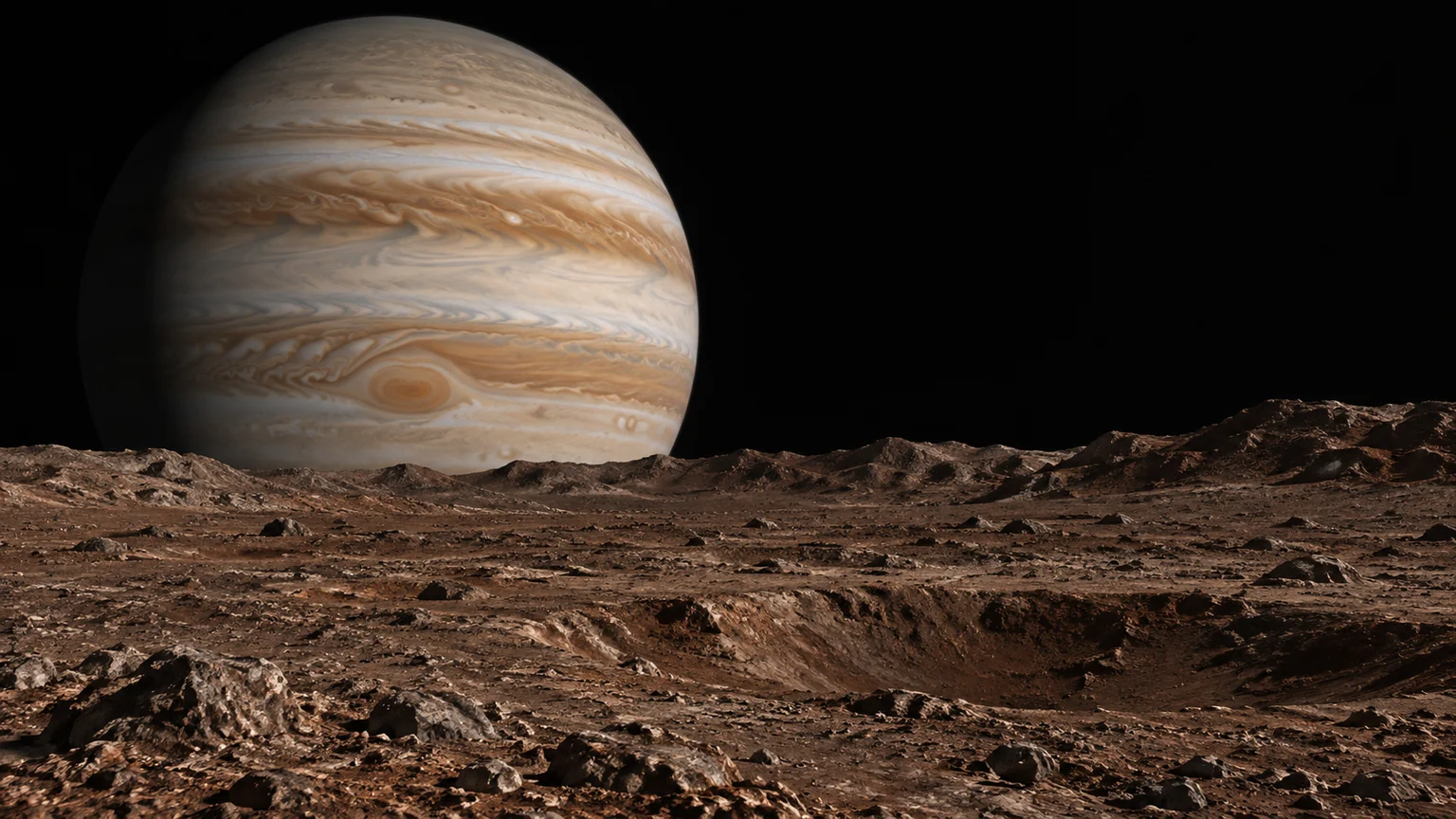
    An imagined view from Thebe’s Jupiter-facing side. Earthin, cloud patterns and lighting are reconstructed; the giant planet’s large apparent size reflects the close orbit.

    Jupiter over the broken ridge

    An imagined view from Thebe’s Jupiter-facing side. Earthin, cloud patterns and lighting are reconstructed; the giant planet’s large apparent size reflects the close orbit.

    Rough dark reddish-brown blocks scattered over a muted fine surface. An artistic reconstruction of Thebe; local detail, lighting and viewpoint are imagined.

    Dark reddish impact fragments

    Rough dark reddish-brown blocks scattered over a muted fine surface. An artistic reconstruction of Thebe; local detail, lighting and viewpoint are imagined.